|
Work progress 0.97
|
|
| Salvo | Date: Wednesday, 03.10.2012, 19:20 | Message # 91 |
 Star Engineer
Group: Local Moderators
 Italy
Italy
Messages: 1400
Status: Offline
| I always use RPB, because I think it should make SE more realistic, is impossible that make SE less realistic, because the algorithm should be right, but I'm not sure about that, because pluto (that in SE is so darks), in photos looks very bright, neptune and uranus too...
Anyway, I like the idea of deactivate it on System Browser 
The universe is not required to be in perfect harmony with human ambition.
CPU: Intel Core i7 4770 GPU: ASUS Radeon R9 270 RAM: 8 GBs
(still don't know why everyone is doing this...)
Edited by Salvo - Wednesday, 03.10.2012, 19:21 |
| |
| |
| HarbingerDawn | Date: Wednesday, 03.10.2012, 19:41 | Message # 92 |
 Cosmic Curator
Group: Administrators
 United States
Messages: 8717
Status: Offline
| Quote (Salvo) I always use RPB, because I think it should make SE more realistic, is impossible that make SE less realistic
Not only is it possible, but it in fact does make it less realistic (see below), this is why I am critical of it, because many people have this idea that worlds really look like this and lighting conditions really behave like this, when in fact they don't, so people get the wrong idea. Exactly the wrong thing for an educational program. If RPB was renamed to "Compare Planet Brightness" then it would be fine, because that's exactly what it currently does.
Quote (Salvo) but I'm not sure about that, because pluto (that in SE is so darks), in photos looks very bright, neptune and uranus too...
Exactly, this is what I have been saying... unless the brightness of the planet is less than the brightness of the background stars (which is not the case for any planet in our Solar system) then RPB should not make the planet dimmer. Yet it does. This is because it is not to make things "realistic" but just to compare the relative illumination of different planets at the same time.
Quote (apenpaap) Neptune isn't nearly as brightly lit as Earth, after all. I think the problem lies in auto-exposure not actually changing the exposure, but the magnitude-limit.
Autoexposure only adjusting the mag limit of the sprites makes perfect sense, but to be perfect it would also need to adjust the exposure of any planets in addition to that. Exactly as I outlined in my proposal.
Quote (apenpaap) Personally, I couldn't disagree more; I think the real planet brightness is gorgeous, and much more realistic than having bright blue sky ice worlds, fierce orange titans, and hot Jupiters looking just as bright as normal gas giants.
With autoexposure on though it doesn't matter, since the brightness of the stars matches the brightness of the planet.
How can looking at a dim, barely visible Neptune when the background stars are shining brightly possibly be considered "realistic"? In reality that is not how it would look at all; just look at any picture taken by Voyager 2! Real data is far more important than an algorithm.
All forum users, please read this!
My SE mods and addons
Phenom II X6 1090T 3.2 GHz, 16 GB DDR3 RAM, GTX 970 3584 MB VRAM
Edited by HarbingerDawn - Wednesday, 03.10.2012, 19:46 |
| |
| |
| apenpaap | Date: Wednesday, 03.10.2012, 19:42 | Message # 93 |
 World Builder
Group: Users
 Antarctica
Messages: 1063
Status: Offline
| ^Well, that is because those pictures are made with more exposure than you'd make a picture of Earth or the Moon. That's why I think auto-exposure should increase the brightness of poorly-lit planets.
I occasionally stream at http://www.twitch.tv/magistermystax. Sometimes SE, sometimes other games.
|
| |
| |
| HarbingerDawn | Date: Wednesday, 03.10.2012, 19:49 | Message # 94 |
|
Cosmic Curator
Group: Administrators
United States
Messages: 8717
Status: Offline
| Quote (apenpaap) That's why I think auto-exposure should increase the brightness of poorly-lit planets.
It does, in that it increases the mag limit of the background stars to match the appropriate brightness for the planet. It breaks down however when the planet is so dimly lit that the background stars are at full brightness (note: this is probably 1% or less of the worlds in SE). Otherwise autoexposure works fine as is. Refer to my earlier post on my ideas for autoexposure to see how it should best look in the future.
Also, I edited my previous post to respond to your earlier one 
All forum users, please read this!
My SE mods and addons
Phenom II X6 1090T 3.2 GHz, 16 GB DDR3 RAM, GTX 970 3584 MB VRAM
|
| |
| |
| smjjames | Date: Wednesday, 03.10.2012, 20:19 | Message # 95 |
|
World Builder
Group: Users
United States
Messages: 913
Status: Offline
| SpaceEngineer, I don't know if you caught my reply back on http://en.spaceengine.org/forum/21-881-11526-16-1348158789 when asking about the axial tilts since I'm still wondering about that (and you did say in the thread I linked in that post that you were going to look into it).
|
| |
| |
| AlessiaCristallooo | Date: Thursday, 04.10.2012, 17:15 | Message # 96 |
 Astronaut
Group: Users
Italy
Messages: 44
Status: Offline
| We want screenshots! We want screenshots!
|
| |
| |
| smjjames | Date: Friday, 05.10.2012, 04:59 | Message # 97 |
|
World Builder
Group: Users
United States
Messages: 913
Status: Offline
| Quote (AlessiaCristallooo) We want screenshots! We want screenshots! biggrin
SpaceEngineer already posted screenshots of the new wiki style stuff and data entry some pages back.
|
| |
| |
| HarbingerDawn | Date: Friday, 05.10.2012, 16:45 | Message # 98 |
|
Cosmic Curator
Group: Administrators
United States
Messages: 8717
Status: Offline
| Quote (n3xt) They say the Sun's light is roughly a 1000 times fainter when it hits Pluto... due to it's distance...
The apparent magnitude of the Sun as seen from Pluto varies from around -18.3 to -19.3. This is hundreds of times brighter than the full Moon, which is quite bright, more than bright enough to see and read by. The "dim streetlight" analogy is false. A camera set to expose the background stars would drastically overexpose Pluto (don't take my word for it, look at the New Horizons pictures when they arrive in July 2015). Ergo, RPB looks absurdly unrealistic. It only compares planet brightnesses to each other; that is its sole function.
This is precisely why I am critical of it. People gather the false impression that these worlds really would look so dim if you were there. This is just not the case. At night it is many many times darker than it would be on Pluto, yet you can see perfectly fine. Features with an albedo similar to Pluto appear quite bright. At times just before sunrise, when the lighting is similar to Pluto, would you say that the world is too dim to see? Of course not.
I don't know what the point of contention is.
RPB allows planet illumination levels to be compared: fact.
RPB is visually unrealistic: fact.
Using RPB all the time looks absurd: opinion which stems from fact.
All forum users, please read this!
My SE mods and addons
Phenom II X6 1090T 3.2 GHz, 16 GB DDR3 RAM, GTX 970 3584 MB VRAM
Edited by HarbingerDawn - Friday, 05.10.2012, 16:46 |
| |
| |
| smjjames | Date: Saturday, 06.10.2012, 21:56 | Message # 99 |
|
World Builder
Group: Users
United States
Messages: 913
Status: Offline
| Quote (HarbingerDawn) The apparent magnitude of the Sun as seen from Pluto varies from around -18.3 to -19.3. This is hundreds of times brighter than the full Moon, which is quite bright, more than bright enough to see and read by. The "dim streetlight" analogy is false. A camera set to expose the background stars would drastically overexpose Pluto (don't take my word for it, look at the New Horizons pictures when they arrive in July 2015). Ergo, RPB looks absurdly unrealistic. It only compares planet brightnesses to each other; that is its sole function.
This is precisely why I am critical of it. People gather the false impression that these worlds really would look so dim if you were there. This is just not the case. At night it is many many times darker than it would be on Pluto, yet you can see perfectly fine. Features with an albedo similar to Pluto appear quite bright. At times just before sunrise, when the lighting is similar to Pluto, would you say that the world is too dim to see? Of course not.
I don't know what the point of contention is.
RPB allows planet illumination levels to be compared: fact.
RPB is visually unrealistic: fact.
Using RPB all the time looks absurd: opinion which stems from fact.
Yeah, SE doesn't do night sides properly. It treats them as if there is absolutely NO light at all (oddly, the ambience still works since it would require light, but um, yea....), not even faint starlight.
Still though, the reason I like it is because it does the illumination, but I don't know how realistic it is (apparently not) and it treats planets a certain distance from their star as if the surface was 100% reflective.
So, yeah, while I like the fact that it does illumination, I do agree that the lighting system needs work still and reworked even.
All that said, how can we make the lighting system (not just the RPB) work so that it does illuminate planets correctly? I would certainly like to see what the real illumination is of objects out at Kupier Belt distances and further as well as have the night side not be pitch black (or infinite magnitude as SE puts it).
What about real star brightness? I think that works okay, and SE deals with reflected light from moons and nearby planets when it is nighttime on the object that you are at.
|
| |
| |
| HarbingerDawn | Date: Saturday, 06.10.2012, 22:01 | Message # 100 |
|
Cosmic Curator
Group: Administrators
United States
Messages: 8717
Status: Offline
| Quote (smjjames) Yeah, SE doesn't do night sides properly. It treats them as if there is absolutely NO light at all (oddly, the ambience still works since it would require light, but um, yea....), not even faint starlight.
SE does a decent job of night lighting if lit by a moon or planet. But that is irrelevant to this conversation since it is about illumination by suns.
All forum users, please read this!
My SE mods and addons
Phenom II X6 1090T 3.2 GHz, 16 GB DDR3 RAM, GTX 970 3584 MB VRAM
Edited by HarbingerDawn - Saturday, 06.10.2012, 23:06 |
| |
| |
| Voekoevaka | Date: Saturday, 06.10.2012, 23:00 | Message # 101 |
 World Builder
Group: SE team
 France
Messages: 1016
Status: Offline
| Quote (HarbingerDawn) SE does a decent job of night lighting if lit by a moon or planet. But that is irrelevant to this conversation since it is about illumination by stars.
Totally agree !
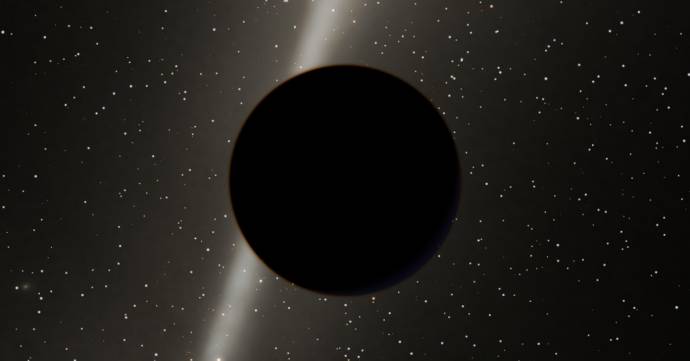
Take a look at this black hole planet :
Want some music of mine ? Please go here !

|
| |
| |
| HarbingerDawn | Date: Saturday, 06.10.2012, 23:07 | Message # 102 |
|
Cosmic Curator
Group: Administrators
United States
Messages: 8717
Status: Offline
| I meant "suns" when I said "stars", just for clarification. (I edited my earlier post now to reflect that).
All forum users, please read this!
My SE mods and addons
Phenom II X6 1090T 3.2 GHz, 16 GB DDR3 RAM, GTX 970 3584 MB VRAM
|
| |
| |
| smjjames | Date: Sunday, 07.10.2012, 18:32 | Message # 103 |
|
World Builder
Group: Users
United States
Messages: 913
Status: Offline
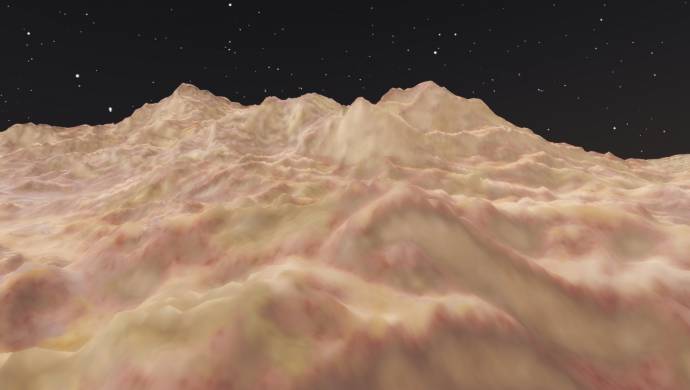
| For the sake of discussion and the fact that posting examples will probably help other people understand the difference between RPB and what it actually should be. I do understand what you're talking about as far as light levels and RPB, I'm just trying to see what it would look like. Since Harbinger mentioned Pluto, I'm using that as a frame of reference.
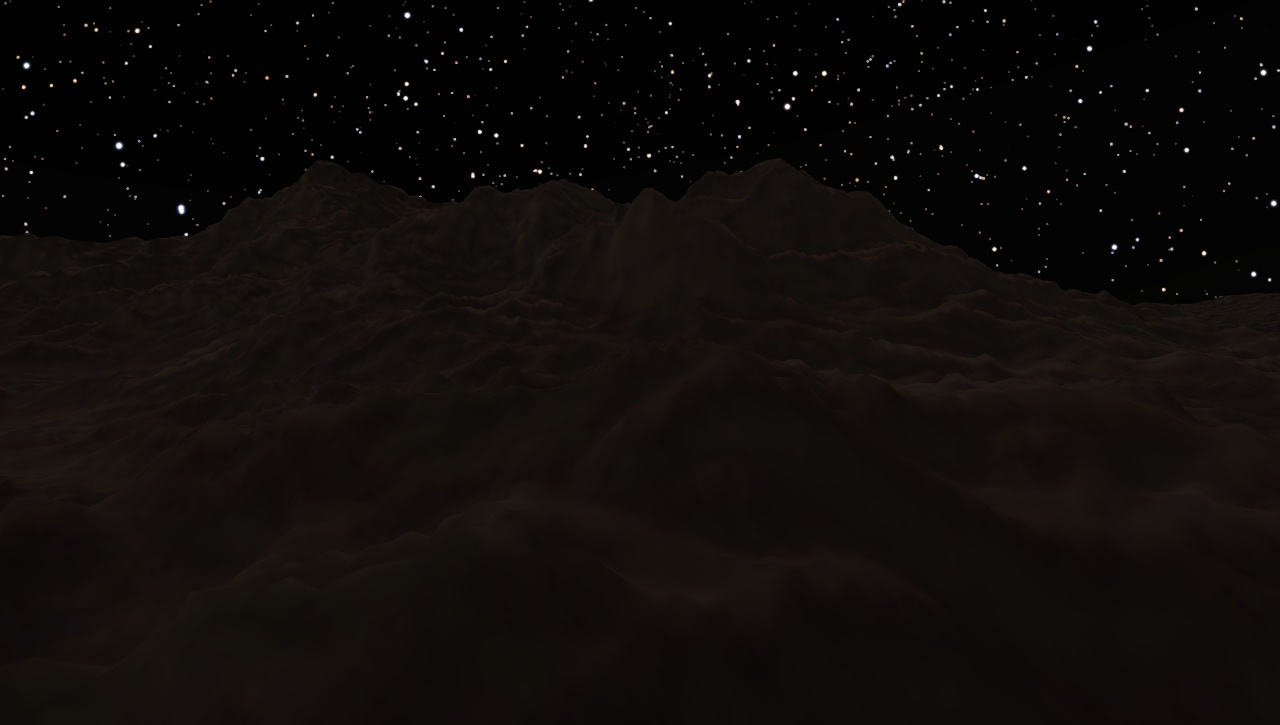
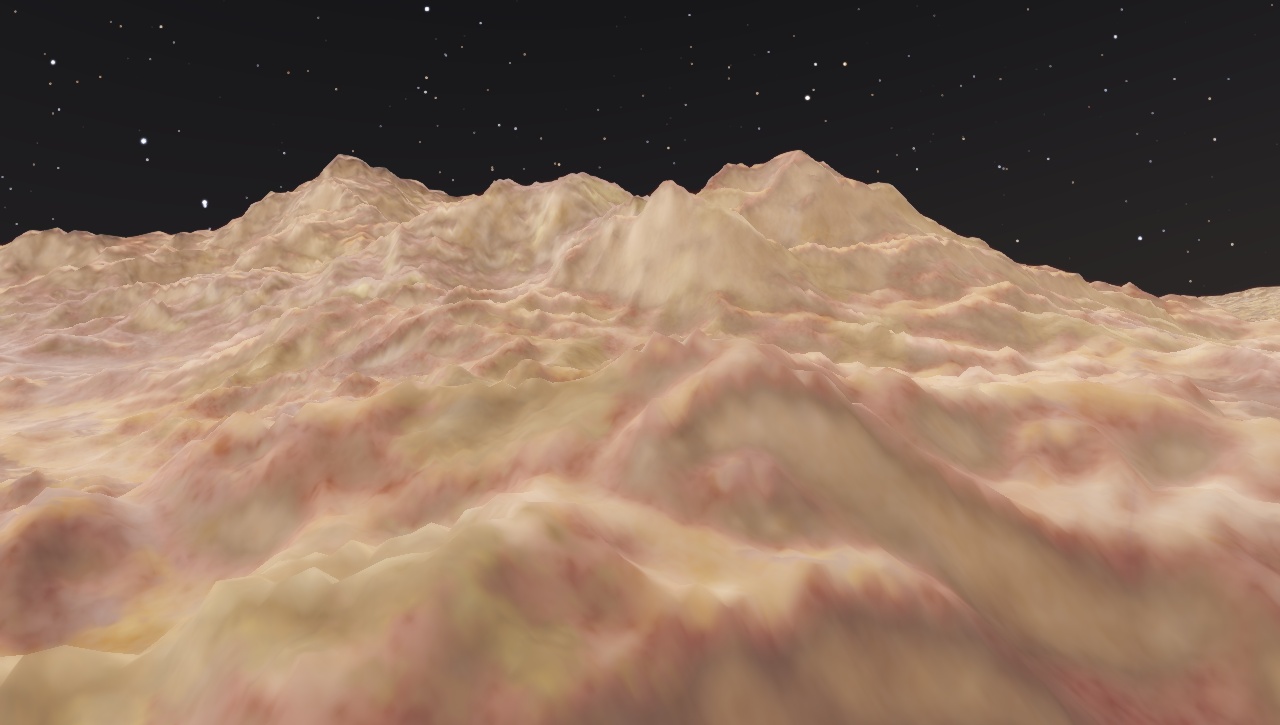
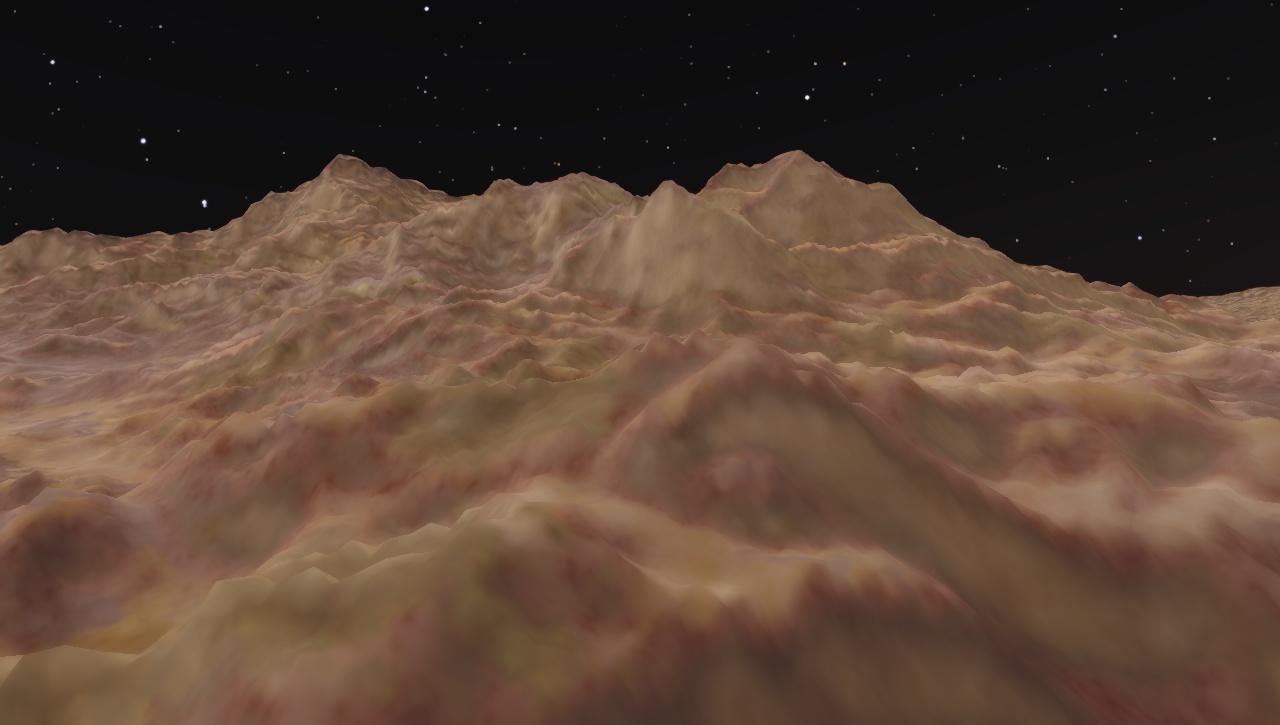
Pluto with real planet brightness on, which certainly doesn't look 100 times brighter than the full moon. For location reference, it's midday at that spot.
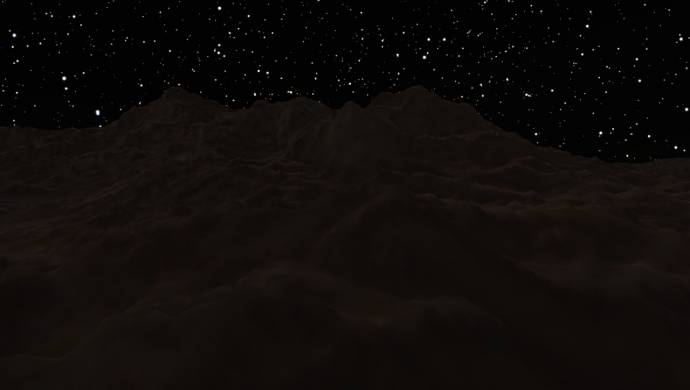
RPB off. Not sure how accurate a representation this would be.
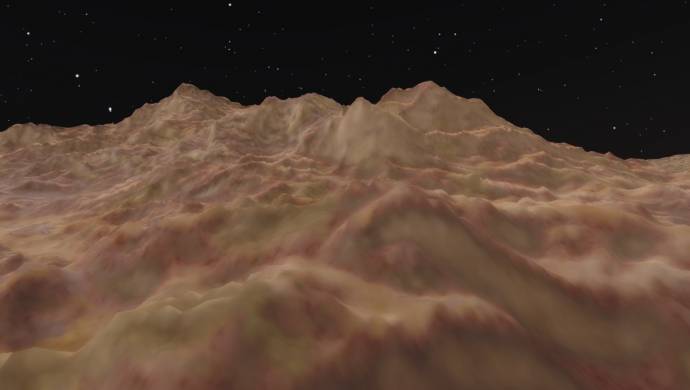
RPB off and exposure at .500 to simulate lower light levels, would this one be more accurate?
Edited by smjjames - Sunday, 07.10.2012, 18:32 |
| |
| |
| SpaceEngineer | Date: Sunday, 07.10.2012, 19:00 | Message # 104 |
 Author of Space Engine
Group: Administrators
 Russian Federation
Messages: 4800
Status: Offline
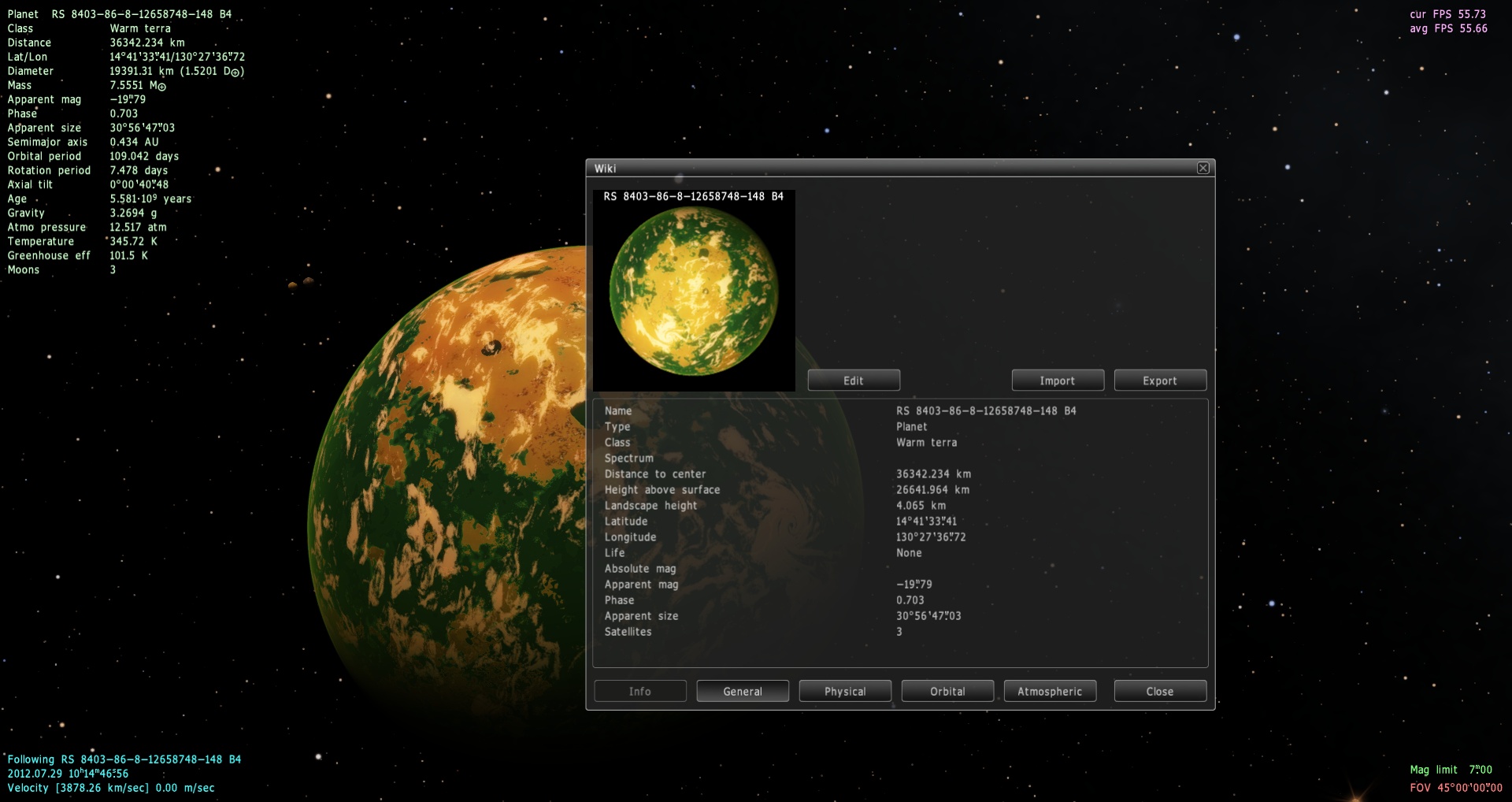
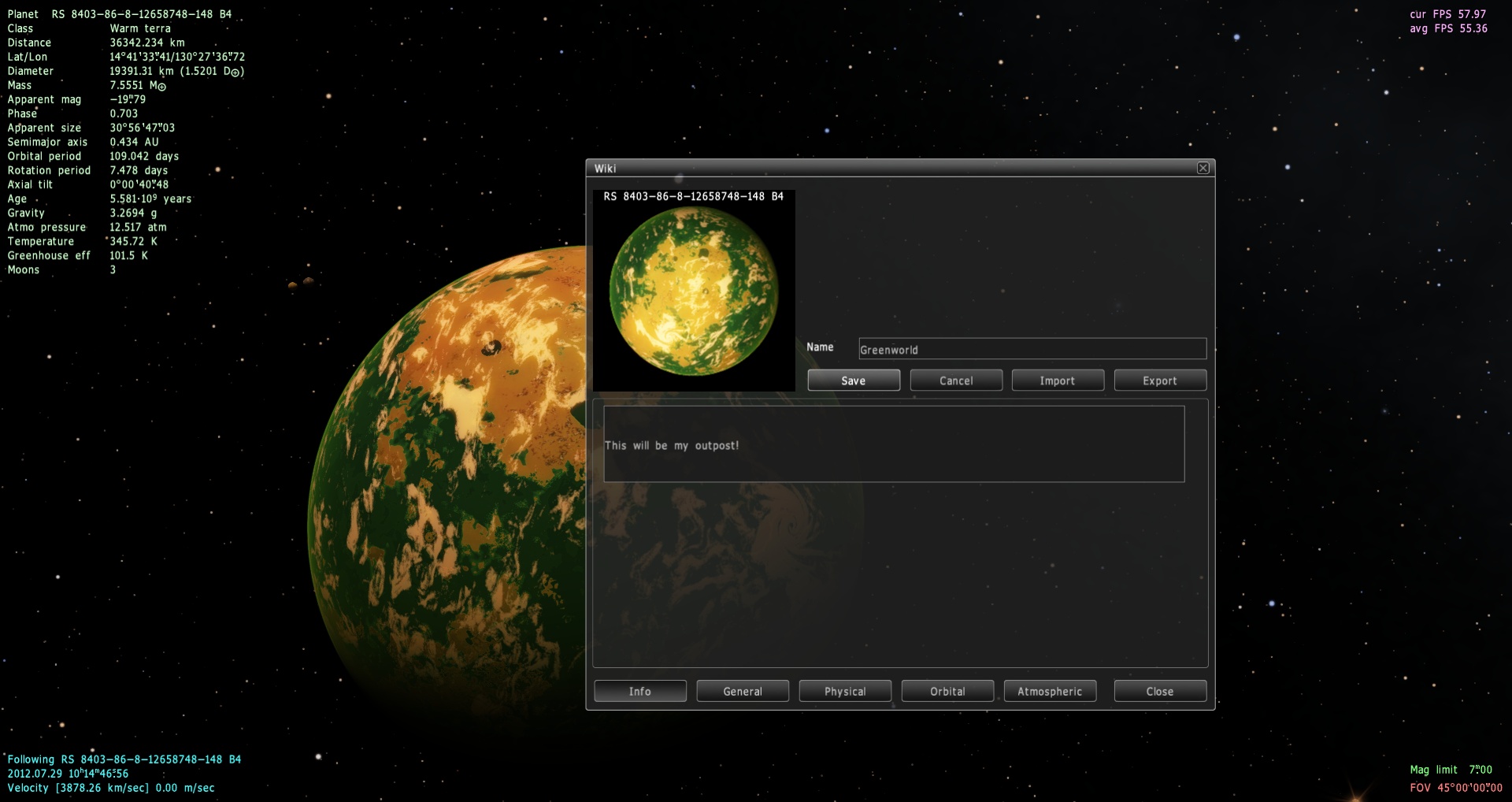
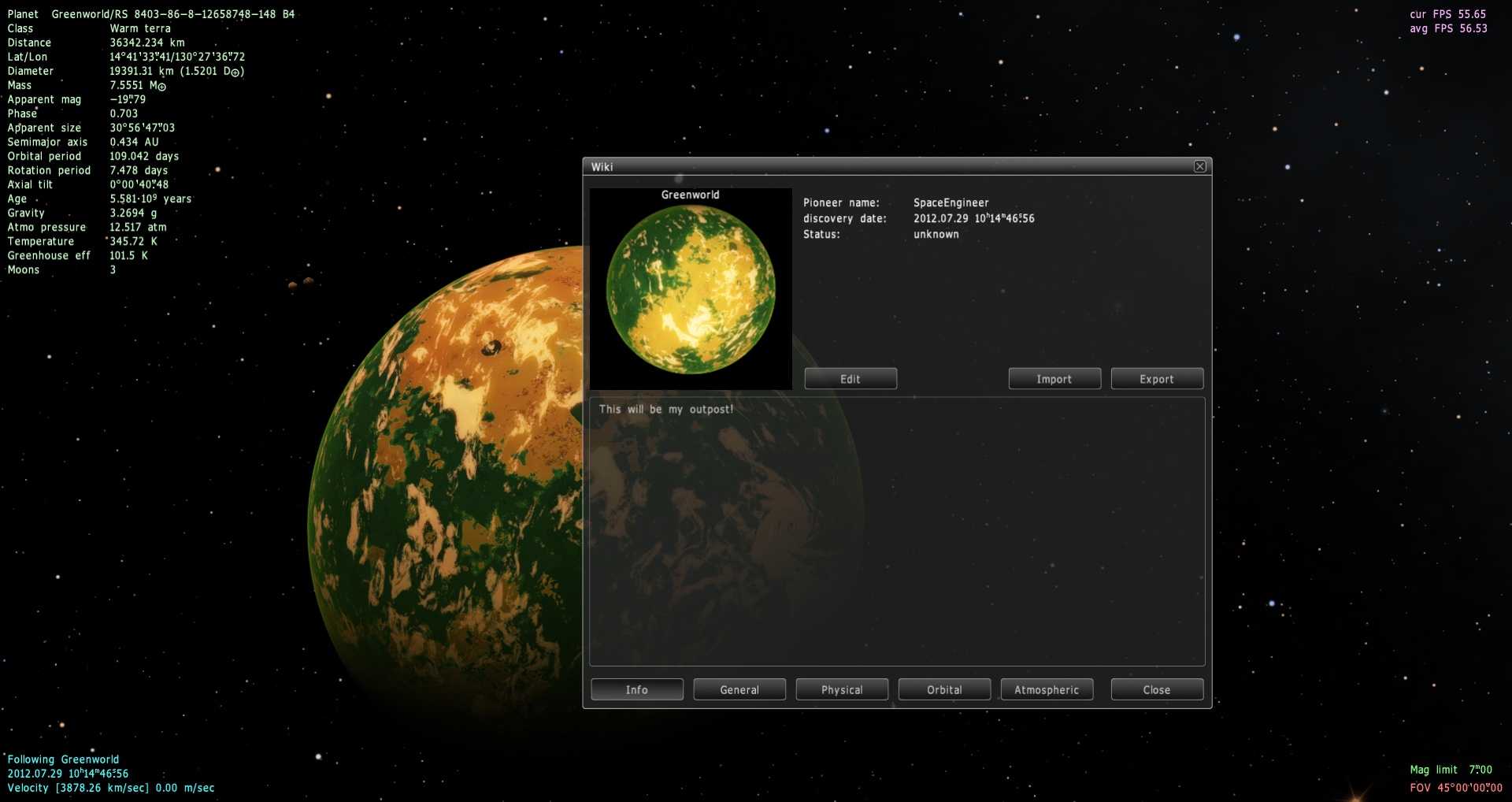
| So I almost finished the Wiki system. It now supports all types of objects (except ships - some work here to be done), the object's name and description can be edited in-game, and database is saved on the disk:
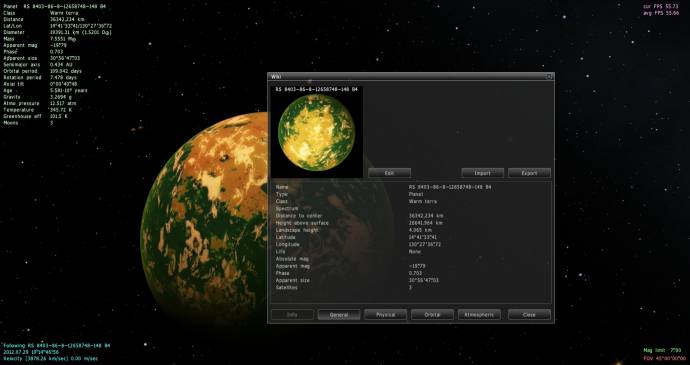
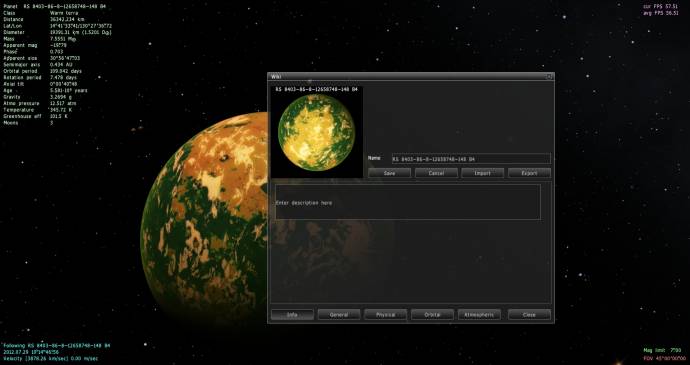
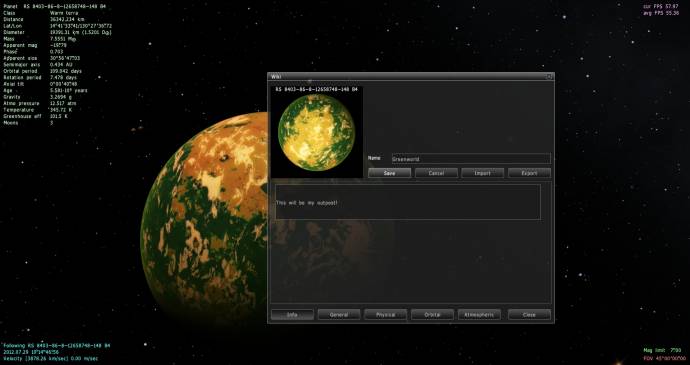
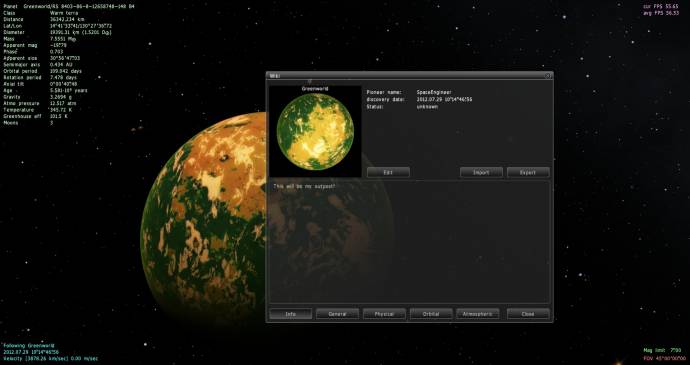
The "Export" and "Import" functions are not implemented yet. "Export" will open a dialog where it asks you which database entries you would like to export - all of your discoveries or only the currently selected one, or something like this. The function then creates a script file and asks you where to save it. You may then attach it to a forum post or send it to a friend in email etc. The "Import" function will allow you to choose the downloaded script and merge it with your engine's database. This is a temporary solution, then the server networking will be implemented, it may be removed (or not, it may be useful for offline work).
The import function is a problem. What if your database already has the planet/galaxy that is in the imported script? If their names and descriptions are the same, there's no problem. But what if they are different? The import function may ask you what to do for every conflict situation: skip imported data, replace your data with imported, or write imported data to the end of yours. The last way seems to be the easiest, but may generate an almost doubling of descriptions and names, you should then edit them manually.
The other problem is the language. As long as SE supports localization, Russian, German and Italian, users would give names to their planets in their native language, and write a descriptions for it. So if you would wish to import their databases too, there will be a problem. SE now supports only one language at the same time (in addition to the default English), so a multi-language database will look like a mess of random characters. Even if I implement Unicode support (and probably the use of Windows fonts instead of a pre-baked font texture) and Wiki will show right characters, but names and descriptions of other languages will make no sense in most cases. You can't even find a planet with the F3 menu, because you can't type its name if its native language is not supported by your keyboard.
How can this be solved? Creating an independent community for every language is not a good choice. Forcing to give an English name, in addition to a native language name, may solve the problem with search, while the description will still be in another language. Of course I can't order users to learn English and write additional description in English. Suggestions?
*

|
| |
| |
| smjjames | Date: Sunday, 07.10.2012, 19:17 | Message # 105 |
|
World Builder
Group: Users
United States
Messages: 913
Status: Offline
| A fall back option would be to use the 'zip code' that SE uses for every object that it generates, even though I agree that it isn't the best option.
Actually I do have one idea. Have a page that is a database of the wiki'd objects with an option to go to a selected object, maybe that can bypass the problem of the F3 search window. Searching within the wiki database would still bring up the language support issue however......
Or maybe, somehow make the letters with special characters be searchable as if they were latin alphabet characters? For example, an U with an umlaut above it would be searchable as an U.
Edited by smjjames - Sunday, 07.10.2012, 19:20 |
| |
| |
 ENG
ENG New site


 Italy
Italy 


 United States
 Antarctica
 France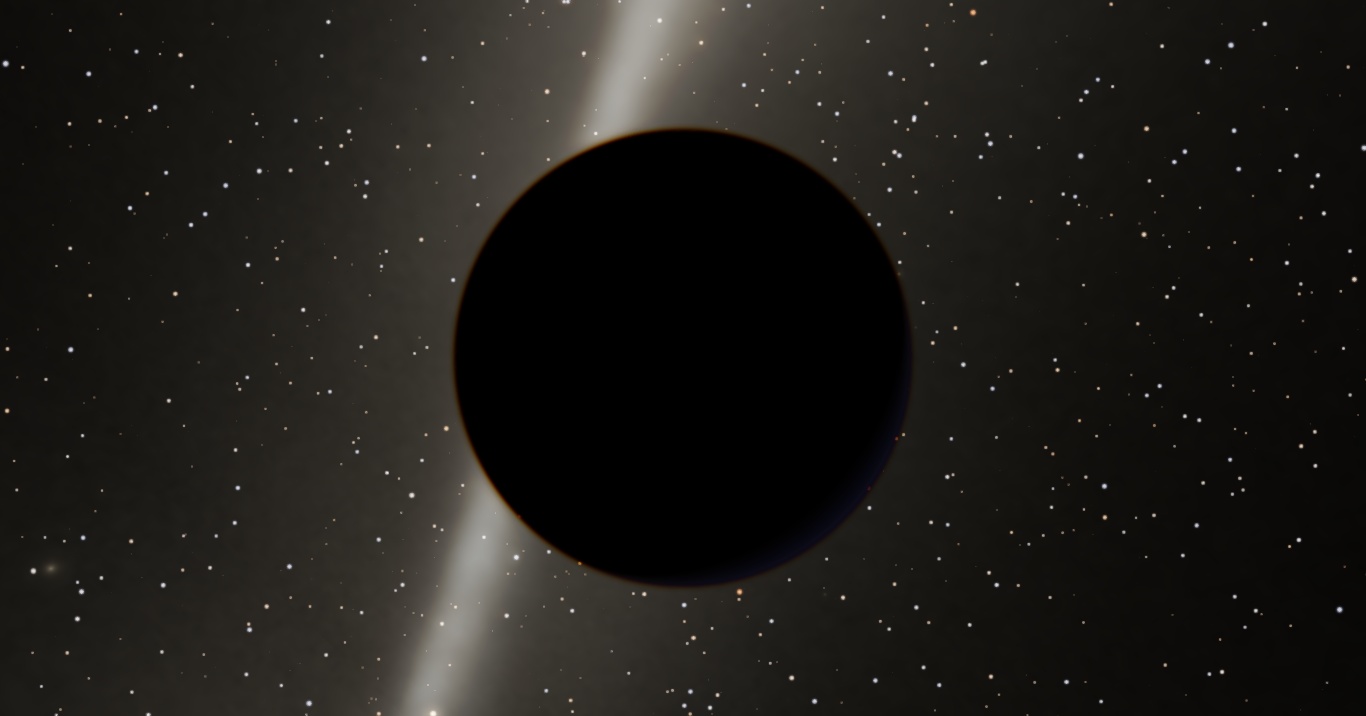
 Russian Federation