|
Work progress and public beta test - 0.9.7.4
|
|
| Salvo | Date: Monday, 09.11.2015, 10:06 | Message # 751 |
 Star Engineer
Group: Local Moderators
 Italy
Italy
Messages: 1400
Status: Offline
| I wish to see the new black holes in a video, it looks gorgeous. 
The universe is not required to be in perfect harmony with human ambition.
CPU: Intel Core i7 4770 GPU: ASUS Radeon R9 270 RAM: 8 GBs
(still don't know why everyone is doing this...)
|
| |
| |
| Kamil_Cader | Date: Monday, 09.11.2015, 14:43 | Message # 752 |
|
Observer
Group: Users
 Poland
Messages: 12
Status: Offline
| Quote parameciumkid (  ) I like the idea behind the red-blue shifting on the black hole. It looks absolutely great on the wide-angle shot of the accretion disk. On the close-up, however, it looks a little tacky, with colors that seem a little too vivid to be realistic.
I'm sure you're already working on tweaking it, but that's my hopefully constructive feedback.
I think in reality accretion disc would be much brighter than that, and no background stars would be visible. SpaceEnginer just adjusted the graphics options for better visibility of featuers IMO.
|
| |
| |
| Inarius | Date: Monday, 09.11.2015, 14:56 | Message # 753 |
 Explorer
Group: Local Moderators
 France
Messages: 237
Status: Offline
| Quote I think in reality accretion disc would be much brighter than that, and no background stars would be visible. SpaceEnginer just adjusted the graphics options for better visibility of featuers IMO.
I did't really know. I thought they were very visible, but more in X-ray and Gamma Ray than visible light ?
|
| |
| |
| HarbingerDawn | Date: Tuesday, 10.11.2015, 12:12 | Message # 754 |
 Cosmic Curator
Group: Administrators
 United States
Messages: 8717
Status: Offline
| Quote parameciumkid ( ) On the close-up, however, it looks a little tacky, with colors that seem a little too vivid to be realistic.
He already stated that it's not realistic, and can't be since SE does not contain infrared or ultraviolet image information, which would be needed for realistic colors.
All forum users, please read this!
My SE mods and addons
Phenom II X6 1090T 3.2 GHz, 16 GB DDR3 RAM, GTX 970 3584 MB VRAM
|
| |
| |
| SpaceEngineer | Date: Tuesday, 10.11.2015, 14:39 | Message # 755 |
 Author of Space Engine
Group: Administrators
 Russian Federation
Messages: 4800
Status: Offline
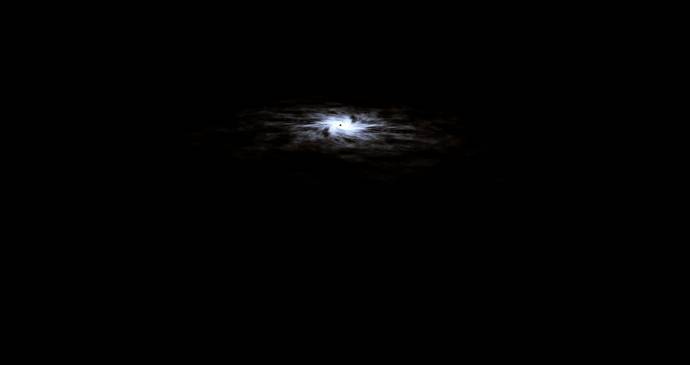
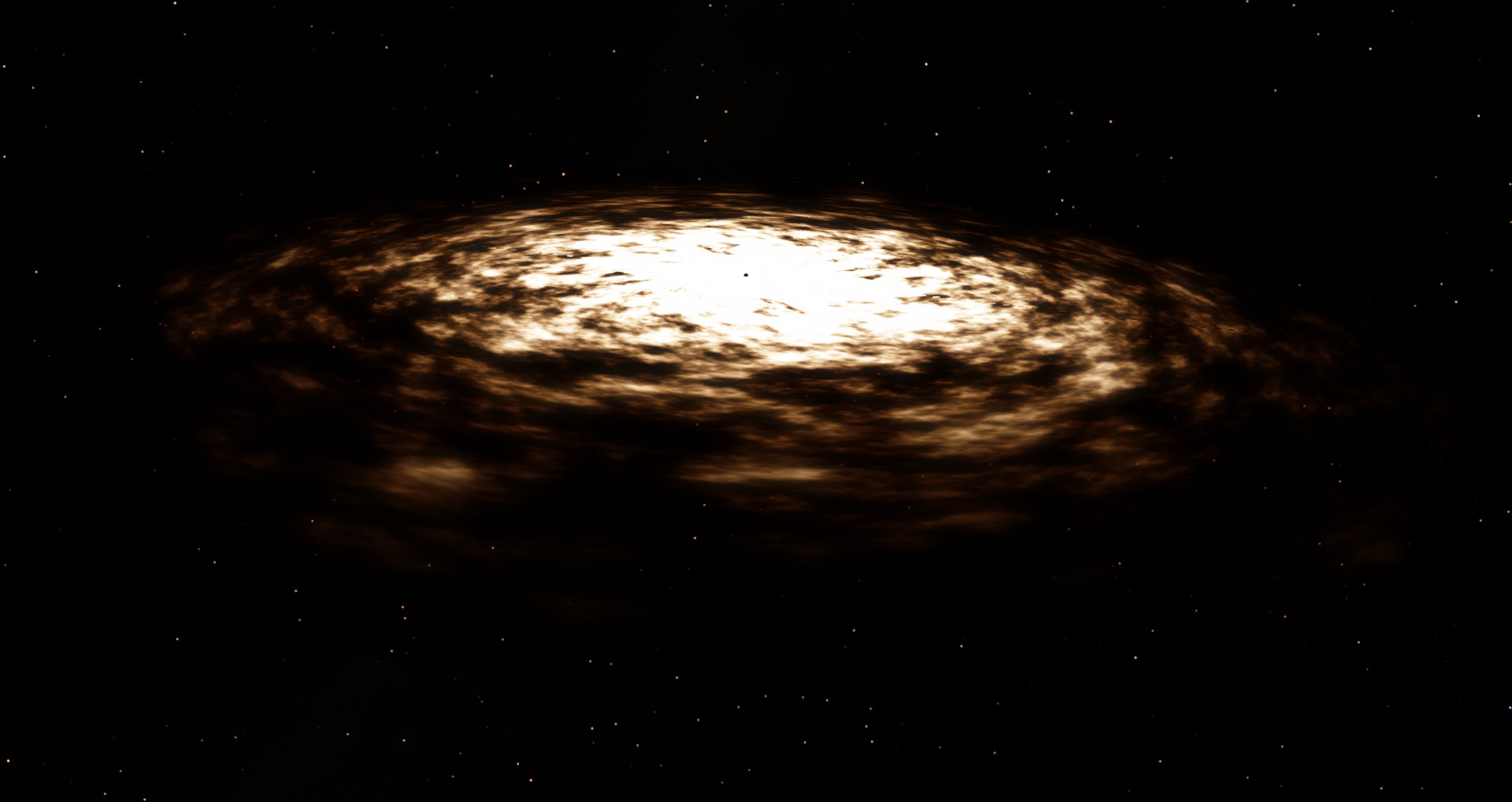
| Accretion disk is indeed overwhelmingly bright. I made some computations using analythic model (alpha-disk model) for accretion disk around Sagittarius A* in the Milky Way center. Using it's mass of 4.2 million solar masses and realistic accretion rate (3 Earth masses per year), I derived this temperature profile:
max temperature at 4.3 Schwarzschild radii - 96,000K
temperautre at 1000 Schwarzschild radii, where SE rendering stops for now - 2600K (still too bright)
temperature at 3600 Schwarzschild radii - 1000K (so rendering radius in SE should be increased 4x times)
Matter at 96,000K have extremely high brightness. According to the Stefan-Bolzmann law, surface brightness is proportional to T4. So 96,000K is 80,000 times brighter than Sun's surface. It will be saturated to white in SE if exposure is more than 0.0001.
Screenshots here showing accretion disk around Sgr A* with different levels of exposure: 1, 0.01, 0.0001:


Temperature in accretion disk around stellar black hole with high accretion rate is even more extreme. For 5 solar mass black hole, eating 0.001 solar mass per year, it will be 330 million Kelvins at 4.3 Schwarzschild radii and 10 million Kelvins at 1000 Schwarzschild radii. Temperature falling down to 1000 Kelvins only at 200 million Schwarzschild radii, or 20 AU from the black hole. This means what stellar black hole's accretion disk can't be such cold, because it's outer edge lies much closer - defined by orbit of the secondary stellar companion, which feeding the black hole with its own matter.
This also means what SE cannot render accretion disks realistically, at least for now. SE can't render temperatures more than 100,000 K (all higher will have the same color and brightness) and can't render accretion disks of any radius (1000 Schwarzschild radii is limit for now). I am forced to use some cheats like smooth falloff of the disk's outer edge and limiting it's maximum temperature.

|
| |
| |
| Kamil_Cader | Date: Tuesday, 10.11.2015, 15:14 | Message # 756 |
|
Observer
Group: Users
Poland
Messages: 12
Status: Offline
| ...someone asked about how big accretion discs can be... So, that small dot in the centre is Sgr A*, with has the radius of ~0,06AU?... 
|
| |
| |
| DoctorOfSpace | Date: Tuesday, 10.11.2015, 16:57 | Message # 757 |
 Galaxy Architect
Group: Global Moderators
 Pirate
Messages: 3600
Status: Offline
| Those are some impressive looking accretion disks.
Intel Core i7-5820K 4.2GHz 6-Core Processor
G.Skill Ripjaws V Series 32GB (4 x 8GB) DDR4-2400 Memory
EVGA GTX 980 Ti SC 6GB
|
| |
| |
| Destructor1701 | Date: Tuesday, 10.11.2015, 22:40 | Message # 758 |
|
Pioneer
Group: Users
 Ireland
Messages: 533
Status: Offline
| That Sag A* simulation is astonishing.
I usually imagine that monster as a naked hole, but it's so much more terrifying with the disc visualised.
In reality, the disc would have more 3D structure, though, right? It would bulge thicker as you get further from the hole, wouldn't it?
Like this:

Aesthetically, I think I prefer the flat disk.
disc disk.
|
| |
| |
| parameciumkid | Date: Wednesday, 11.11.2015, 00:33 | Message # 759 |
 Explorer
Group: Users
United States
Messages: 277
Status: Offline
| Quote HarbingerDawn ( ) He already stated that it's not realistic, and can't be since SE does not contain infrared or ultraviolet image information, which would be needed for realistic colors.
Yes, I read that part. If it is indeed supposed to involve vivid, saturated colors, I'll rest my case, but my gut feeling is that the colors would be a bit more muted.
It's sort of like how the accretion disk itself, where "blue" shifted, is instead a brilliant white, while the "red" shifted part is dark orange, due to the way blackbody emissions work. But the sky in the background is bright blue, even between the stars.
What I'd imagine as a bit more believable is if a different sort of filter could be applied to the sky pixels that would increase the intensity and color temperature of the stars, but leave the black untouched.
Again, I presume SpaceEngineer has already looked into this for the release version
Intel HD Graphics 4000 ;P
|
| |
| |
| HarbingerDawn | Date: Wednesday, 11.11.2015, 01:31 | Message # 760 |
|
Cosmic Curator
Group: Administrators
United States
Messages: 8717
Status: Offline
| Quote parameciumkid ( ) But the sky in the background is bright blue, even between the stars.
Because between the stars are the galaxy model's bulge sprites which are "stars" themselves (or we should pretend that they are). The shader isn't going to shift the color of something that isn't there.
Quote parameciumkid ( ) my gut feeling is that the colors would be a bit more muted.
Of course it would look a lot less colorful IF IT WERE REALISTIC. I must stress again, the colors cannot look accurate without UV and IR rendering, and you're going to have a lot of blue and a lot of red if you're clamped to visible wavelengths.
All forum users, please read this!
My SE mods and addons
Phenom II X6 1090T 3.2 GHz, 16 GB DDR3 RAM, GTX 970 3584 MB VRAM
|
| |
| |
| Salvo | Date: Wednesday, 11.11.2015, 08:01 | Message # 761 |
|
Star Engineer
Group: Local Moderators
Italy
Messages: 1400
Status: Offline
| Quote HarbingerDawn ( ) the colors cannot look accurate without UV and IR rendering
If SpaceEngineer implemented "HDR", would it be possible?
If I'm not wrong it helps representing luminosity using, not more 0.0 - 1.0 colors, but an absolute value.
Otherwise I'm afraid its almost impossible, since you would need to edit the OpenGL rendering itself...
The universe is not required to be in perfect harmony with human ambition.
CPU: Intel Core i7 4770 GPU: ASUS Radeon R9 270 RAM: 8 GBs
(still don't know why everyone is doing this...)
Edited by Salvo - Wednesday, 11.11.2015, 08:05 |
| |
| |
| SpaceEngineer | Date: Wednesday, 11.11.2015, 09:41 | Message # 762 |
|
Author of Space Engine
Group: Administrators
Russian Federation
Messages: 4800
Status: Offline
| Quote parameciumkid ( ) It's sort of like how the accretion disk itself, where "blue" shifted, is instead a brilliant white, while the "red" shifted part is dark orange, due to the way blackbody emissions work.
Skybox don't have temperature data. Instead of shifting temperature, the shader make spectrum shift, ie redistribute energy between R, G and B channels according to the blueshift value. The problem is what there is nothing before R channel (no infrared channels). So it simply take some constant value to simulate infrared emission of stars (obviously, it appear uniform across the sky). This reduces blue color saturation, and I choose this value to make blueshifted red stars look like blue stars (this must be close to reality). This also must dot destroy very much appearance of monochromatic sources, such as red nebulae: with increasing blueshift, they must become yellow, green, blue and violet.
Quote parameciumkid ( ) What I'd imagine as a bit more believable is if a different sort of filter could be applied to the sky pixels that would increase the intensity and color temperature of the stars, but leave the black untouched.
There was no black in this scene - look carefully at first screen, there is galaxy bulge visible, like HarbingerDawn said.
Quote Salvo ( ) If SpaceEngineer implemented "HDR", would it be possible?
LOL, HDR was implemented in 0.8x version.
|
| |
| |
| Salvo | Date: Wednesday, 11.11.2015, 10:10 | Message # 763 |
|
Star Engineer
Group: Local Moderators
Italy
Messages: 1400
Status: Offline
| Quote SpaceEngineer ( ) LOL, HDR was implemented in 0.8x version.
Really? 
Yeah, maybe without HDR Auto-Exposure couldn't be possible... Anyway, I don't know how that could be implemented, but, for sure, it's a very interesting topic!
The universe is not required to be in perfect harmony with human ambition.
CPU: Intel Core i7 4770 GPU: ASUS Radeon R9 270 RAM: 8 GBs
(still don't know why everyone is doing this...)
|
| |
| |
| Destructor1701 | Date: Wednesday, 11.11.2015, 12:26 | Message # 764 |
|
Pioneer
Group: Users
Ireland
Messages: 533
Status: Offline
| Salvo, you're basically asking for full-spectrum rendering, because spatial contortion can frequency-shift light from invisible frequencies into the visible. This would lead to UV and IR (and radio and gamma, etc, etc) getting mapped onto the visible colours in ways that look different to ordinary appearances, dependent on the frequency shift. Blueshift and redshift aren't just a "Blue-ening" or a "reddening"... they're a translation of the invisible into the visible.
In order to render that accurately, SE would have to simulate the invisible... which would be a monumental undertaking.
|
| |
| |
| JackDole | Date: Wednesday, 11.11.2015, 15:30 | Message # 765 |
 Star Engineer
Group: Local Moderators
 Germany
Messages: 1742
Status: Offline
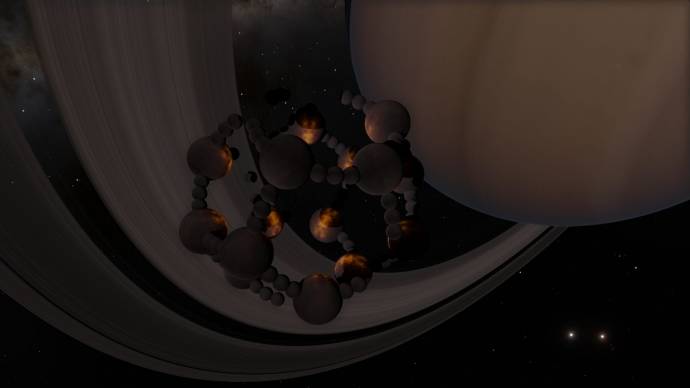
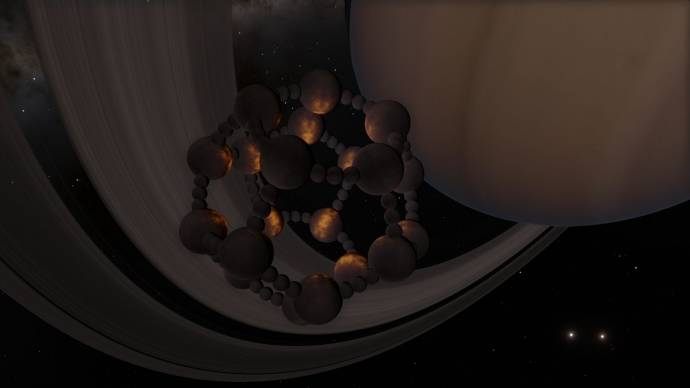
| Concerning eclipse shadows bugs:
I made this negative energy cage for DoctorOfSpace's wormholes. Sometimes the cages are broken. The reason are the eclipse shadows.
Eclipse shadow on:
Eclipse shadow off:
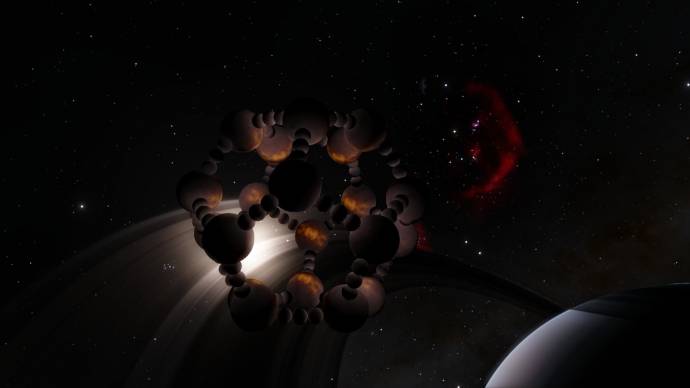
This bug does not seem to occur in SE 0.973.
The script is for a cage without Wormhole.
Don't forget to look here.

Edited by JackDole - Wednesday, 11.11.2015, 15:32 |
| |
| |
 ENG
ENG New site


 Italy
Italy 


 Poland
  France
 United States
  Russian Federation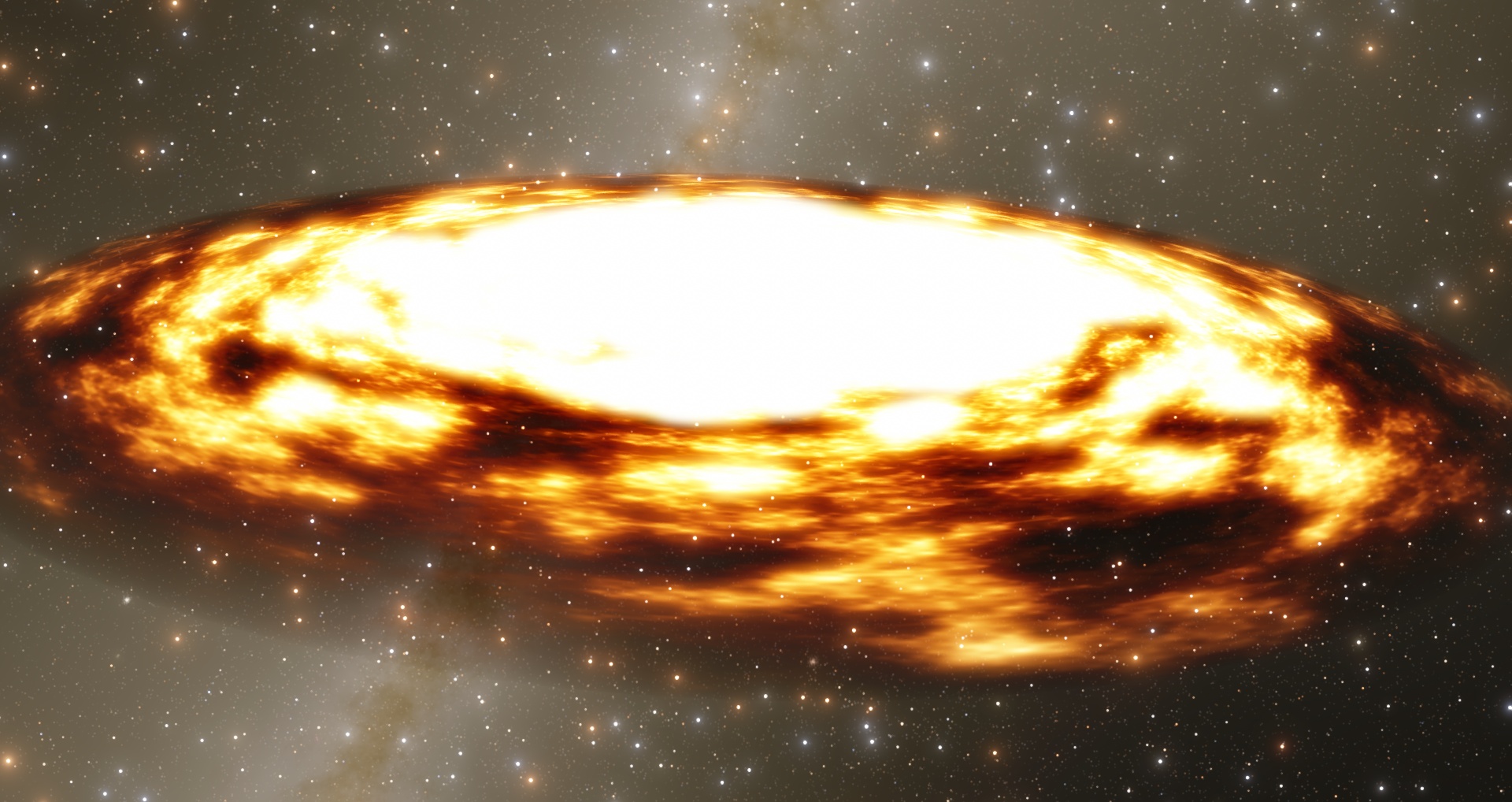


 Pirate
  Ireland
  Germany

