|
General suggestions
|
|
| quarior14 | Date: Wednesday, 24.02.2016, 15:49 | Message # 691 |
 World Builder
Group: Users
 Pirate
Messages: 649
Status: Offline
| Quote Watsisname (  ) Quote quarior14 ( ) 1 g = 9.81 N·m²·kg^−2 You are confusing the units of "g" (acceleration due to gravity at Earth's surface, which averages 9.81 m/s2), with "G" (the gravitational constant, 6.67*10-11 N*m2/kg2).I don't understand your suggestion or questions either. If you're asking if it's possible to show the surface gravity of a black hole (at its horizon), then this is a meaningless quantity. In some respects it is infinite.If you're asking if it's possible to show the tidal forces from a black hole, this is already shown, in units of g per meter. You can consider a tidal force stronger than (very roughly) 10g/m to be lethal.
Yes, it is in fact N.kg^-1 but what is the relationship between the strength of the tidal force (g/m) ?
Quote SpaceEngineer ( ) Quote quarior14 ( ) Also, is that it is possible to display the "surface" gravity event horizon or surface of the tidal force by distance of black holes ? I don't understand, please make correct sentence.
I use with the following formula :
g = (G*m)/d²
g in N.kg^-1 (gravity)
G = 6.67*10^(-11) N.m²/kg² (gravitational constant)
m in kg (mass)
d in m (distance)
Exemple for Sagittarius A* (Mass : 4.31*10^6 * 1.977*10^(30) = 8.5769*10^(36) kg, Radius (event horizon) : 0.085 AU = 1.27*10^(10) m) :
g = (6.67*10^(-11)*8.5769*10^(36))/(1.27*10^(10))² = 1.29*10^47 N.kg^-1 = 1.31*10^46 g
I hope you understand, I do not know how to describe further, d it is the distance between camera and the center of black hole.
Quarior
Edited by quarior14 - Wednesday, 24.02.2016, 15:50 |
| |
| |
| Kubacki99 | Date: Friday, 26.02.2016, 22:06 | Message # 692 |
|
Observer
Group: Newbies
 Poland
Messages: 7
Status: Offline
| Is it possible to add some function, which shows selected star on the Hertzsprung–Russell diagram?
|
| |
| |
| Watsisname | Date: Saturday, 27.02.2016, 01:28 | Message # 693 |
 Galaxy Architect
Group: Global Moderators
 United States
Messages: 2613
Status: Offline
| Quote quarior14 Yes, it is in fact N.kg^-1 but what is the relationship between the strength of the tidal force (g/m) ?
Correct, or just m/s2. Acceleration due to gravity is independent of the mass, so why use force per mass?
Tidal force is the change in force of gravity with respect to distance. To calculate it with Newton's Laws:
g(d)-g(d+Δd)=GM(1/d2-1/(d+Δd)2)
Quote quarior14 ( ) Exemple for Sagittarius A* (Mass : 4.31*10^6 * 1.977*10^(30) = 8.5769*10^(36) kg, Radius (event horizon) : 0.085 AU = 1.27*10^(10) m) :
g = (6.67*10^(-11)*8.5769*10^(36))/(1.27*10^(10))² = 1.29*10^47 N.kg^-1 = 1.31*10^46 g
Uhh, check your math. You should be getting something like 3.5*106m/s2, or about 360,000 times Earth's surface gravity. Also, since event horizon radius (of a Schwarzschild black hole) is 2GM/c2, you can calculate it as
g(event horizon) = c4/(4GM)
However, this calculation is wrong. It's using Newton's laws in a *very* general relativistic regime. The result suggests you could hover at the event horizon if you accelerate upward with finite acceleration. This is wrong. The acceleration needed would actually be infinite. Only photons or other massless particles moving at the speed of light can remain on the horizon.
So... I wouldn't use this calculation. There are other interpretations of "surface gravity" of a black hole that mimic it (particularly in how it depends on the mass of the hole), but it's really not the same thing.
Similarly, the calculation of tidal force given above isn't completely accurate near a black hole. SE calculates it general relativistically (at least I'm pretty sure) from the space-time curvature.
Edit: Sorry, quoted wrong person.

|
| |
| |
| quarior14 | Date: Saturday, 27.02.2016, 10:04 | Message # 694 |
|
World Builder
Group: Users
Pirate
Messages: 649
Status: Offline
| Quote Watsisname ( ) Correct, or just m/s². Acceleration due to gravity is independent of the mass, so why use force per mass?
It is the unity international.
Quote Watsisname ( ) Uhh, check your math. You should be getting something like 3.5*10^6 m/s²
Ah yes, i forget the square, it is g = (6.67*10^(-11)*8.5769*10^(36))/(1.27*10^(10))² = 3546898.32 m/s² (or N/kg) = 361559.4618 g
Quote Watsisname ( ) g(event horizon) = c^4/(4GM)
M = 8.5769*10^(36) kg
c = 299 792 458 m/s
G = 6.67*10^(-11) N.m²/kg²
g(event horizon) = (299792458)^4/(4*6.67*10^(-11)*(8.5769*10^(36)) = 3529934.443 m/s² = 359830.2185 g
Damn, it looks like my previous result.
In fact what is strange is that when the distance is 0 as gravity takes infinite + from the relationship (watch over limit in mathematics) to any body even if in reality, I'm not on it's realistic except for black hole I think.
Quote Watsisname ( ) However, this calculation is wrong. It's using Newton's laws in a *very* general relativistic regime. The result suggests you could hover at the event horizon if you accelerate upward with finite acceleration. This is wrong. The acceleration needed would actually be infinite. Only photons or other massless particles moving at the speed of light can remain on the horizon. So... I wouldn't use this calculation. There are other interpretations of "surface gravity" of a black hole that mimic it (particularly in how it depends on the mass of the hole), but it's really not the same thing.Similarly, the calculation of tidal force given above isn't completely accurate near a black hole. SE calculates it general relativistically (at least I'm pretty sure) from the space-time curvature.
I think there is beyond my knowledge so I do not know what to say.
PS : How do you put the other powers that ² because even by copy paste, put it as a figure "normal" (example 4) ?
Quarior
Edited by quarior14 - Saturday, 27.02.2016, 10:06 |
| |
| |
| HarbingerDawn | Date: Saturday, 27.02.2016, 17:59 | Message # 695 |
 Cosmic Curator
Group: Administrators
United States
Messages: 8717
Status: Offline
| Quote quarior14 ( ) How do you put the other powers that ² because even by copy paste, put it as a figure "normal" (example 4) ?
Code 10[sup]4[/sup] m/s[sup]2[/sup]
produces
104 m/s2
All forum users, please read this!
My SE mods and addons
Phenom II X6 1090T 3.2 GHz, 16 GB DDR3 RAM, GTX 970 3584 MB VRAM
Edited by HarbingerDawn - Saturday, 27.02.2016, 18:00 |
| |
| |
| Watsisname | Date: Saturday, 27.02.2016, 22:04 | Message # 696 |
|
Galaxy Architect
Group: Global Moderators
United States
Messages: 2613
Status: Offline
| Quote quarior14 ( ) Damn, it looks like my previous result.
Yeah, it should.  It's the same formula, just expressed differently. It replaced distance with the event horizon radius. It's the same formula, just expressed differently. It replaced distance with the event horizon radius.
Quote quarior14 ( ) In fact what is strange is that when the distance is 0 as gravity takes infinite
Of course. The limit of 1/r2 as r goes to zero is infinity. If a black hole singularity is infinitely small, then it is infinitely attractive at that point.
Quote quarior14 ( )
I think there is beyond my knowledge so I do not know what to say.
Basically all I am saying is that the formula for the force of gravity F=GMm/r2 (Newton's Law of Gravity) is not accurate near a black hole. We really need to use general relativity.
|
| |
| |
| jacobaaronberube | Date: Sunday, 06.03.2016, 04:26 | Message # 697 |
 Observer
Group: Users
Pirate
Messages: 11
Status: Offline
| When I went into the black hole (https://gyazo.com/04d615b9f963c686158398a57defad63) It wasnt what I was expecting, the rings are too bright, and theres no way to change that other than changing exposure, It would be cool to have a ring editor where we can add multiple rings with different offsets to the same body, as well as an array of other features like brightness, JPG file importation, thickness... etc Note: I am SO glad (yet super scared) that I can go IN the black hole, and make it almost impossible to get out :P that was some good coding guys! Last thing: You should add seperate tabs for searching for different types of bodies, like, lets say I want to look for black holes, BAM, theres a tab for it, AND lets say I want to find an asteroid, BAM; another tab... you get the deal... I hope you read this... This game has sparked my imagination by a LOT... I'm glad you're working on this game :P (I know... I shouldnt get mushy and crap... and that I should only post comments about the game in the misc section, but... chances are you wont read this there...)
|
| |
| |
| SpaceEngineer | Date: Sunday, 06.03.2016, 12:16 | Message # 698 |
 Author of Space Engine
Group: Administrators
 Russian Federation
Messages: 4800
Status: Offline
| Quote Watsisname ( ) Basically all I am saying is that the formula for the force of gravity F=GMm/r2 (Newton's Law of Gravity) is not accurate near a black hole. We really need to use general relativity.
In simple calculations (or in calculations which required good performance) one can use the Paczynski-Wiita approximation for Schwarzschild potential:
F = - G * M / (R - Rg)[sup]2[/sip]

|
| |
| |
| SpaceEngineer | Date: Sunday, 06.03.2016, 12:21 | Message # 699 |
|
Author of Space Engine
Group: Administrators
Russian Federation
Messages: 4800
Status: Offline
| Quote jacobaaronberube ( ) It would be cool to have a ring editor
Planet editor supports editing accretion disk parameters.
Quote jacobaaronberube ( ) where we can add multiple rings with different offsets to the same body
This is impossible. Accretion disk and warp effect is a single shader effect. Such things cannot be cascaded over each other.
Quote jacobaaronberube ( ) SO glad (yet super scared) that I can go IN the black hole, and make it almost impossible to get out
You can't go inside black hole. Camera is stopped at a Schwarzschild radius.
Quote jacobaaronberube ( ) You should add seperate tabs for searching for different types of bodies, like, lets say I want to look for black holes, BAM, theres a tab for it, AND lets say I want to find an asteroid, BAM; another tab...
Press "configure filter" button on the Star Browser dialog.
|
| |
| |
| jacobaaronberube | Date: Sunday, 06.03.2016, 18:57 | Message # 700 |
|
Observer
Group: Users
Pirate
Messages: 11
Status: Offline
| Quote SpaceEngineer ( ) You can't go inside black hole. Camera is stopped at a Schwarzschild radius.
You're wrong though (0.974): 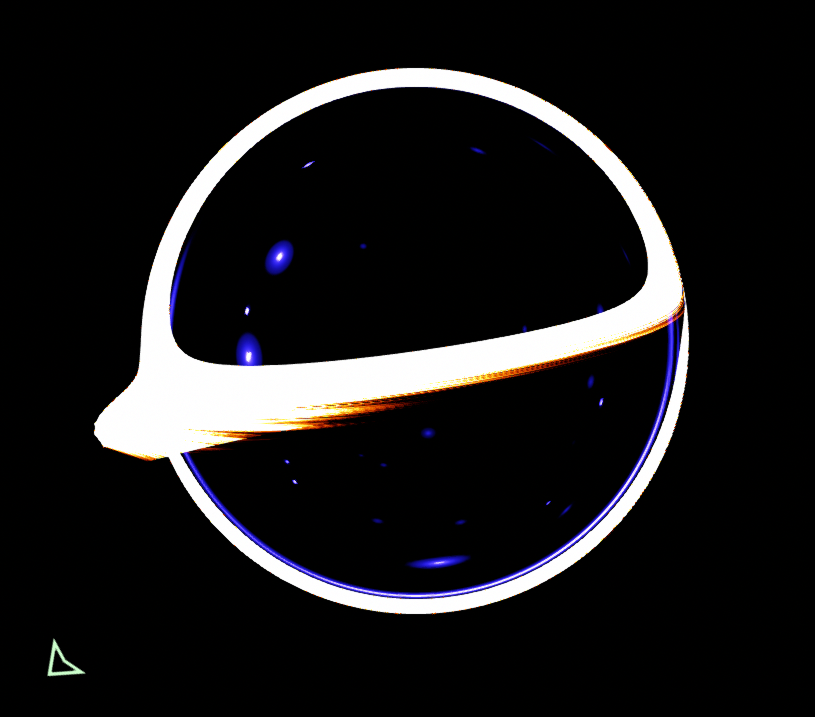
also, I found out how to search EVERYTHING , just put a lot of 9's and then when you search, the search radius will be infinity :P
Edited by jacobaaronberube - Sunday, 06.03.2016, 18:58 |
| |
| |
| philociraptor | Date: Sunday, 06.03.2016, 20:24 | Message # 701 |
|
Observer
Group: Newbies
Pirate
Messages: 2
Status: Offline
| I've played with space engine quite a bit. Here's a few suggestions that may help and add on to the immersion:
* A Local Solar Time, for any world. Basically, a time of day clock, unique to the orbital parameters, size, etc.
* A top-down global map. For navigating close to the surface, it would be awesome to see where I'm going, with respect to the terrain. A scalable, zoomable, orientable map, in color. This would help without having to go into high orbit, just to point myself towards that particular mountain range, crater, ocean, etc.
* Another type of orientation, that follows the curvature of the world. For camera mode. Flying along at whatever altitude, this would conform to the curvature, so one doesn't have to correct the pitch every second. It would be similar to the 'Rotate with object' , without having to correct the pitch. Once the angle of attack is set, the alt should remain the same, even during complete circumnavigation.
These little things seem simple enough. They would improve the simulator in the minor ways.
|
| |
| |
| anonymousgamer | Date: Sunday, 06.03.2016, 20:37 | Message # 702 |
 World Builder
Group: Global Moderators
United States
Messages: 1011
Status: Offline
| Quote jacobaaronberube ( ) You're wrong though (0.974):
That's still outside of the event horizon.
Desktop: FX-8350 4.0 GHz, 8 GB DDR3 RAM, EVGA GeForce GTX 1080 FTW 8 GB, 2 TB HDD, 24 inch 1920x1080 screen
Laptop: Core i5 480M 2.66 GHz (turbo 2.93), 8 GB DDR3 RAM, AMD Radeon HD 6550m 1 GB, 640 GB HDD, 17.3 inch 1600x900 screen
|
| |
| |
| SpaceEngineer | Date: Sunday, 06.03.2016, 20:49 | Message # 703 |
|
Author of Space Engine
Group: Administrators
Russian Federation
Messages: 4800
Status: Offline
| Quote jacobaaronberube ( ) You're wrong though (0.974):
lol no, I am not wrong:
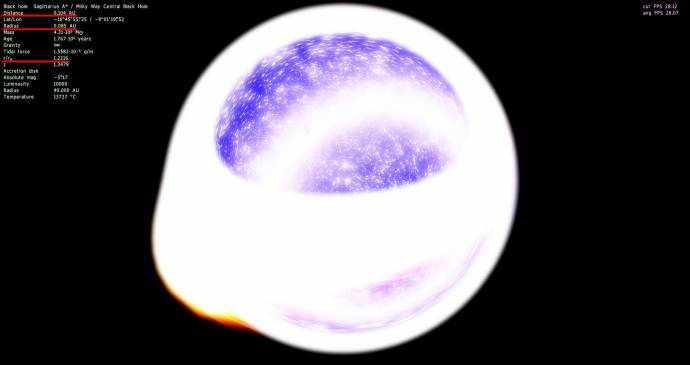
Stationary observer near the black hole may see Universe as a disk above his head. As observer approaches the event horizon, the disks's diameter become smaller than 180° (or, the same, black hole's shadow diameter become greater than 180°). At the event horizon the Universe image collapsing into a point with infinite blueshift.
It's time to open a thread "Why black holes looked like this", similar to the thread about read giants. Universe is not always intuitive!
|
| |
| |
| SpaceEngineer | Date: Sunday, 06.03.2016, 20:55 | Message # 704 |
|
Author of Space Engine
Group: Administrators
Russian Federation
Messages: 4800
Status: Offline
| Quote philociraptor ( ) * A Local Solar Time, for any world. Basically, a time of day clock, unique to the orbital parameters, size, etc.
This may be ambiguous. On a tidally locked planet, time of day have no sense. A planet with 90° axial tilt (like Uranus) once in a year facing the sun by by it's pole - local time have no sense in this moment. A planet with long rotational period and eccentric orbit may have moments in time when sun moved backward in the sky, sitting at the east or rising at the west (like on Mercury).
|
| |
| |
| Mosfet | Date: Sunday, 06.03.2016, 22:04 | Message # 705 |
 World Builder
Group: Users
 Italy
Italy
Messages: 754
Status: Offline
| Quote SpaceEngineer ( ) It's time to open a thread "Why black holes looked like this", similar to the thread about read giants. Universe is not always intuitive!
I approve heartily, a topic that's fascinating beyond measure, and right now black hole sims in SE are graphically capable to help grasping the concept of black hole "shadow". That's Astronomy, baby!
"Time is illusion. Lunchtime doubly so."
Douglas N. Adams
My mods
Asus x555ub: cpu i5-6200u - ram 4gb - gpu nvidia geforce 940m 2gb vram
|
| |
| |
 ENG
ENG New site


 Pirate


 Poland
 United States
 Russian Federation
 Italy
Italy