|
General suggestions
|
|
| JackDole | Date: Sunday, 15.11.2015, 01:05 | Message # 646 |
 Star Engineer
Group: Local Moderators
 Germany
Messages: 1742
Status: Offline
| Quote Watsisname (  ) ponies made of diamonds
That would be far too dangerous! Constantly someone would try to steal them. 
Don't forget to look here.

|
| |
| |
| HarbingerDawn | Date: Sunday, 15.11.2015, 09:35 | Message # 647 |
 Cosmic Curator
Group: Administrators
 United States
Messages: 8717
Status: Offline
| Quote Watsisname ( ) I wish I could have real life ponies made of diamonds
All forum users, please read this!
My SE mods and addons
Phenom II X6 1090T 3.2 GHz, 16 GB DDR3 RAM, GTX 970 3584 MB VRAM
|
| |
| |
| SpaceEngineer | Date: Monday, 16.11.2015, 17:48 | Message # 648 |
 Author of Space Engine
Group: Administrators
 Russian Federation
Messages: 4800
Status: Offline
| In addition to what Watsisname said, you can't have a purely metallic or purely water planet. This is impossible in natural planet-forming process, because it is taking deal with entire Periodic table. You can't have a part of a protoplanet nebula made purely of iron, when a part made purely of basalt particles, when purely of water ice. Everything will be intermixed, abundance of each material will change gradually with distance to sun.
Quote OMGspace_engine ( ) For the Water planets, I mean not a full transparence, but a transparece in the planet "borders", imagine if you was looking for the star from behind the planet, the light, instead of a full cut in the luminosity, will suffer a "fade-out" to the core of the planet(I think it was not much clear, but is the best I can think to explain )
Impossible. Did you ever seen the Sun shining through the ocean few minutes after sunset?

|
| |
| |
| Bells_Theorem | Date: Monday, 16.11.2015, 19:51 | Message # 649 |
 Explorer
Group: Users
United States
Messages: 188
Status: Offline
| Are cloud shadows planned for in future updates? Would they be difficult to implement?
|
| |
| |
| HarbingerDawn | Date: Tuesday, 17.11.2015, 00:48 | Message # 650 |
|
Cosmic Curator
Group: Administrators
United States
Messages: 8717
Status: Offline
| Quote Bells_Theorem ( ) Are cloud shadows planned for in future updates? Would they be difficult to implement?
Yes and probably.
All forum users, please read this!
My SE mods and addons
Phenom II X6 1090T 3.2 GHz, 16 GB DDR3 RAM, GTX 970 3584 MB VRAM
|
| |
| |
| BKunze | Date: Friday, 20.11.2015, 06:17 | Message # 651 |
|
Observer
Group: Newbies
 Canada
Messages: 1
Status: Offline
| Are tidal effects planned in the near future, or will that most likely be further down the road, if at all?
Edited by BKunze - Friday, 20.11.2015, 06:18 |
| |
| |
| n0b0dy | Date: Friday, 20.11.2015, 06:53 | Message # 652 |
 Explorer
Group: Users
 Pirate
Messages: 297
Status: Offline
| Quote BKunze ( ) Are tidal effects planned in the near future, or will that most likely be further down the road, if at all?
I doubt they will be implemented in the near future. Most likely it will be further down or not possible at all (hopefully not).
|
| |
| |
| Zefnoly | Date: Friday, 20.11.2015, 22:24 | Message # 653 |
 Space Tourist
Group: Users
Pirate
Messages: 38
Status: Offline
| What about a system generator where you can like choose a place in a galaxy you find. then open it up to generate a system at a choosen spot. maybe with help of cordinates or location of camera. Then you can insert parameters for the system. What kind of star. how many planets? what kind of moons/planets they will have and the base color and if they will have life or not etc...
EDIT: I'm not talking about the star browser. I'm talking about a tool to generate a system with help of parameters if you don't find what you want
A creature from a planet found far on the other side of Milkyway, found on a planet orbiting a gas giant.

Edited by Zefnoly - Friday, 20.11.2015, 23:00 |
| |
| |
| GlenStevensTD | Date: Sunday, 29.11.2015, 19:48 | Message # 654 |
|
Observer
Group: Banned
 Belgium
Messages: 11
Status: Offline
| What about subdwarfs and subgiants will be procedurally generated. Subgiants and subdwarfs will less common than main sequence
Irrregular and Lenticular galaxies:
Blue-White and Yellow subdwarfs
Blue-White subgiants
Sprial galaxies:
White-Yellow-Orange-Red subdwarfs
Blue-White-Yellow-Orange-Red subgiants
Elliptical galaxies:
Red-Yellow-Orange subdwarfs
Red-Orange subgiants
Edited by GlenStevensTD - Sunday, 29.11.2015, 19:48 |
| |
| |
| SpaceEngineer | Date: Monday, 30.11.2015, 15:18 | Message # 655 |
|
Author of Space Engine
Group: Administrators
Russian Federation
Messages: 4800
Status: Offline
| Quote GlenStevensTD ( ) What about subdwarfs and subgiants will be procedurally generated. Subgiants and subdwarfs will less common than main sequence
I am work on upgraded stellar classificatoin right now.
|
| |
| |
| DeathStar | Date: Monday, 30.11.2015, 19:47 | Message # 656 |
|
Pioneer
Group: Users
 Croatia
Messages: 515
Status: Offline
| Quote SpaceEngineer ( ) I am work on upgraded stellar classificatoin right now.
That's fantastic! Right now, SE doesn't seem to be generating many types of stars that otherwise exist as catalog objects(subgiants,subdwarfs, WR stars, white-blue hypergiants, etc.) - hopefully the upgraded classification for procedural objects will also include these.
|
| |
| |
| GlenStevensTD | Date: Tuesday, 01.12.2015, 17:07 | Message # 657 |
|
Observer
Group: Banned
Belgium
Messages: 11
Status: Offline
| Quote That's fantastic! Right now, SE doesn't seem to be generating many types of stars that otherwise exist as catalog objects(subgiants,subdwarfs, WR stars, white-blue hypergiants, etc.) - hopefully the upgraded classification for procedural objects will also include these.
Wolf rayet stars should be more rare than red hypergiants and blue-white hypergiants also blue-white supergiants will be only on younger galaxies
Edited by GlenStevensTD - Tuesday, 01.12.2015, 17:08 |
| |
| |
| PlutonianEmpire | Date: Tuesday, 08.12.2015, 05:06 | Message # 658 |
 Pioneer
Group: Users
United States
Messages: 475
Status: Offline
| Would it be possible to have SE randomly or procedurally have some (not all) terras and/or titans to use the bottom-most cloud layer as a very thin "fog" layer, a meter or two above the sea level?
An example cloud script on one of my custom worlds:
Code
Clouds {
Height 0.001
BumpHeight 1.0
Coverage 0.1664405
}
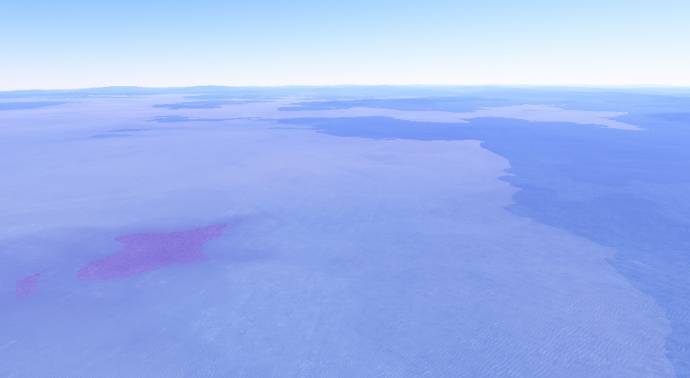
Basically, a bump height no greater than 1.0 for the "fog" layer.
Would this be feasible at all?
Specs: Dell Inspiron 5547 (Laptop); 8 gigabytes of RAM; Processor: Intel® Core™ i5-4210U CPU @ 1.70GHz (4 CPUs), ~2.4GHz; Operating System: Windows 7 Home Premium 64-bit; Graphics: Intel® HD Graphics 4400 (That's all there is :( )
|
| |
| |
| accursedCursive | Date: Thursday, 10.12.2015, 02:05 | Message # 659 |
|
Observer
Group: Newbies
 New Zealand
Messages: 5
Status: Offline
| I think it would be worth looking into whether many of Space Engine's problems could be solved by distributing matter in the universe with some kind of 4-dimesnional hybrid fractal, and time will be the parameter for looking at 3D slices of the fractal.
The biggest question though is whether it's possible to have gravity-like behaviour between slices of a fractal.
The Newton Fractal, if proximity to the centre is considered as the time dimension, could be likened to an orbital system of cantor dust where the orbits decay presumably to all the dust in space, so I guess that's something.
|
| |
| |
| SpaceEngineer | Date: Thursday, 10.12.2015, 09:40 | Message # 660 |
|
Author of Space Engine
Group: Administrators
Russian Federation
Messages: 4800
Status: Offline
| Quote DeathStar ( ) hopefully the upgraded classification for procedural objects will also include these.
No, classification is one system, generator is another.
Quote PlutonianEmpire ( ) bottom-most cloud layer as a very thin "fog" layer, a meter or two above the sea level?
It will clip with terrain, and z-fight everywhere. Also, 2D sheet is not look like a fog. Wait for volumetric clouds 
|
| |
| |
 ENG
ENG New site


 Germany


 United States
 Russian Federation

 Canada
  Pirate
 Belgium
  Croatia
 New Zealand