|
Work progress and public beta test - 0.9.7.4
|
|
| parameciumkid | Date: Wednesday, 02.12.2015, 08:14 | Message # 856 |
 Explorer
Group: Users
 United States
Messages: 277
Status: Offline
| ^ In that case I wouldn't expect it at all. Currently SpaceEngine has a heavy emphasis on realistic scales of both space and time, meaning two things: one, if anything were to gravitationally interact in any fashion that destabilized its orbit, in all probability it would have done so long, long before anyone got a spaceship there to catch it, or it would occur over a boringly long timescale; two, performing physics calculations on one simplified star system as in Universe Sandbox is easy (-ish) - performing the same sorts of calculations on billions upon billions of stars and planets is insane.
That said, who am I to put limits on SpaceEngineer's ambitions? He's surprised us before and might do so again... 
Intel HD Graphics 4000 ;P
|
| |
| |
| DoctorOfSpace | Date: Wednesday, 02.12.2015, 09:15 | Message # 857 |
 Galaxy Architect
Group: Global Moderators
 Pirate
Messages: 3600
Status: Offline
| Quote parameciumkid (  ) who am I to put limits on SpaceEngineer's ambitions? He's surprised us before and might do so again..
This is something I wouldn't hold my breath on.
Intel Core i7-5820K 4.2GHz 6-Core Processor
G.Skill Ripjaws V Series 32GB (4 x 8GB) DDR4-2400 Memory
EVGA GTX 980 Ti SC 6GB
|
| |
| |
| niseminoshiro | Date: Wednesday, 02.12.2015, 10:27 | Message # 858 |
 Observer
Group: Users
United States
Messages: 15
Status: Offline
| Quote Wicker1M ( ) In patch .973, Kepler-10c is listed inaccurately as a hot ice giant. The real Kepler 10c is believed to be a rocky mega-Earth. Although Kepler 10c may have the mass of an ice giant, its density suggests that it is a solid rocky world.
I think I heard somewhere that SE makes all planets above a certain size into ice or gas giants. It probably needs a few more categories like Shallow Neptune/Saturn, Desert Giant, Cannonball (iron) variations, carbon variations, and scorched all the way to frozen variations of those. Probably some interesting Terra-like types too (Large terra with hydrogen and/or helium atmo anyone?) A planet forming in an area where a lot of stars have died might be rich in heavy elements and exotic combinations of those. When the James Webb Space Telescope is launched in Oct 2018 we will probably learn a bit more about planet formation. I would think that a few more planet variations have yet to be discovered.
|
| |
| |
| LookAtDatDakka | Date: Wednesday, 02.12.2015, 14:27 | Message # 859 |
 Explorer
Group: Users
United States
Messages: 156
Status: Offline
| Quote niseminoshiro ( ) I think I heard somewhere that SE makes all planets above a certain size into ice or gas giants. It probably needs a few more categories like Shallow Neptune/Saturn, Desert Giant, Cannonball (iron) variations, carbon variations, and scorched all the way to frozen variations of those. Probably some interesting Terra-like types too (Large terra with hydrogen and/or helium atmo anyone?) A planet forming in an area where a lot of stars have died might be rich in heavy elements and exotic combinations of those. When the James Webb Space Telescope is launched in Oct 2018 we will probably learn a bit more about planet formation. I would think that a few more planet variations have yet to be discovered.
I agree! 
NVIDIA 960 GTX 2048MB
|
| |
| |
| GlenStevensTD | Date: Thursday, 03.12.2015, 17:10 | Message # 860 |
|
Observer
Group: Banned
 Belgium
Messages: 11
Status: Offline
| will there black holes and neutron stars with type classifications because SpaceEngineer already implemented accretion disk to the black holes and neutron stars also jets is still WIP what about classifcations for neutron stars and black holes?
X = normal black hole (just original black hole like 0.9.7.3)
XD = Black hole with smaller disk (Like in Insterstellar)
XDS = Black hole with bigger disk (Sgr A)
XDJ = black hole with disk and jets (Cygnus X-1)
Q = normal neutron star
QP = Pulsar (neutron star with jets)
QD = Neutron star with disk
Edited by GlenStevensTD - Thursday, 03.12.2015, 17:15 |
| |
| |
| huishb | Date: Thursday, 03.12.2015, 21:21 | Message # 861 |
 Astronaut
Group: Users
Pirate
Messages: 72
Status: Offline
| SpaceEngineer, will there be a on/off option for the red/blue Doppler effect?
Great work with space engine btw!
Possessor: AMD FX™-4100 Quad-Core Possessor (CPUs), ~3.6 GHz
Memory: 8192MB RAM. Graphics Card: NVIDIA GeForce GT 610. Approx total memory: 4045 MB
Edited by huishb - Friday, 04.12.2015, 00:19 |
| |
| |
| Handbanana | Date: Friday, 04.12.2015, 01:00 | Message # 862 |
 Astronaut
Group: Users
United States
Messages: 70
Status: Offline
| Quote GlenStevensTD ( ) will there black holes and neutron stars with type classifications because SpaceEngineer already implemented accretion disk to the black holes and neutron stars also jets is still WIP what about classifcations for neutron stars and black holes?
X = normal black hole (just original black hole like 0.9.7.3)
XD = Black hole with smaller disk (Like in Insterstellar)
XDS = Black hole with bigger disk (Sgr A)
XDJ = black hole with disk and jets (Cygnus X-1)
Q = normal neutron star
QP = Pulsar (neutron star with jets)
QD = Neutron star with disk
Space Engine uses official stellar classification types. There is no type known as 'XD' XDS' etc, so it won't work exactly like that. There may be some form of designation to differentiate between them, but it won't be listed as a spectral type.
Tonight... you.
Edited by Handbanana - Friday, 04.12.2015, 01:02 |
| |
| |
| Alek | Date: Friday, 04.12.2015, 04:00 | Message # 863 |
 Pioneer
Group: Users
United States
Messages: 326
Status: Offline
| Quote GlenStevensTD ( ) will there black holes and neutron stars with type classifications because SpaceEngineer already implemented accretion disk to the black holes and neutron stars also jets is still WIP what about classifcations for neutron stars and black holes?
X = normal black hole (just original black hole like 0.9.7.3)
XD = Black hole with smaller disk (Like in Insterstellar)
XDS = Black hole with bigger disk (Sgr A)
XDJ = black hole with disk and jets (Cygnus X-1)
Q = normal neutron star
QP = Pulsar (neutron star with jets)
QD = Neutron star with disk
I think that if pulsars are to be added, it should be at least considered to add millisecond pulsars in.
Living among the stars, I find my way. I grow in strength through knowledge of the space I occupy, until I become the ruler of my own interstellar empire of sorts. Though The world was made for the day, I was made for the night, and thus, the universe itself is within my destiny.
|
| |
| |
| Donatelo200 | Date: Friday, 04.12.2015, 05:25 | Message # 864 |
|
Explorer
Group: Users
United States
Messages: 261
Status: Offline
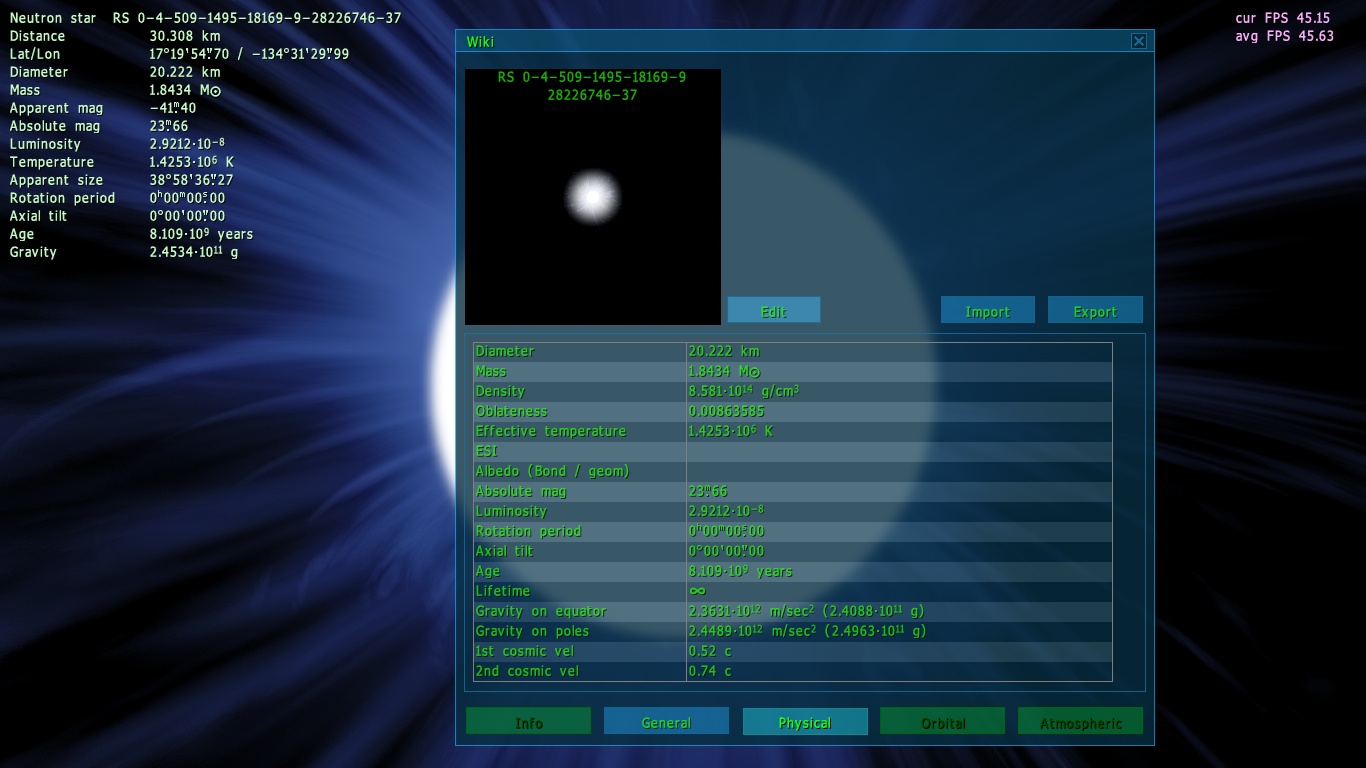
| Millisecond pulsars are no different than normal pulsars. They only spin faster. SE already generates high rotation speeds on some neutron stars as well so once pulsars are added millisecond pulsars are automatically added.
Here is an example of a millisecond neutron star in SE. It's even slightly oblate.

CPU: Intel Core i7-4790K
GPU: Nvidia GTX 1080
SSD: Samsung 850 Evo 250GB
HDD: Toshiba DT01ACA200 2TB
HDD: WD Blue 1TB (2012)
RAM: Unknown 16G-D3-1600-MR 2x8GB
MBD: MSI Z97S SLI Krait Edition (MS-7922)
|
| |
| |
| DarkenTerra | Date: Friday, 04.12.2015, 07:05 | Message # 865 |
 Astronaut
Group: Users
 China
China
Messages: 45
Status: Offline
| I wonder when will the new patch/verson realease  And I an looking forward to the development of the protoplanetary desk And I an looking forward to the development of the protoplanetary desk 
Who am I ?
|
| |
| |
| DarkenTerra | Date: Friday, 04.12.2015, 07:16 | Message # 866 |
|
Astronaut
Group: Users
China
Messages: 45
Status: Offline
| Quote Handbanana ( ) I think that if pulsars are to be added, it should be at least considered to add millisecond pulsars in.
Pulsars are actually some fast-rotating neutron stars with strong magnetic field of 10^7 to 10^9T, their rotation speed is usually extremely fast, but they are just neutron stars  So, I really don't think that pulsars could be added So, I really don't think that pulsars could be added 
Who am I ?
|
| |
| |
| Destructor1701 | Date: Friday, 04.12.2015, 17:43 | Message # 867 |
|
Pioneer
Group: Users
 Ireland
Messages: 533
Status: Offline
| DarkenTerra, since neutron stars are already in the game, SE just needs to add a Pulsar visual effect* to the appropriate stars, and the job is done.
*(and maybe a sound effect? The conceit could be the "systems" of the "observer" are being affected by the electromagnetic sweeps - would probably open a can of worms as to what else should have such sound effects)

|
| |
| |
| niseminoshiro | Date: Saturday, 05.12.2015, 00:50 | Message # 868 |
|
Observer
Group: Users
United States
Messages: 15
Status: Offline
| Quote Destructor1701 ( ) and maybe a sound effect? The conceit could be the "systems" of the "observer" are being affected by the electromagnetic sweeps - would probably open a can of worms as to what else should have such sound effects
Hmm, pulsars emit a lot of different kinds of EMR and probably some other types of high energy quantum particles strongly enough that we can easily detect them from far away. Sometimes they have planets (easy to detect around pulsars), often made of pieces of dead star, far denser than our solar system's own (https://en.wikipedia.org/wiki/PSR_J1719-1438). Such systems would be rich in interesting elements and any captured asteroid moons would be great mining targets. If you stepped out of a shielded command pod in a standard space suit onto a small but dense asteroid, the rapidly rotating pulsar's magnetic field would vibrate anything magnetic (stronger ones would possibly heat and electrify everything metal), and cause a constant electric hum. In the unlucky event that the beam intersects the asteroid and you are get lost on EVA while trying to evacuate, if you turn your ear towards your visor the beam would probably cause some vibration (along with subsequent disintegration) of your eardrums. But instead of twisting your neck in your space suit during your last moments, you think: "What would Matt Damon do?" You grab some extra oxygen, fuel, and baked potatoes as you ride on the back of a mining transport drone into a lower and inclined orbit around the dense gas giant-ish planet. You film the brilliant auroras and play the Interstellar soundtrack, hoping that the profits from selling it to Christopher Nolan will pay for your inevitable cancer treatments. As you descend out out of the dense planet's shadow you begin planning a daring trajectory towards one of the frozen moons, hoping that the thick atmosphere protected the colony on the surface. You turn the drone into a makeshift heat shield and it's just enough to land a few km from the base. A lone figure bounces out toward you. His visor opens, revealing the aged but unmistakable face of Matt Damon.
|
| |
| |
| parameciumkid | Date: Saturday, 05.12.2015, 01:43 | Message # 869 |
|
Explorer
Group: Users
United States
Messages: 277
Status: Offline
| I think you mean Magnetars. As mentioned above, neutron stars already exist, and magnetic fields are not currently simulated in SE, so "adding" magnetars would boil down to a simple label for a selection of neutron stars.
Intel HD Graphics 4000 ;P
|
| |
| |
| LookAtDatDakka | Date: Saturday, 05.12.2015, 04:46 | Message # 870 |
|
Explorer
Group: Users
United States
Messages: 156
Status: Offline
| I got a question SpaceEngineer. Has a floating point precision hit limitation have been eliminated so we get details of 0.1-1 cm. It has been there for a very loooooooooong time.
NVIDIA 960 GTX 2048MB
|
| |
| |
 ENG
ENG New site


 United States


 Pirate
 Belgium
 China
China  Ireland