If you use the UFO mode, currently, do not use the automatic go to feature as you will break ship orientation until you relaunch the program. I also recommend rebinding stop time to "x" and sync velocity to spacebar.
This is as close to arcade style as you will probably get.
Intel Core i7-5820K 4.2GHz 6-Core Processor G.Skill Ripjaws V Series 32GB (4 x 8GB) DDR4-2400 Memory EVGA GTX 980 Ti SC 6GB
The spaceships will have an arcade control mode in the future? the actual physics system turn too hard to just explore the planets with the ships
No, never. Not unless someone uses the engine as a basis for a less-realistic game.
Space Engine aims to simulate reality. The best you might hope for in terms of easier ship controls is the "flight assist" mode that is currently available (though, as with all elements of the Autopilot, it needs further work).
When are solar flares going to be implemented? Is it possible?
This is not the thread to ask things like that. Anyway, regarding such features, read the website FAQ.
QuoteOMGspace_engine ()
The spaceships will have an arcade control mode in the future? the actual physics system turn too hard to just explore the planets with the ships
There will be more advanced autopilot features, but there will never be an "arcade mode", (unless it's implemented as a cheat code in the far future). The whole purpose of SpaceEngine is realism. Anyway, flying spacecraft isn't all that hard, you just need to learn the principles of spaceflight.
All forum users, please read this! My SE mods and addons Phenom II X6 1090T 3.2 GHz, 16 GB DDR3 RAM, GTX 970 3584 MB VRAM
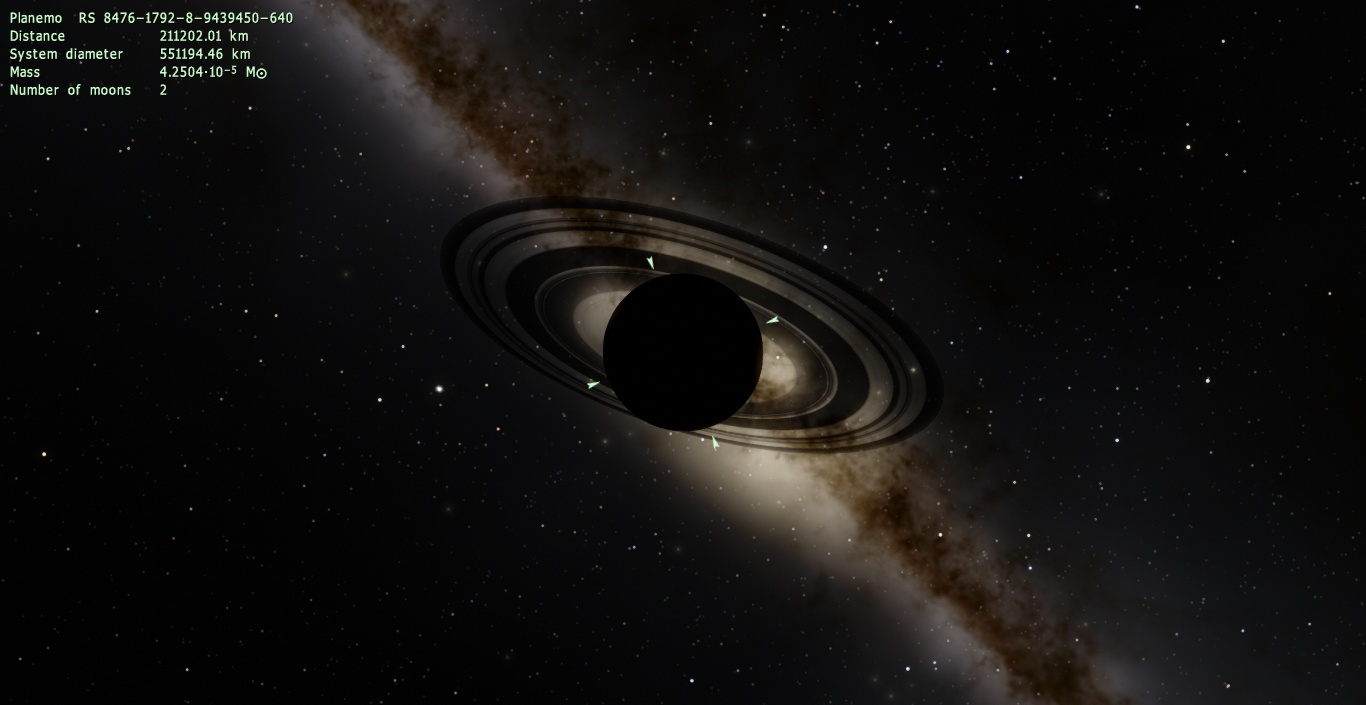
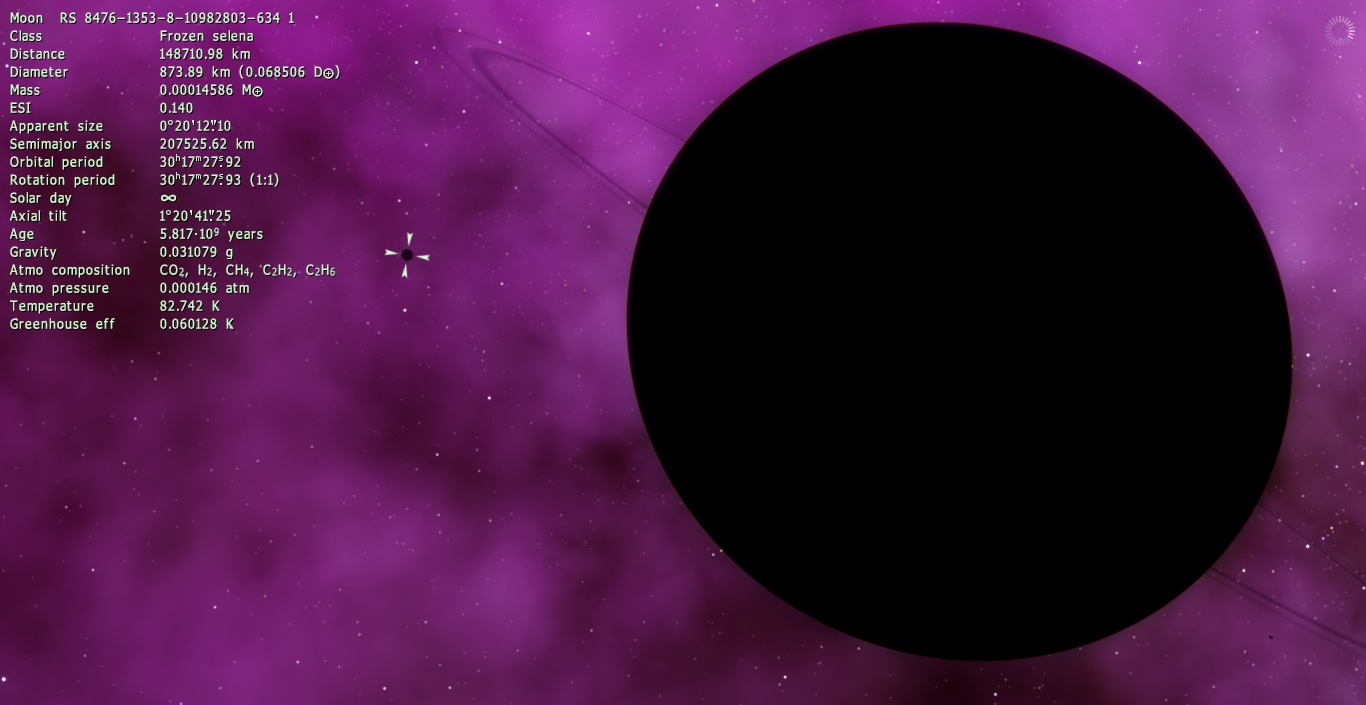
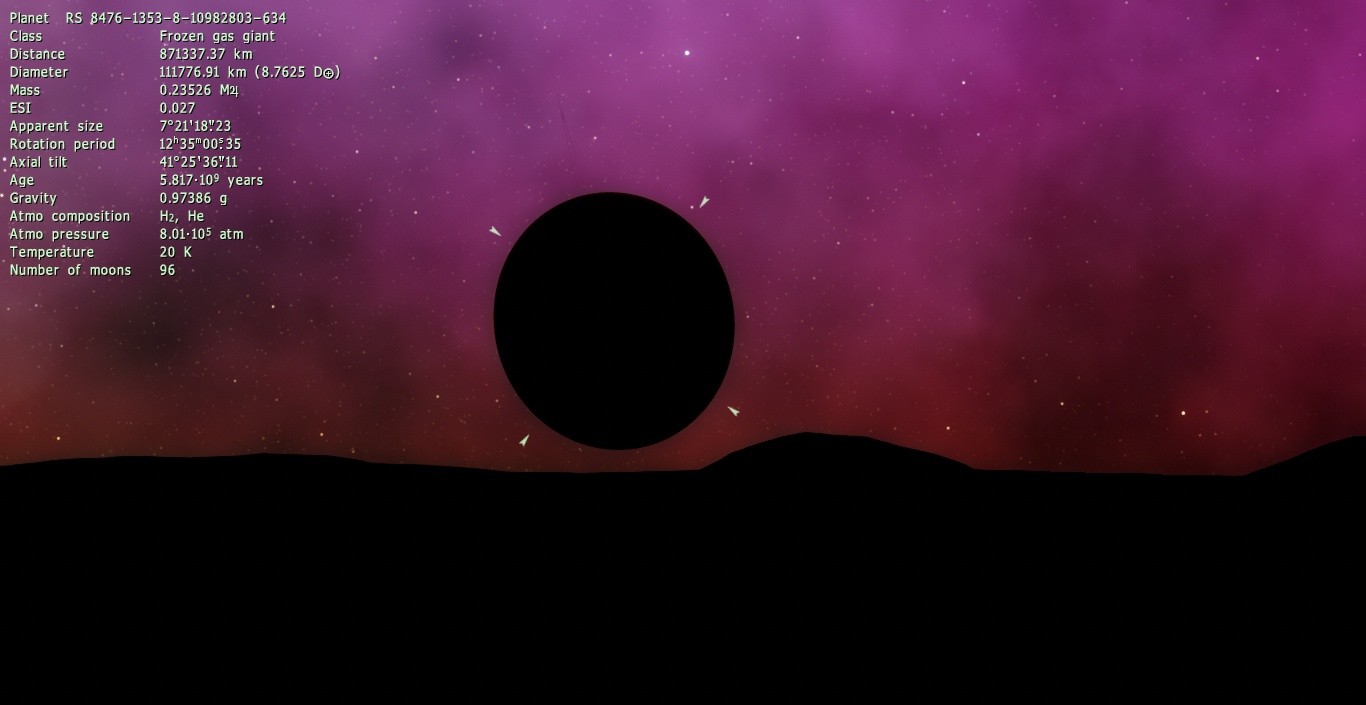
This is planemo (rogue planet). Just a black ball, nothing to see there, if you don't have bright background or don't use ambient lighting.
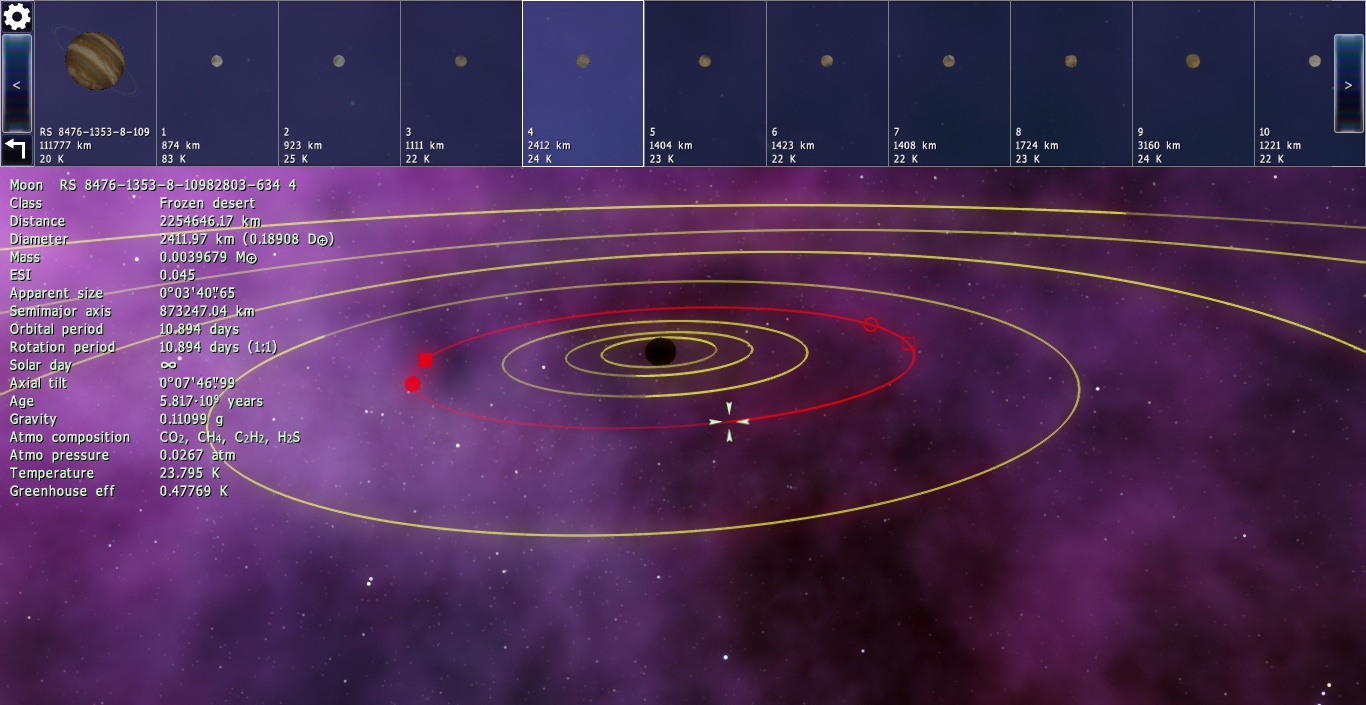
The planetary system without a star is classified as "planemo" (oops localizations must be updated once again...). The planet itself and its moons are called as usual, planet/dwarf planet/moon/dwarf moon. ... And no, SpaceEngine does not support lighting from nebula, nearest stars or other interstellar object.
Solar system browser and Wiki renders previews with some ambient lighting, to be able to see at least something. The same is used in a black hole systems with no accretion disk and other light emitting bodies.
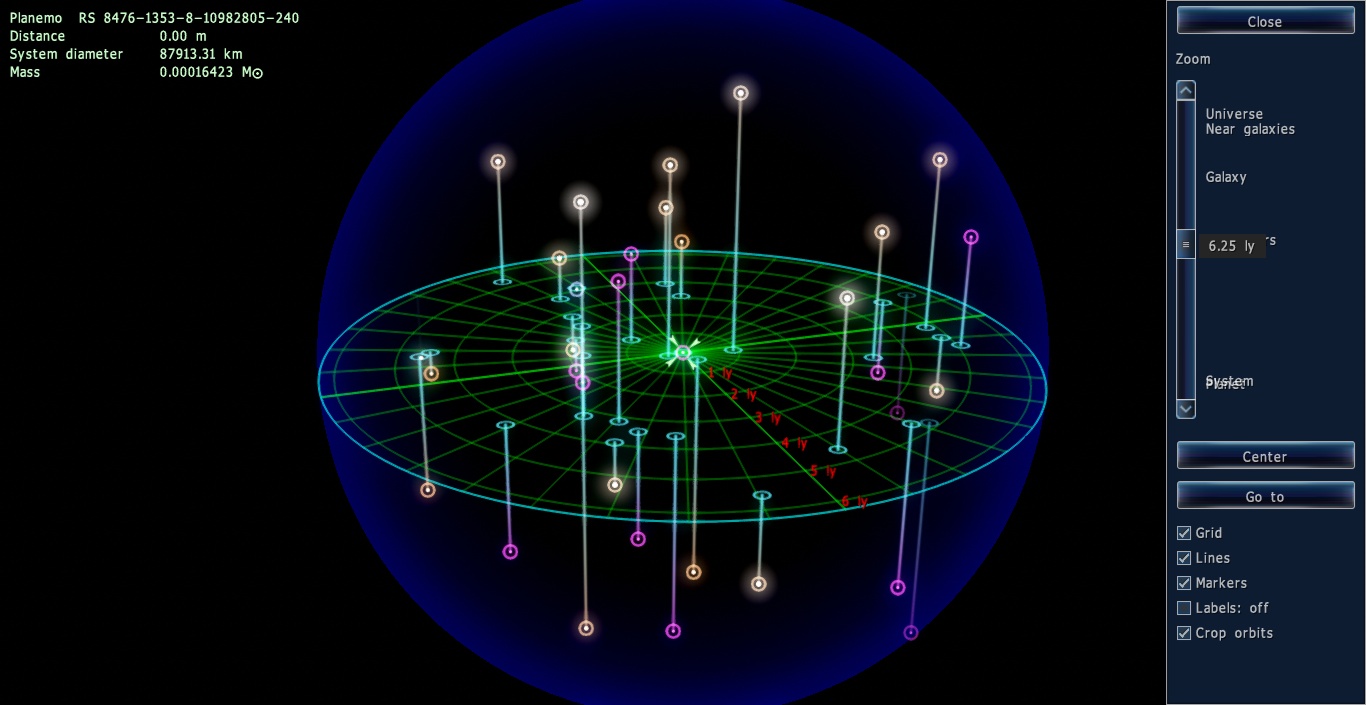
The Map mode shows planemo systems as a pink dots (yeah there are a lot of them, planemos are thought to be as much abundant as stars). As long as planemo have zero luminosity, it could be visible only at highest zoom level (like black hole systems).
The star browser is also updated, it now have options to search planemo, or search in normal star system, ignoring planemo while building a star list (otherwise the list will be spammed with planemo). "P" is a new stellar class representing planemo, it is used in SE scripts to add them.
And yes, scripts supports planemo also. Example code:
Star script:
Code
StarBarycenter "Grom" { RA -111 49 35 Dec -4 22 53 Dist 790 Class "P" }
planet script:
Code
Planet "Gor" { ParentBody "Grom" Class "IceGiant" Mass 16.0 Radius 19200
Now you see what adding some small feature is a huge work. All engine systems affected by that feature must be updated. In this case, they are: Solar system browser, Star browser, Map mode, scripts. And a star classification system. This is not visible to user, but it was a hard task: I completely change the way SE handle star class in the code (the majority of work was done a months ago though, then I added Y brown dwarfs).
This is a total revolution! A lot of people have asked it in the past 1/2 years, and I seriously didn't expected it to be implemented in the next release.
Thank you!
(Unfortunately this leads to an huge number of new bugs, since you've modified the core of the program, I was happy to have a pretty stable version, but I guess I'll just go with it.)
The universe is not required to be in perfect harmony with human ambition.
this is very awesome to be in game, but its gonna be hard to play around them without see nothing :p well...like in real life. but question, i remember about reading that some Rogue planets can still have very hot core and have some little light from them so they wont be full black. is it true?
"we began as wanderers, and we are wanderers still" -carl sagan
Wowowowowowow!! this is awesome Vladimir!!! Thanks thank you a lot. This is great.
I have some things to ask/notice that where discussed here :D
1.- The lower estimate considers around two planemos per main sequence star (so that is accomplished) but there are other estimates that reach even 100.000 planemos per main sequence star. Why these numbers? Is a conservative aproach? (Maybe 10 or 100 would be more accurate).
3.- Not all rogue planets have to be non-illuminated or pitch black. For example a close planetary binary would create inmense heat by the tidal interaction as to melt part of the crust (or a moon near a giant planet) so that it glows. Or maybe lonely giant planemos could have thermal emissión because of internal heat due to radioactive decay or recent formation like the night side of this picture. Maybe lightning could illuminate part of the surface some times (but this is a yet to implement feature I know). 4.- In the new engine's system there can be also trinary planemos? Planemos should follow also the hierarchical structure of multiple-stellar systems. Maybe there are binary rogue planets that orbit other binary for example (a quadruple planemo).
5.- I assume that the perturbations of the nearest objects are neglegible so that the hill's sphere of a plenemo shoould be huge! This means maybe moons with semi-mayor axis of tens of AUs for example. 6.- I suppose that the great mayority of planemos are made of ice and volatiles: if the planemos originated in interstellar space then is obvious and if is an aboject scattered by some planetary system it's quite logical to assume that farther from their stars planets where more commonly scattered (thus many more formed beyond the frost line).
Thank you a lot. I'm so excited. I have so many questions!
Edited by FastFourierTransform - Thursday, 05.05.2016, 17:42
 ENG
ENG New site




 Pirate


 Ireland

 United States
 Slovenia
 France
 Russian Federation





 Italy
Italy 


 Israel
 Spain
Spain