|
Work progress - 0.9.7.2
|
|
| apenpaap | Date: Wednesday, 28.05.2014, 23:15 | Message # 226 |
 World Builder
Group: Users
 Antarctica
Messages: 1063
Status: Offline
| Lava planets!


I occasionally stream at http://www.twitch.tv/magistermystax. Sometimes SE, sometimes other games.
|
| |
| |
| Theorem | Date: Thursday, 29.05.2014, 00:11 | Message # 227 |
 Observer
Group: Newbies
 Germany
Messages: 5
Status: Offline
| That last image.
isthisreallifeorjustfantasea.jpg
Absolutely magnificent.
|
| |
| |
| anonymousgamer | Date: Thursday, 29.05.2014, 00:58 | Message # 228 |
 World Builder
Group: Global Moderators
 United States
Messages: 1011
Status: Offline
| Quote Betelgeuze (  ) will work Frozen or Cold on lava planets?
I'm not sure that's how lava works
Desktop: FX-8350 4.0 GHz, 8 GB DDR3 RAM, EVGA GeForce GTX 1080 FTW 8 GB, 2 TB HDD, 24 inch 1920x1080 screen
Laptop: Core i5 480M 2.66 GHz (turbo 2.93), 8 GB DDR3 RAM, AMD Radeon HD 6550m 1 GB, 640 GB HDD, 17.3 inch 1600x900 screen
|
| |
| |
| Destructor1701 | Date: Thursday, 29.05.2014, 01:45 | Message # 229 |
|
Pioneer
Group: Users
 Ireland
Messages: 533
Status: Offline
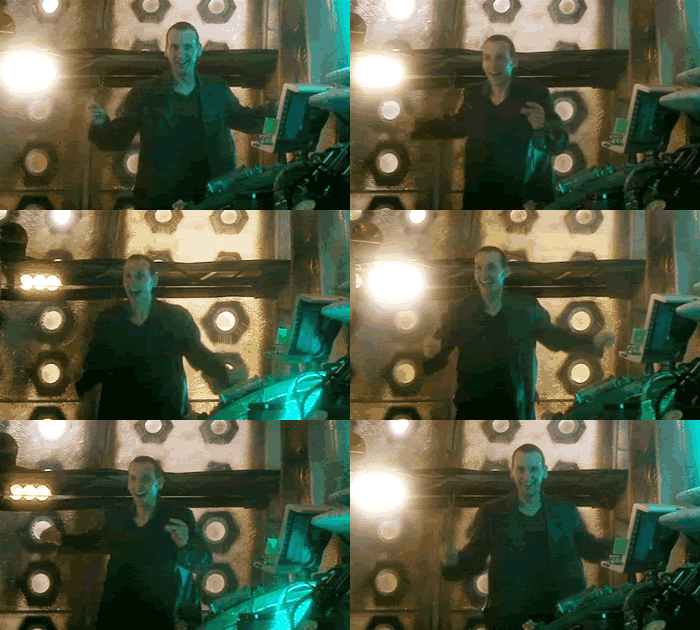
| Well, Earth has lava and ice...
|
| |
| |
| anonymousgamer | Date: Thursday, 29.05.2014, 01:58 | Message # 230 |
|
World Builder
Group: Global Moderators
United States
Messages: 1011
Status: Offline
| Quote Joey_Penguin ( ) I promised myself no more ponies on this thread
Your gif made my reddit post thumbnail that of ponies.
http://www.reddit.com/r....work_in
Desktop: FX-8350 4.0 GHz, 8 GB DDR3 RAM, EVGA GeForce GTX 1080 FTW 8 GB, 2 TB HDD, 24 inch 1920x1080 screen
Laptop: Core i5 480M 2.66 GHz (turbo 2.93), 8 GB DDR3 RAM, AMD Radeon HD 6550m 1 GB, 640 GB HDD, 17.3 inch 1600x900 screen
|
| |
| |
| Destructor1701 | Date: Thursday, 29.05.2014, 02:08 | Message # 231 |
|
Pioneer
Group: Users
Ireland
Messages: 533
Status: Offline
| lol, I was wondering what the heck that thumbnail was!
|
| |
| |
| werdnaforever | Date: Thursday, 29.05.2014, 03:34 | Message # 232 |
 World Builder
Group: Users
 Pirate
Messages: 897
Status: Offline
| 
Finally, and I suppose this means Earth nightlights will follow soon!
|
| |
| |
| FaceDeer | Date: Thursday, 29.05.2014, 04:04 | Message # 233 |
|
Space Pilot
Group: Users
 Canada
Messages: 117
Status: Offline
| Quote werdnaforever ( ) I suppose this means Earth nightlights will follow soon!
And maybe the occasional ultra-rare procedural planet out there with city lights of its own? Could stick the Drake Equation into the game's config file to make those happen.
|
| |
| |
| DoctorOfSpace | Date: Thursday, 29.05.2014, 04:15 | Message # 234 |
 Galaxy Architect
Group: Global Moderators
Pirate
Messages: 3600
Status: Offline
| Quote FaceDeer ( ) Could stick the Drake Equation into the game's config file to make those happen.
The Drake equation isn't really an actual equation with known variables though. All the values for (intelligent) life are completely unknown so anything put is just guessing.
Intel Core i7-5820K 4.2GHz 6-Core Processor
G.Skill Ripjaws V Series 32GB (4 x 8GB) DDR4-2400 Memory
EVGA GTX 980 Ti SC 6GB
|
| |
| |
| werdnaforever | Date: Thursday, 29.05.2014, 04:19 | Message # 235 |
|
World Builder
Group: Users
Pirate
Messages: 897
Status: Offline
| Quote FaceDeer ( ) And maybe the occasional ultra-rare procedural planet out there with city lights of its own? Could stick the Drake Equation into the game's config file to make those happen. smile
Well, the Drake equation isn't really defined or definable, and procedural civilizations aren't going to happen for a while, if they are even feasible for SE.
I'd also like to bring up bio-luminescence- you could have "night lights" from planets covered with forests of bio-luminescent plants, etc.
|
| |
| |
| FaceDeer | Date: Thursday, 29.05.2014, 05:12 | Message # 236 |
|
Space Pilot
Group: Users
Canada
Messages: 117
Status: Offline
| Quote DoctorOfSpace ( ) The Drake equation isn't really an actual equation with known variables though.
That's why it'd be in the config, you could set the parameters to whatever you felt reasonable. Just like you can already modify the odds of life arising under various conditions.Added (29.05.2014, 08:12)
---------------------------------------------
Quote werdnaforever ( ) I'd also like to bring up bio-luminescence- you could have "night lights" from planets covered with forests of bio-luminescent plants, etc.
How about phosphorescent minerals glowing on a pulsar planet or some other extreme radiation environment? Like landbound aurorae. That was what I thought might be happening on one of the lava world images posted above until I realized it was probably just clouds reflecting other light sources.
|
| |
| |
| FastFourierTransform | Date: Thursday, 29.05.2014, 14:38 | Message # 237 |
 Pioneer
Group: Local Moderators
 Spain
Spain
Messages: 542
Status: Offline
| Quote SpaceEngineer ( ) What I am currently working on:
If that is what a lazy couch potato does  I'm gonna suicide. This is amazing, thank You Space Engineer!!! I'm gonna suicide. This is amazing, thank You Space Engineer!!!
I want to collaborate to improve those textures and make very different lava planets, but sadly I don't know how to do this things 
I can maybe help you with some suggestions and with inspiring images of realistic space artists views of lava planets. They also show gigantic volcanic eruptions (maybe for future improvements of SE )
I think a planet with high volcanic activity would have a thiker athmosphere (even if it's too small to retain one normally) and would (in principle) have a cloudy whether (cloudy because of piroclastic clouds xD). Like this images:
http://m1.behance.net/renditi....c7f.jpg
http://m1.behance.net/renditi....51b.jpg
Also is important, for variety (and I think different lava worlds has to be done to be a fully explorable addon), the fact that there are different cuantities of lava in each planet.
For example, there are planets that have only some cracks in its crust or maybe only a few spots with lava and volcanic activity while the rest of the surface remains identical, like this ones:
http://fc06.deviantart.net/fs71....ngo.jpg
http://in3xplicit.deviantart.com/art/SCAR-QHD-383310931
http://fc03.deviantart.net/fs71....n1w.jpg
http://fc06.deviantart.net/fs33....d3r.jpg (this is beautifull because of the ring system)
http://fc04.deviantart.net/fs71....ooa.jpg
Moreover, there has to be planets with all of it's surface covered by lava, I mean planets that are like Oceanias but instead of water they have lava, like these:
http://fc04.deviantart.net/fs71....xc3.jpg (also with beautifull rings)
http://fc03.deviantart.net/fs71....egd.jpg (in the sky of one of it's moons maybe)
http://fc04.deviantart.net/fs71....zxn.jpg (this one it's only a half "Lava Oceania" but represent what I mean)
Also there would be intermediate lava worlds whith lava not covering the whole surface and not been a particular feature of some region, like that I can see in your fantastic images, with "land islands" inside a see of magma. Like there interesting textures:
This image has an ultra-detailed texture (also for the night side): http://fc04.deviantart.net/fs71....wwo.jpg
This has been created procedurally with Terragen 2: http://fc01.deviantart.net/fs71....wp3.jpg
Look at that amazing lava-moon system: http://fc05.deviantart.net/fs70....zcd.jpg
We can say that there are at least 3 phenomena that create lava planets, and different phenomena make different planets;
In the first case you have lava planets because of their recent formation (they are still bombarded by small bodies). The second class is obvius, planets that are extremly close to their stars so the crust has melted and in the third class we have moons or planets that are near the roche limit and start to heat themselves by gravitational tidal forces (like Io on Jupiter).
In the first class, the amount of lava has to be inverse proportional to the age of the system (if the planet is older it would be less bombarded and colder so the lava would not cover the entire surface).
In the second class, we can associate the amount of lava with the distance to the star. Less distance to the star --> hotter planet ---> more surface area covered by lava. But also we have to associate other characteristics, the lava in a hotter planet has to glow in other wavelengths (because of the black body radiation).
So, planets that are suficiently far don't only have less lava (in statistical terms) but also the color of the lava has to be in the red like this picture: http://fc00.deviantart.net/fs21....d3r.jpg
Meanwhile in a planet closer to the star, the lava has to be more yellow (like this: http://fc01.deviantart.net/fs71....y1.jpg) and a planet even hotter and closer to the star can have the rocks melted in a way that they glow in a yelowish-white. These planets are so close to the star that they have to be all covered by the same homogeneus bright color, except when the planet is tidally locked (at this distance many would be). In that case one face has to have a gradient from white to yellow to red lava until we surpass the terminator (when the day becomes night) and then in the night side, without lava, a bit like this: http://sos.noaa.gov/ftp_mir....big.jpg
We have to think also in other interesting posibility. A planet with a high excentric orbit around a star could be a normal planet in the aphelion but when in comes closer to the perihelion it could become hotter until it started to melt the surface rocks. Then the planet cools down and the lava stops to glow in every orbit (long period for that to happen).
These is maybe more complex than the other suggestions but also interesting;
Immagine the geological structures of a lava planet. The "islands in the lava" would be covered with a landscape of molten rocks and mountains more or less like this: http://fc03.deviantart.net/fs23....ere.jpg
Maybe with some magma rivers in beetween
And I have an other suggestion
BLUE LAVA!!!!! like that created by molten sulfur. I have talked about it in this post http://en.spaceengine.org/forum/21-11-39719-16-1397404807
It would be amazing to see a planet with red and yellow lava all over the surface and some blue lava in some regions of the planet with high levels of sulfur (like in Indonesia, where this images are taken).
I know there are too many suggestions, but i love what you have done and I think it dosen't require much additional effort to make this thing perfect!! with some details like different amounts of surface covered by lava 
Thank you so much for your work. I would be happy if someone can discuss what I have said here and add some suggestions to this new feature of Space Engine.
Edited by FastFourierTransform - Thursday, 29.05.2014, 14:43 |
| |
| |
| spacer | Date: Thursday, 29.05.2014, 14:40 | Message # 238 |
 Star Engineer
Group: Users
 Israel
Messages: 1258
Status: Offline
| but why the lava on the planet is lines? and there is squares with not lava?  
edit: island land! I enjoyed to read your reply FastFourierTransform!
"we began as wanderers, and we are wanderers still"
-carl sagan
-space engine photographer
Edited by spacer - Thursday, 29.05.2014, 14:52 |
| |
| |
| JCandeias | Date: Thursday, 29.05.2014, 14:56 | Message # 239 |
 Pioneer
Group: Translators
 Portugal
Messages: 387
Status: Offline
| Quote FastFourierTransform ( ) I think a planet with high volcanic activity would have a thiker athmosphere (even if it's too small to retain one normally) and would (in principle) have a cloudy whether (cloudy because of piroclastic clouds xD).
Not really. Just look at Io: almost no atmosphere at all.
In fact, the presence of atmosphere and how thick it is is always a question of balance between the rate at which gases (and which gases) are lost to space due to stellar fluxes and the rate at which gases are internally produced by whatever means the planet has in operation, volcanism being only one of them (although arguably the most important, especially in the earlier stages of formation). Smaller bodies will have little to no atmosphere regardless of how volcanic they are, since their gravity isn't strong enough to hold on to any of the volcanic gases. It's a bit more complex than this, since it also depends on radiation-driven molecular dissociation, but you get the idea.
Quote FastFourierTransform ( ) And I have an other suggestion
BLUE LAVA!!!!!
That's what his second to last image is showing, I believe.
They let me use this!
|
| |
| |
| spacer | Date: Thursday, 29.05.2014, 15:01 | Message # 240 |
|
Star Engineer
Group: Users
Israel
Messages: 1258
Status: Offline
| Quote JCandeias ( ) That's what his second to last image is showing, I believe.
no, its clouds
"we began as wanderers, and we are wanderers still"
-carl sagan
-space engine photographer
|
| |
| |
 ENG
ENG New site


 Antarctica


 Germany
 United States
  Ireland
  Pirate
  Canada
 Spain
Spain  Israel
 Portugal