Make sure that your bugs are not on the following list of known issues. You can use your browser's word finder to help search the list.
If the bug is not on the list then please post it in this thread. Attach to your message a screenshot (if possible) and a log file (it's called the "se.log" and is located in the system folder of SpaceEngine's directory). Only the log file will help me to understand your problem and find a solution.
Known Issues
Green items have been fixed for the next release
- Star catalog have many errors in star classification, so there are many "giant dwarfs" and "dwarf giants". - Many real binary stars rendered as single, and many single rendered as binary. This is not a bug. - Ships do not render in the interstellar space - Ships do not render in systems belonging to a star cluster and displayed as "Interstellar" - Few issues with asynchronous loading (stars don't always generate properly, especially when flying to new galaxies) - Holes in some giant stars when camera is directly above a very tall spot [example] - Impossible to find very dim objects (like stellar remnants) in the map mode - Star browser does not detect stars belonging to the central galaxy star cluster and some globular cluster stars - Star browser is not effective at detecting halo stars - In the Map mode, Star browser performing search around camera position, not around the map center - Star browser sometimes shows incorrect star multiplicity data - Flashing landscape LOD on a planet when Wiki for it is displayed - Unfinished text editor for descriptions - When transition from lens flare to star flare begins, the star point turns black and shines through flares/objects when using star style "points". Examples: [1][2] - Unable to select something with cursor for several seconds after repeated clicks sometimes - Star clusters not displayed in Wiki - GUI response issues with some users (interface items glitchy or not respond easily) - GUI toolbars may completely disappear when pressing pin button while half-hidden - Digital value/edit field in planet editor may completely disappear sometimes - Music player doesn't work - Deep space objects (e.g. stars, galaxies) will shine through planets when HDR for DSO is off, but HDR is on and Bloom is on [example] - Comet nucleus star-sprite will shine through planets [example] - Aurora radius limited to planet radius (not a bug, just catalog parameter limitation) - Some neutron stars can have very low temperatures [example] - Flickering flare color in close binary systems [example] - Bugs with some catalog planets with textures from files when using the Editor [example] - Dwarf planets not only generated in asteroid belts - Sunspot distribution is not always realistic - Auto-exposure does not react when a sun is blocked while diffraction spikes are set to normal or super - Planet rings have an unrealistic color palette - "Eclipse bug" on distant planets (weird dark shimmering on outer planet caused by inner planet crossing the sun or two suns eclipsing) - Rounding errors (e.g. 30° in catalog rounds to 29°59'59.99" displayed on HUD) - Shimmering bloom splotch when very close to the surface of a gas giant [example] - Setting StarProcBifurcation to false in the universe config disables generation of all multi-star systems, including procedural - Planets with life are not generated in single-star systems - Cloud cyclones have cut edges sometimes - Galaxy/nebula sprites will rotate when seen from certain angles. This is not a bug. - Level horizon command (End key) doesn't work properly on oblate objects - FOV ignored when choosing default camera position in game mode - Problems when releasing Left+Right click - Solitary brown dwarfs are not generated - The primary planet of a barycenter displays one too many satellites in the Wiki - Wiki displayed luminosity of the Sun as 0.9 - Some bugs with exported surface maps - Auroras and rings can be rendered in front of ships/moons sometimes - Comet tails can be rendered in front of ships/planets - Lens flares are distorted by gravitational lensing (black holes) - Lines or junctures are visible on planetary surface - Problems with shaders loading (disappearing of water, eclipse shadows, etc) - Weird behaviour of Shift-G with star clusters - Switching to fullscreen doesn't work sometimes - Procedural landscape uses only snow detail textures - VSync mode is always Auto (2)
Edited by HarbingerDawn - Monday, 30.09.2013, 22:45
I spotted this while looking around a challenge galaxy. If the secondary planet of a barycenter has life, the primary planet doesn't show the moon as having life on it. This one might be an old bug or may just be an oddity of the way barycenters work.
This is a bug, it has been fixed.
Quote (neutronium76)
When the solar system is in the field of view, the comet is visible: but it is not rendered when the solar system is out of the field of view:
Of course. Any planetary system in SE have a certain bounding radius, for clipping. If sphere with this radius is outside the screen, system does not render. If system is so far away that sphere is smaller than one pixel, it does not generate and render. But this comet have a hyperbolic orbit, so it may pass the bounding sphere surface and go into interstellar space. SE can't handle such objects directly. And this have no purpose - at large time scales the comet must be affected by a gravity of neighboring stars and become a part of their systems. SE can't model this.
Quote (smjjames) I spotted this while looking around a challenge galaxy. If the secondary planet of a barycenter has life, the primary planet doesn't show the moon as having life on it. This one might be an old bug or may just be an oddity of the way barycenters work.
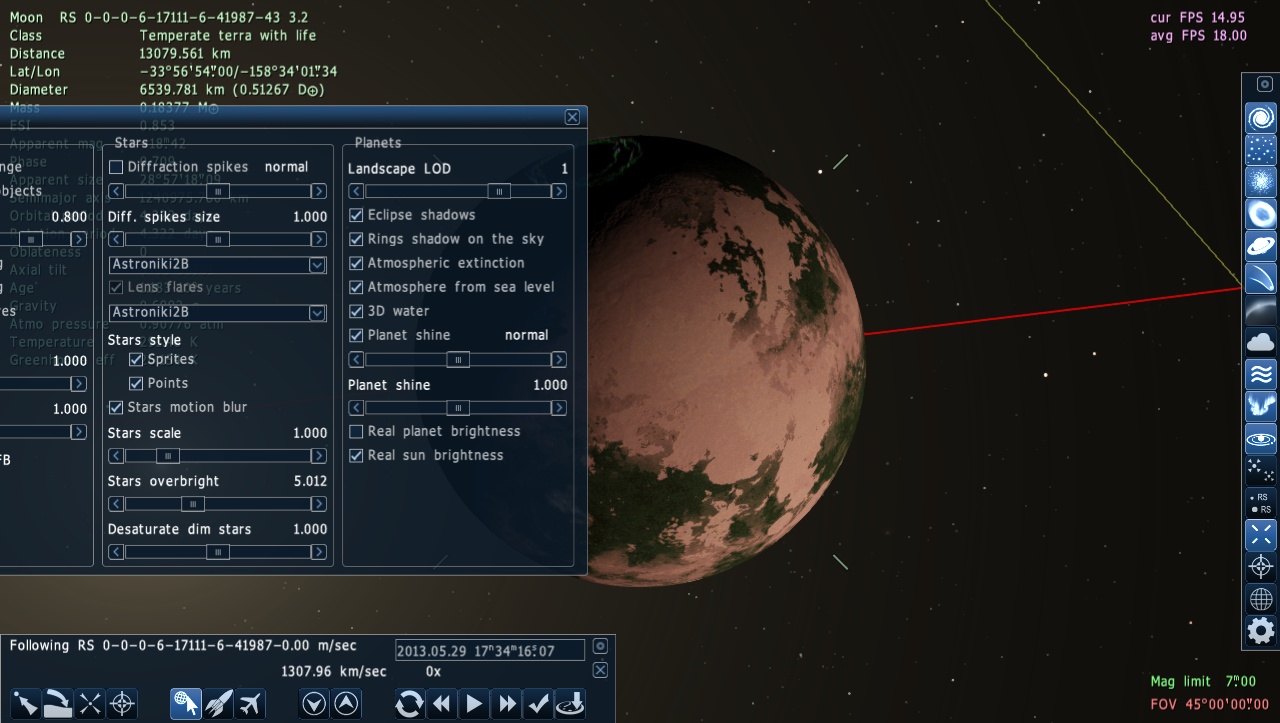
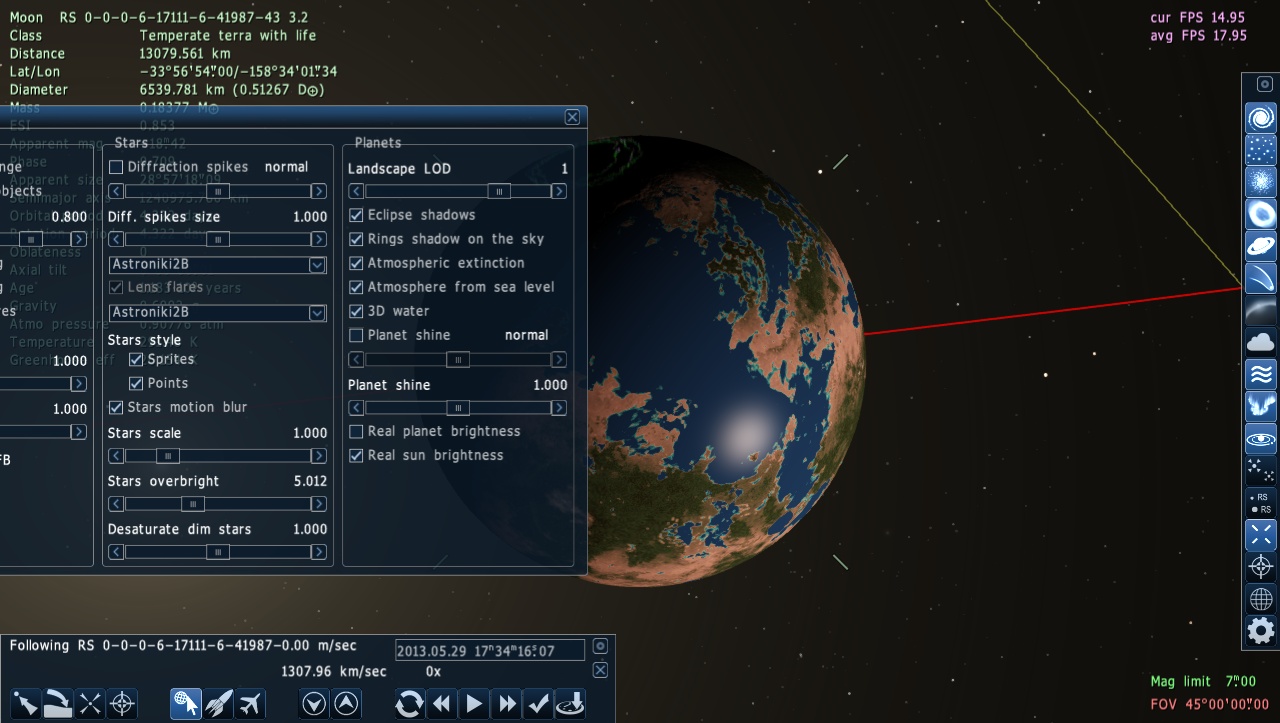
Sometimes I like to turn the atmosphere off to see the landforms better (especially if it's a hazy atmosphere) and I noticed that the water was dissapearing as well. In checking it out a bit deeper, it seems to have something to do with planet shine.
It is a bug in the shader manager. SE uses wrong shader sometimes.
This one is probably old (got it in 0.9.6 as well), but I wonder why stars have started to disappear in the background when I look at suns and planets real close.
Intended feature. When looking at a sun/planet in real life, the light would cause the camera to lower the exposure so the planet/star doesn't look washed out, thus as a consequence making stars too dim to see. It's similar to walking inside a building after being outside on a sunny day. Notice how dim everything looks for a couple minutes?
Also why the Moon Landing photos have no stars in the background.
Intended feature. When looking at a sun/planet in real life, the light would cause the camera to lower the exposure so the planet/star doesn't look washed out, thus as a consequence making stars too dim to see. It's similar to walking inside a building after being outside on a sunny day. Notice how dim everything looks for a couple minutes?
Also why the Moon Landing photos have no stars in the background.
Before when I watched a sun, I could see planets behind...
Okay..... I just had something really wierd happen.
I was at this location posted below checking out a crater when I noticed that the crater rim and mountains were being transparent in that the primaries shone right through them at sunset/rise as if the crater rim and mountains didn't exist, saved that spot as the location so I could come back to it, looked around for a normal mountain range on that planet. Found one, landed, and checked and it was working fine.
Then I exited SE for whatever reason (to clear memory maybe) and when i came back, there was absolutely nothing there, the object simply vanished. Place "Moon Temperate terra with life" { Body "RSC 0-7-1385623-456-6488-0-0-276 1.3" Parent "RSC 0-7-1385623-456-6488-0-0-276 1" Pos (3.133593113723715e-011, -3.303210352814667e-012, 1.267805738321658e-010) Rot (-0.6195099236181922, -0.6932463937410089, -0.308189762973976, -0.2015836355007826) Date "2013.12.12 02:42:01.39" Vel 3.2407764e-015 Mode 2 }
This is what i found to actually be at the system coordinates, a completely different system.
The last time I remember having this glitch is when I found a frozen terra with life, then when I tried to come back to it, it was replaced with something else. Wierd glitch whatever this is O.o
Also, should have saved the SE log, sorry, then again, I didn't even know it was going to happen.
Added (02.06.2013, 00:56) --------------------------------------------- In a separate bug report, looks like the bug mentioned back here: http://en.spaceengine.org/forum/26-705-13792-16-1351289359 hasn't been 100% squashed. The bug here though might be that the cluster is so tiny, 0.419 parsecs in diameter.
I couldn't replicate the effect for the system as a whole, but it's visible when moving around while looking at one of the planets or moons.
Place "returned glitch" { Body "RSC 0-7-1385623-456-6165-0-0-5 1.1" Parent "RSC 0-7-1385623-456-6165-0-0-5 1" Pos (5.353341229509534e-011, 3.812963367353511e-011, 9.609643696019063e-011) Rot (0.6519705928397682, -0.2928792877855305, 0.03894159733695155, -0.6983119796017024) Date "2013.06.01 20:50:00.06" Vel 1.1068067e-011 Mode 1 }
Nope, I changed it to interleaved after I had those initial problems related to asynchronous loading when I installed 0.97.
Added (02.06.2013, 02:43) --------------------------------------------- DAMMIT, It happened again. I was on a planet moving around a bit and trying to get a shot right and the scenery was still busy loading when SE crashed. When I returned, the system had vanished (object not found).
Also, there were a few times while I was hunting around for the challenge that SE froze up and became unresponsive and the only way I could shut it down was to end proccess, could I have messed something up? I didn't seem to have that problem with the challenge galaxy though.
Edit: Both of those times, the locations were inside an open cluster, no idea if that is coincidence though with only two of these that happened.
Also, there were a few times while I was hunting around for the challenge that SE froze up and became unresponsive and the only way I could shut it down was to end proccess, could I have messed something up? I didn't seem to have that problem with the challenge galaxy though.
Did you use Star browser before? I fixed the cause of great slow-down then using SB in the dense parts of the galaxy (ie star clusters).
Intended feature. When looking at a sun/planet in real life, the light would cause the camera to lower the exposure so the planet/star doesn't look washed out, thus as a consequence making stars too dim to see. It's similar to walking inside a building after being outside on a sunny day. Notice how dim everything looks for a couple minutes?
Also why the Moon Landing photos have no stars in the background.
You can also test looking up at the night sky, and hold a flash light and let the light hit your eyes. Not many stars can be seen.
Quote (smjjames) Also, there were a few times while I was hunting around for the challenge that SE froze up and became unresponsive and the only way I could shut it down was to end proccess, could I have messed something up? I didn't seem to have that problem with the challenge galaxy though.
Did you use Star browser before? I fixed the cause of great slow-down then using SB in the dense parts of the galaxy (ie star clusters).
Yeah, that was while I had been using the star browser in that challenge galaxy. However, the galaxy in this case was a large elliptical (100kp I think) and I was still pretty much on the outskirts. I was using a search of 100 parsecs and in the later stages of my search, the SB varied between 300-500 or something like that.
Although for the two cases where the system unexpecedly dissapeared, I did use the star browser before the first one but not the second.
Since this isn't an 'asking for help' post, I guess I could post this crash report here.
While going around open clusters pretty close to the core of this galaxy (between 5k and 2800 parsecs), I had noticed that sometimes while in clusters, I would get a massive FPS drop from my normal FPS of around 30-40 (sometimes 20s) to averaging 1-3 FPS. It seemed sort of random, almost every other cluster or two. I didn't check the distance of every cluster from the core, so I don't know if that is a factor.
When I had gone to what might have been the closest (2,800 parsec from core), I was having the heavy lagspike as usual and was trying to ride it out as it just sort of spontaneously goes away, so I was looking around trying to find a good triple star system when SE crashed from the lag.
However, when I started SE back up, the FPS was fine.
Oh yeah, I'm seeing the object not found in the journey log from some systems I visited. So, there's something going on with clusters. There's also something interesting, the journey log coordinate boxes (that you select) for the selected star system with planets that dissapeared and the system above it both say that they are triple systems, yet the infobox says a different star luminosity and they're binary.
One thing I'm noticing is that while systems outside star clusters are fine, stars inside clusters are screwed up (at least most of the ones I visit anyway).
I did some testing by clearing out the cache to see what would happen, the star I have in the example changed, then I went to a distant cluster, restarted and the star system had changed again. I went to that particular star (now a white giant), restarted and it didn't change. Then I went some way distance away (was double checking on stars outside clusters) and somehow it seems to have locked into that and didn't change even though I restarted. The other triple system in the log in the screenshot also seems to have settled as a single A2 V star.
Since it's already messed up for me, could someone check that star coordinate and see what is there, for SCIENCE!
To summarize, there is something screwy going on with star clusters, and I have the loader mode on interleaved.
Edit: Just adding an observation note that Globular clusters are unaffected.