|
Totally off-topic thread
|
|
| midtskogen | Date: Sunday, 10.03.2013, 06:26 | Message # 691 |
 Star Engineer
Group: Users
 Norway
Messages: 1674
Status: Offline
| Quote (Watsisname) edit: For clarity, it is silly to say 'someone will be correct' because nobody is claiming a unique value,
Why do you need a unique value to make a prediction? Except that a prediction gets pointless if it doesn't exclude anything, and that would not be science.
Quote (Watsisname) and 'the right reasons' is silly because there is inherent uncertainty involved in these types of predictions.
If "inherent uncertainty" means that you can't make a prediction, but you still do, then you break one of the primary rules of science, that it must be possible to falsify your claims. You're of course allowed to define some conditions, meaning that you can say that if CO2 gets within a certain and other things stay roughly the same, you will get at least and at most this and that temperature rise. If you got a temperature drop instead after a comet hit Earth, you weren't wrong, we just didn'y get the chance to find out. And those who claimed that there would be a temperature drop and didn't mention the comet, weren't proved right either.
NIL DIFFICILE VOLENTI

|
| |
| |
| Watsisname | Date: Sunday, 10.03.2013, 07:57 | Message # 692 |
 Galaxy Architect
Group: Global Moderators
 United States
Messages: 2613
Status: Offline
| It is incorrect to describe predictions of future warming as bunch of people coming up with different numbers, therefore it's not a matter of someone getting it right and someone else getting it wrong. Fifty years from now I won't be able to point and say "that scientist was right!" or "that scientist was wrong!". Rather, I would say "this value is where climate sensitivity appears to fall, and this emissions scenario was followed instead of that one."
Quote If "inherent uncertainty" means that you can't make a prediction, [etc]
It does not mean this at all. If you do not understand why, then reread what I said about the contributing factors for these types of predictions.

|
| |
| |
| midtskogen | Date: Sunday, 10.03.2013, 12:34 | Message # 693 |
|
Star Engineer
Group: Users
Norway
Messages: 1674
Status: Offline
| Quote (Watsisname) It does not mean this at all.
Of course not, but you said something about having right reasons being silly when there are inherent uncertainty. If we in 50 years can know what the sensitivity is with reasonable confidence given the emission scenario that was followed, I think would be useful to investigate which models were able to predict it, and whether the reasons were right (e.g. they assumed the emission scenario that happened, they didn't simply roll a dice, etc). We don't scrap a model if it passes a test thinking that we don't need it anymore since we know the answer anyway. We would use it to make new predictions. I don't think this is what you meant, so care to elaborate on the silliness go "right reasons"?
NIL DIFFICILE VOLENTI
|
| |
| |
| Watsisname | Date: Sunday, 10.03.2013, 14:34 | Message # 694 |
|
Galaxy Architect
Group: Global Moderators
United States
Messages: 2613
Status: Offline
| Okay, I'll go over it again.
Quote I think would be useful to investigate which models were able to predict it, and whether the reasons were right (e.g. they assumed the emission scenario that happened,
I have underlined the parts where you are having misconceptions.
Researchers aren't coming out with unique predictions/models in the manner you have described. Nobody is making assumptions on what emissions scenario will be, or what the climate sensitivity is exactly. Rather, we are stating what the collective range of possible outcomes may be, depending on the uncertainty in these factors.
This is why you should not say "with so many predictions of how the climate will be in 100 years, somebody will be correct." -- because there are not different people with different predictions.
And why you should not ask if they were 'correct for the right reasons' -- because the reasons are inherently not precisely knowable. Do you know what the future of fossil fuel consumption will be? Neither do I. So, rather than making specific predictions based off assumptions for these things, we treat them collectively with the uncertainty, and show what the range of outcomes are as a result of these possibilities. The result is +2 to +5 degrees C by 2100, provided some enormously unexpected turn of events does not occur.
Is this understandable? I honestly do not think I can describe this any more clearly than that. Let me know if you still have questions.
Edited by Watsisname - Sunday, 10.03.2013, 14:38 |
| |
| |
| midtskogen | Date: Sunday, 10.03.2013, 15:45 | Message # 695 |
|
Star Engineer
Group: Users
Norway
Messages: 1674
Status: Offline
| Quote (Watsisname) This is why you should not say "with so many predictions of how the climate will be in 100 years, somebody will be correct." -- because there are not different people with different predictions.
Now I begin to wonder if you believe in some kind of scientific canon. But science is full of different people proposing different hypotheses with different and conflicting predictions/implications. Like the origin of the continents, of the Moon, age of the world, etc. If you have a model of the world, and for one set of inputs you got 42, while for another set of inputs, which also was what nature later happened to choose, you got 2.718281828, then I'm not saying that the parts of the model that was involved in producing the number 42 were wrong. Is that how you understood me?
NIL DIFFICILE VOLENTI
Edited by midtskogen - Sunday, 10.03.2013, 15:45 |
| |
| |
| Watsisname | Date: Sunday, 10.03.2013, 18:33 | Message # 696 |
|
Galaxy Architect
Group: Global Moderators
United States
Messages: 2613
Status: Offline
| I meant it is not as if there is one group claiming 2°, another group claiming 5°, etc. Or did you mean predictions significantly different than this range, in which case if you know of relevant peer-reviewed articles I'd love to see a link?
As for if I believe in some scientific 'canon'... well, I'd say I tend to go by consensus. It may be wrong, and it's good to investigate other ideas, but until compelling evidence arises to support such a change then I'm probably not going to do so.
Quote If you have a model of the world, and for one set of inputs you got 42, while for another set of inputs, which also was what nature later happened to choose, you got 2.718281828, then I'm not saying that the parts of the model that was involved in producing the number 42 were wrong. Is that how you understood me?
Ok, and yeah it did originally strike me that way. Glad to have this cleared up.
Edited by Watsisname - Sunday, 10.03.2013, 19:18 |
| |
| |
| midtskogen | Date: Sunday, 10.03.2013, 20:41 | Message # 697 |
|
Star Engineer
Group: Users
Norway
Messages: 1674
Status: Offline
| Quote (midtskogen) I meant it is not as if there is one group claiming 2°, another group claiming 5°, etc. Or did you mean predictions significantly different than this range, in which case if you know of relevant peer-reviewed articles I'd love to see a link?
I think we've cleared up that now. You mean papers claiming sensitivity outside the IPCC likely range? Google gave me these:
Richard Lindzen: 0.6 to 1.0 C (Asia-Pacific Journal of Atmospheric Sciences, 2011)
Andreas Schmittner: 1.4 to 2.8 C (Science, 2011)
James Annan, using two techniques: 1.2 to 3.6 C and 1.3 to 4.2 C (Climatic Change, 2011)
J.H. van Hateren: 1.5 to 2.5 C (Climate Dynamics, 2012)
Michael Ring: 1.5 to 2.0 C (Atmospheric and Climate Sciences, 2012)
Julia Hargreaves, including cooling from dust: 0.2 to 4.0 C and 0.8 to 3.6 C (Geophysical Research Letters, 2012)
But we strictly don't need to stop there. The list could be long if we include it all the way to, say, the man in the pub down the street who insists that the equator will freeze over within 100 years. Who may serve to illustrate my "right reasons" point. Even if the equator does freeze over, I highly doubt that it will have anything to do with that man's explanation for it.
Quote (Watsisname) As for if I believe in some scientific 'canon'... well, I'd say I tend to go by consensus.
A canon gets fixed once and for all. A scientific consensus must change, but then, there can't be a strict consensus, can it?
Edit: if everybody goes by the consensus, it would become a canon, so you defenitely need a "tend" there.
NIL DIFFICILE VOLENTI
Edited by midtskogen - Sunday, 10.03.2013, 20:48 |
| |
| |
| Watsisname | Date: Monday, 11.03.2013, 06:04 | Message # 698 |
|
Galaxy Architect
Group: Global Moderators
United States
Messages: 2613
Status: Offline
| Actually I was referring to temperature change by 2100, but climate sensitivity is fine, too. And actually most of those estimates are fairly close or within the low side of IPCC estimates. Climate sensitivity estimates peak at ~3°C but there is a sharp tail on the low side and a very long tail at the upper side.
|
| |
| |
| Spyro | Date: Monday, 11.03.2013, 20:10 | Message # 699 |
 Explorer
Group: Users
United States
Messages: 162
Status: Offline
| Sorry I have been offline for almost a week, I was very sick. Anyway, are you guys talking about comets?
I'm back, but am I here to stay? Hopefully!
|
| |
| |
| HarbingerDawn | Date: Monday, 11.03.2013, 20:39 | Message # 700 |
 Cosmic Curator
Group: Administrators
United States
Messages: 8717
Status: Offline
| Quote (Spyro) Sorry I have been offline for almost a week, I was very sick. Anyway, are you guys talking about comets?
As you can plainly see, they're talking about global warming (again).
All forum users, please read this!
My SE mods and addons
Phenom II X6 1090T 3.2 GHz, 16 GB DDR3 RAM, GTX 970 3584 MB VRAM
|
| |
| |
| Watsisname | Date: Monday, 11.03.2013, 23:18 | Message # 701 |
|
Galaxy Architect
Group: Global Moderators
United States
Messages: 2613
Status: Offline
| It's okay, I'm about as done with talking about it as everyone else is done with hearing it.
|
| |
| |
| DoctorOfSpace | Date: Tuesday, 12.03.2013, 03:06 | Message # 702 |
 Galaxy Architect
Group: Global Moderators
 Pirate
Messages: 3600
Status: Offline
|

Intel Core i7-5820K 4.2GHz 6-Core Processor
G.Skill Ripjaws V Series 32GB (4 x 8GB) DDR4-2400 Memory
EVGA GTX 980 Ti SC 6GB
|
| |
| |
| Watsisname | Date: Tuesday, 12.03.2013, 04:18 | Message # 703 |
|
Galaxy Architect
Group: Global Moderators
United States
Messages: 2613
Status: Offline
| I'm just glad most of those are shoops.
...
Right? 
|
| |
| |
| Spyro | Date: Tuesday, 12.03.2013, 21:14 | Message # 704 |
|
Explorer
Group: Users
United States
Messages: 162
Status: Offline
| I hope.
I'm back, but am I here to stay? Hopefully!
|
| |
| |
| werdnaforever | Date: Wednesday, 13.03.2013, 05:25 | Message # 705 |
 World Builder
Group: Users
Pirate
Messages: 897
Status: Offline
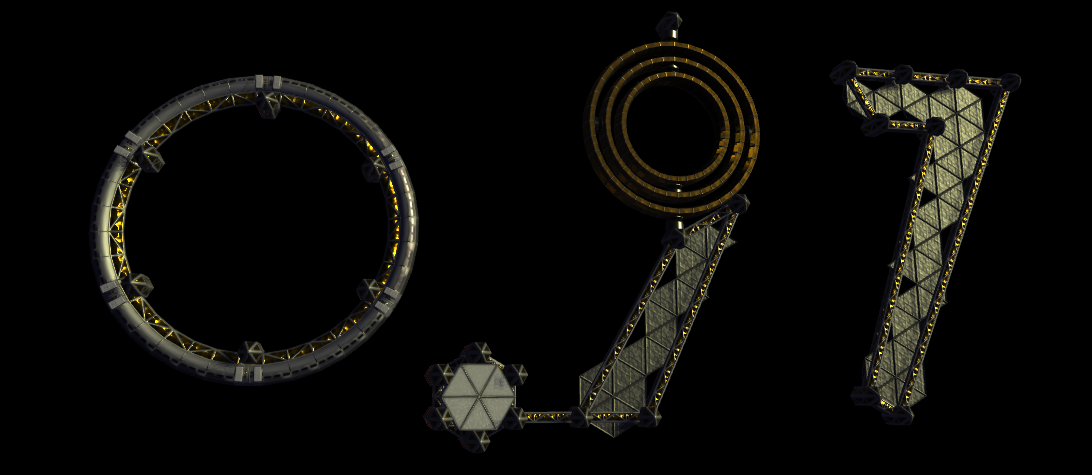
| This asymmetrical design isn't very realistic, but I think it's kind of interesting.

Laugh out loud!
|
| |
| |
 ENG
ENG New site


 Norway


 United States
 Pirate