Watsisname, In my region we also see that the rate of heat waves are going up. this week we have +8c anomaly. there is so many heat waves in the recent years. much more than decades ago. so no just hotter days on average but also more heat waves here. i think its the one before the last article you posted
"we began as wanderers, and we are wanderers still" -carl sagan
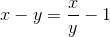
Nice algebra challenge. The answers (plural) are indeed quite simple.
I'm not too good at factoring, so at first I missed seeing that trick and instead just brute forced it with the quadratic formula. It's not as elegant, but since the equation is quadratic in y, the quadratic formula is guaranteed to work.
Probably the most expedient way to solve it is to get a common denominator of y on the right hand side:
and then multiply by y:
Looking at this logically, the equation is true if y=1 (so that x-y=x-y). The equation is also true if x-y equals zero, which then means that y=x.
QuoteHornblower ()
P.S. Watsisname, what do you use for your equations
LaTeX, output as an image with alpha channel, and then invert the color.
Watsisname, Nice work! The way I came across this problem was while I was sitting in math and I was thinking about a complicated equation (sin(x)/cos(y)=blah blah blah) and I was thinking to move side of the equation to the other, you could either subtract from both or divide from both. So I thought about how this would work in a more simple problem (x=y) and I got these two possible outcomes:
or
And then since they're both equal to 0, I set them equal to each other and tried to get from that to y=x again!
That's great! It can be a very useful strategy for problem solving, to take the problem and relate it or simplifying it down to a different problem that you are more comfortable with. If fractions involving trig functions are hard to think about, then break it down to relations of x and y.
I think it's also good to start every problem by first thinking "what kind of problem is it?" If we don't understand what kind of problem we're trying to solve, it's generally hard to know how to begin besides shots in the dark. In my case, my first recognition was "this looks like a quadratic, and I know how to solve those." Of course, the fact that it is quadratic might not be obvious. There's a term with y in it, and a term with something divided by y in it. That's y to the 1st power, and y to the -1 power. Which means the equation is of the form:
ay1+by0+cy-1=0
This is equivalent to a quadratic, since multiplication by y turns it into
wow!! the moon looks awesome north americans!! go out tonight to watch it. you wont regret it. but not extreme big like the news wanted it to be heard.... they just get people too hyped take images of it too. too bad i only have sucks iphone camera
"we began as wanderers, and we are wanderers still" -carl sagan
Too cloudy to see it here, though it looked pretty big and bright in the sky last night. As for hype, it's still pretty much the same as every other 'supermoon', which isn't that much more impressive than an average full moon or even a micromoon. The media loves to hype these things because hype sells and most people don't know how much the Moon's apparent size changes along its elliptical orbit.
It can be a fun exercise to show it -- how much does its appearance change exactly. With trig, you can show its angular size (in degrees) to be:
Plug in the distance of the moon at its closest and its furthest: 356,400km and 406,700km respectively.
Then the apparent sizes are: 0.5587° and 0.4896°, or a change of about 14.1% from smallest to largest. Which is barely noticeable. But it makes a difference in photographs, and whether or not the Moon completely covers the Sun's disk in an eclipse.
 ENG
ENG New site



 United States





 Israel