|
Astrophotography
|
|
| astroniki | Date: Friday, 16.01.2015, 12:09 | Message # 421 |
 Space Pilot
Group: SE team
 Poland
Messages: 115
Status: Offline
| 

Check out my astrophotography:
http://www.astroniki.fbl.pl
http://www.facebook.com/AstroNiki1
|
| |
| |
| Watsisname | Date: Friday, 16.01.2015, 14:31 | Message # 422 |
 Galaxy Architect
Group: Global Moderators
 United States
Messages: 2613
Status: Offline
| Now that's a very nice one of it.  How long were your exposures? How long were your exposures? 

|
| |
| |
| Fireinthehole | Date: Friday, 16.01.2015, 15:09 | Message # 423 |
 Pioneer
Group: Translators
 Sweden
Messages: 356
Status: Offline
| astroniki, whoa! No doubt one of the best shots I've ever seen 
Love SpaceEngine!
|
| |
| |
| pzampella | Date: Tuesday, 20.01.2015, 03:48 | Message # 424 |
 Space Pilot
Group: Users
 Venezuela
Messages: 115
Status: Offline
| Hi! I want to start experimenting with astrophotography. I have a Nikon Coolpix P100, but I think it's not the best camera for this. I already took some nice pictures of the moon, Jupiter and its moons... But what I really want it's to take pictures like those of comet Lovejoy!
Of course that's out of my budget, but I would like some advices!
|
| |
| |
| astroniki | Date: Tuesday, 20.01.2015, 08:40 | Message # 425 |
|
Space Pilot
Group: SE team
Poland
Messages: 115
Status: Offline
| Quote Watsisname (  ) How long were your exposures?
The first one is a mosaic 67x6s F/2.0 ISO-1600 58mm shot with a Helios 44-2, untracked.
The second one is 102x30s F/5 ISO-1600 168mm with a sigma 70-300dg. tracked on a barn door tracker. Camera is Canon 1000D
Check out my astrophotography:
http://www.astroniki.fbl.pl
http://www.facebook.com/AstroNiki1
|
| |
| |
| FastFourierTransform | Date: Tuesday, 20.01.2015, 08:47 | Message # 426 |
 Pioneer
Group: Local Moderators
 Spain
Spain
Messages: 542
Status: Offline
| I would like to see a comet like that on SE
One question. Why the comet's morphology is that? and why it is green? it's quite different from all the other comets I have seen
|
| |
| |
| HarbingerDawn | Date: Tuesday, 20.01.2015, 09:03 | Message # 427 |
 Cosmic Curator
Group: Administrators
United States
Messages: 8717
Status: Offline
| Quote FastFourierTransform ( ) it's quite different from all the other comets I have seen
Green comets are not very rare. The relatively recent comet Lemmon was also green.
All forum users, please read this!
My SE mods and addons
Phenom II X6 1090T 3.2 GHz, 16 GB DDR3 RAM, GTX 970 3584 MB VRAM
|
| |
| |
| Watsisname | Date: Tuesday, 20.01.2015, 23:38 | Message # 428 |
|
Galaxy Architect
Group: Global Moderators
United States
Messages: 2613
Status: Offline
| Quote FastFourierTransform ( ) why it is green?
It's primarily caused by fluorescing diatomic carbon (C2). A lot of astronomy sites claim that CN (Cyanogen) also causes the green color, though I am pretty sure that this is wrong since all academic sources I can find indicate that CN doesn't have significant lines in the green part of the spectrum.
As Harb says, such comets aren't all that rare. You can also see them in Space Engine.
pzampella, I don't know how much manual control that camera gives you, but check the manual and see what functions will allow for high ISO, long shutter speed, and large aperture (small f/number). It might be either a custom program setting, or some nightscape mode. It is sometimes possible to capture (at least somewhat) the Milky Way with a point and shoot camera, but you'll need to be far from light pollution. A tripod will also be very helpful, or else something solid that you can rest the camera on at any angle. Use a shutter timer if you can, to minimize camera shake.
As for small faint objects, like comets, galaxies, and nebulae, you're probably not going to get great results except in the largest and brightest cases. E.g. the Orion Nebula. Try it out on bright objects like that before going on to the fainter things.
|
| |
| |
| anonymousgamer | Date: Sunday, 25.01.2015, 02:01 | Message # 429 |
 World Builder
Group: Global Moderators
United States
Messages: 1011
Status: Offline
| Today, I got a Nikon D5300 with a 300mm lens and naturally the first thing to do was take pictures of the sky.
This went through heavy color correction and noise reduction.

Desktop: FX-8350 4.0 GHz, 8 GB DDR3 RAM, EVGA GeForce GTX 1080 FTW 8 GB, 2 TB HDD, 24 inch 1920x1080 screen
Laptop: Core i5 480M 2.66 GHz (turbo 2.93), 8 GB DDR3 RAM, AMD Radeon HD 6550m 1 GB, 640 GB HDD, 17.3 inch 1600x900 screen
|
| |
| |
| Watsisname | Date: Sunday, 25.01.2015, 02:42 | Message # 430 |
|
Galaxy Architect
Group: Global Moderators
United States
Messages: 2613
Status: Offline
| It's beautiful, very nice job!
|
| |
| |
| anonymousgamer | Date: Monday, 26.01.2015, 04:53 | Message # 431 |
|
World Builder
Group: Global Moderators
United States
Messages: 1011
Status: Offline
| 2nd picture of Orion Nebula

Beehive Cluster

Pleiades Cluster

Cigar Galaxy and Bode's Galaxy

Lame picture of Jupiter with moons

Lame picture of Jupiter

My place has too much light pollution. I tried Andromeda but the lens flaring from lights is too much. Gonna try again tomorrow. Love messing with the camera, though, even though I can hardly resolve anything yet.
Desktop: FX-8350 4.0 GHz, 8 GB DDR3 RAM, EVGA GeForce GTX 1080 FTW 8 GB, 2 TB HDD, 24 inch 1920x1080 screen
Laptop: Core i5 480M 2.66 GHz (turbo 2.93), 8 GB DDR3 RAM, AMD Radeon HD 6550m 1 GB, 640 GB HDD, 17.3 inch 1600x900 screen
|
| |
| |
| midtskogen | Date: Wednesday, 04.02.2015, 06:12 | Message # 432 |
 Star Engineer
Group: Users
 Norway
Messages: 1674
Status: Offline
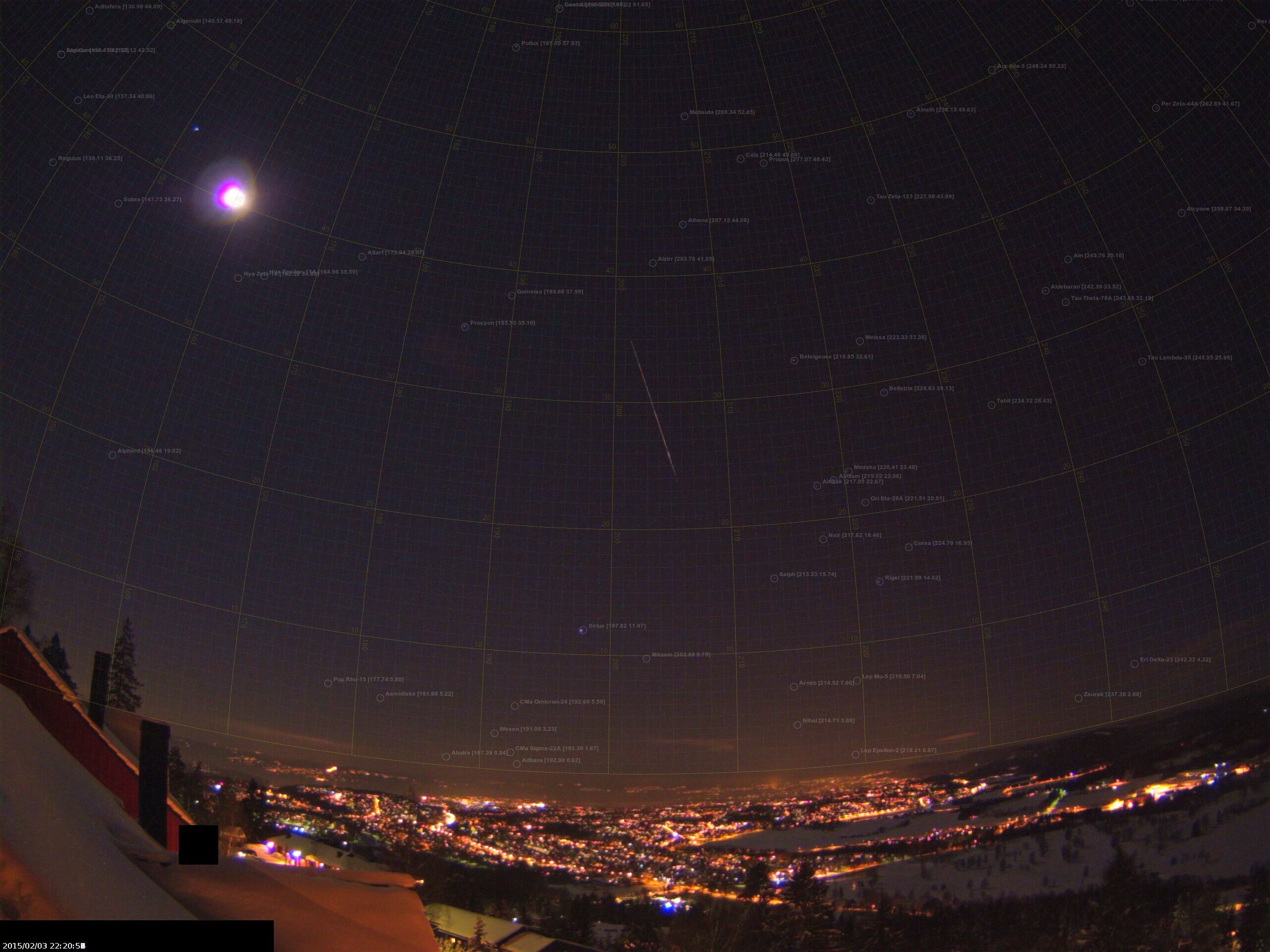
| First clear night in a couple of weeks! Got one slow, but not very bright meteor on video:
NIL DIFFICILE VOLENTI

|
| |
| |
| FastFourierTransform | Date: Wednesday, 04.02.2015, 09:13 | Message # 433 |
|
Pioneer
Group: Local Moderators
Spain
Messages: 542
Status: Offline
| Quote HarbingerDawn ( ) Green comets are not very rare. The relatively recent comet Lemmon was also green.
Yes surely. I have seen many green comets. But what I mean is about morphology. The coma and the tail of those comets looks totally different and that should be shown on SE.
For example, this is a comparison of Lovejoy and an Hale Bopp. You can see that they look like totally different objects. The tail of lovejoy is quite awesome by the way, it has structured clumps and is not like a tenous spray (like in hale bopp):


Lovejoy has a very narrow tail/tails - hale bopp has not
lovejoy has a green spherical coma differentciated form the rest of the body - hale bopp doesn't
Credit for the first image: Gerald Rhemann
Credit for the second image: E. Kolmhofer and H. Raab
Edited by FastFourierTransform - Saturday, 07.02.2015, 00:44 |
| |
| |
| midtskogen | Date: Thursday, 12.02.2015, 20:31 | Message # 434 |
|
Star Engineer
Group: Users
Norway
Messages: 1674
Status: Offline
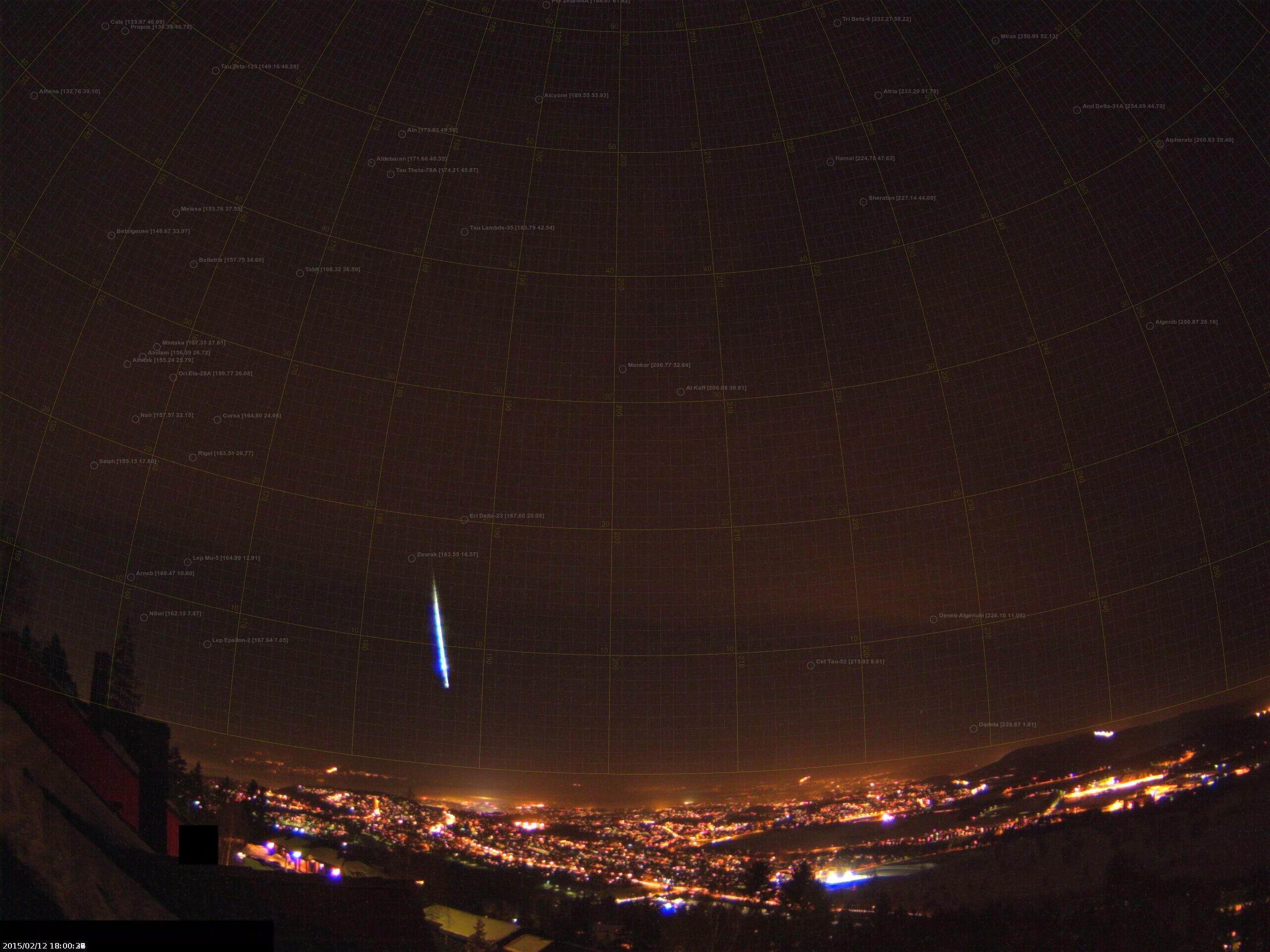
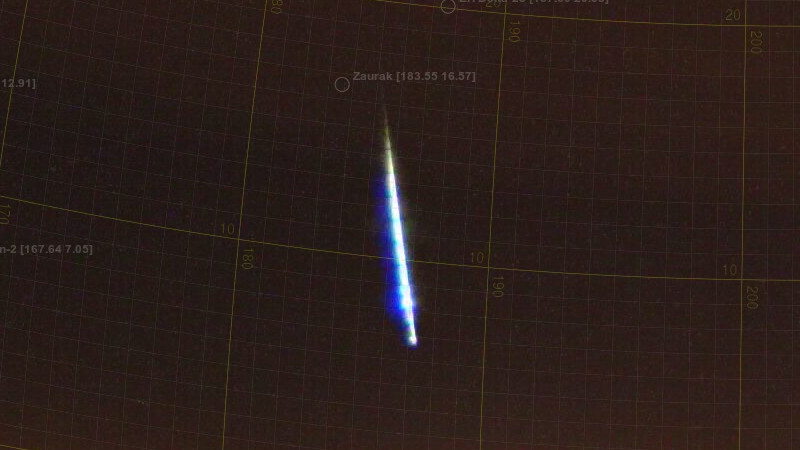
| A nice fireball this evening.
NIL DIFFICILE VOLENTI
|
| |
| |
| Watsisname | Date: Friday, 13.02.2015, 23:49 | Message # 435 |
|
Galaxy Architect
Group: Global Moderators
United States
Messages: 2613
Status: Offline
| Quote FastFourierTransform ( )
For example, this is a comparison of Lovejoy and an Hale Bopp. You can see that they look like totally different objects. The tail of lovejoy is quite awesome by the way, it has structured clumps and is not like a tenous spray (like in hale bopp):
The difference in morphology is simply the presence of a dust tail for Hale-Bopp.
Both comets have an ion tail, which is blue for Hale-Bopp but greenish for Lovejoy because of fluorescing C2. Ion tails are generally more structured than dust tails, and are always aimed more directly away from the sun (dust particles aren't accelerated by the solar wind as much and so they keep more to the orbital path.) That you don't see a spherical coma for Hale-Bopp is also because it is being swamped by the dust emission.
|
| |
| |
 ENG
ENG New site


 Poland


 United States
 Sweden
 Venezuela
 Spain
Spain 
 Norway