|
Work progress and public beta test - 0.9.7.4
|
|
| Mixa | Date: Tuesday, 26.04.2016, 17:06 | Message # 2386 |
|
Space Tourist
Group: Users
 Bosnia and Herzegovina
Messages: 37
Status: Offline
| Quick question. I see that RC2 is .exe file, or precisely said, setup file. Do I have to have previous versions of Space Engine installed, or is this a standalone release?
|
| |
| |
| Fireinthehole | Date: Tuesday, 26.04.2016, 17:11 | Message # 2387 |
 Pioneer
Group: Translators
 Sweden
Messages: 356
Status: Offline
| Quote Mixa (  ) Quick question. I see that RC2 is .exe file, or precisely said, setup file. Do I have to have previous versions of Space Engine installed, or is this a standalone release?
Standalone. 
Love SpaceEngine!
|
| |
| |
| Mixa | Date: Tuesday, 26.04.2016, 17:20 | Message # 2388 |
|
Space Tourist
Group: Users
Bosnia and Herzegovina
Messages: 37
Status: Offline
| Quote Fireinthehole ( ) Standalone.
Thanks. That's great news. I don't really think that adding files to previous versions is a good way of updating things and this is something that I really wanted. I don't know why am I a fan of installers and extractors.
|
| |
| |
| yaqdark | Date: Tuesday, 26.04.2016, 17:29 | Message # 2389 |
 Astronaut
Group: Users
 Pirate
Messages: 53
Status: Offline
| Anybody know why my bookmarks mostly don't "exist" anymore? Not just talking about from beta builds, but from 9.7.3 etc..
|
| |
| |
| HarbingerDawn | Date: Tuesday, 26.04.2016, 17:45 | Message # 2390 |
 Cosmic Curator
Group: Administrators
 United States
Messages: 8717
Status: Offline
| Quote yaqdark ( ) Anybody know why my bookmarks mostly don't "exist" anymore? Not just talking about from beta builds, but from 9.7.3 etc..
Generation parameters have been changed, which changes the whole universe.
All forum users, please read this!
My SE mods and addons
Phenom II X6 1090T 3.2 GHz, 16 GB DDR3 RAM, GTX 970 3584 MB VRAM
|
| |
| |
| LookAtDatDakka | Date: Tuesday, 26.04.2016, 22:08 | Message # 2391 |
 Explorer
Group: Users
United States
Messages: 156
Status: Offline
| Quote HarbingerDawn ( ) Generation parameters have been changed, which changes the whole universe.
It was changed to make way for procedual subgiants.
NVIDIA 960 GTX 2048MB
Edited by LookAtDatDakka - Tuesday, 26.04.2016, 22:08 |
| |
| |
| SpaceEngineer | Date: Wednesday, 27.04.2016, 17:09 | Message # 2392 |
 Author of Space Engine
Group: Administrators
 Russian Federation
Messages: 4800
Status: Offline
| Updates of the Solar system browser.
1) Fictive system barycenter does not displayed now (it is a barycenter used to add a catalog star with custom data). This allowed to add a catalog entry for the Sun with proper temperature and rotation axis/period.
2) Ability to display barycenter of a binary planet and navigate it in the same manner as a star barycenter (new checkbox in the settings at the left).
3) When mouse is over table, navigation buttons appear on it (enter satellites level and return back). It's possible to display these buttons permanently in every table cell, but they may overlap the cell text (the back button in the screenshot already do that). However this can give a quick info of which planets have moons, and which does not have.


|
| |
| |
| LookAtDatDakka | Date: Wednesday, 27.04.2016, 20:32 | Message # 2393 |
|
Explorer
Group: Users
United States
Messages: 156
Status: Offline
| Quote SpaceEngineer ( ) 3) When mouse is over table, navigation buttons appear on it (enter satellites level and return back). It's possible to display these buttons permanently in every table cell, but they may overlap the cell text (the back button in the screenshot already do that). However this can give a quick info of which planets have moons, and which does not have.
Very useful for checking planets with moons. Thanks SpaceEngineer.
NVIDIA 960 GTX 2048MB
|
| |
| |
| quarior14 | Date: Thursday, 28.04.2016, 13:26 | Message # 2394 |
 World Builder
Group: Users
Pirate
Messages: 649
Status: Offline
| Do you plan to add the biome "Subterrestrial" for life, - not to be confused with "Subglacial" - ?
(I have not found any result concerning this still active (there are two, but if I click it, it brings me back to the forum home page and the one it is the planet classification).)
Quarior
Edited by quarior14 - Thursday, 28.04.2016, 13:26 |
| |
| |
| DoctorOfSpace | Date: Thursday, 28.04.2016, 13:56 | Message # 2395 |
 Galaxy Architect
Group: Global Moderators
Pirate
Messages: 3600
Status: Offline
| Quote quarior14 ( ) "Subterrestrial" for life
Technically that would still be terrestrial life.
Intel Core i7-5820K 4.2GHz 6-Core Processor
G.Skill Ripjaws V Series 32GB (4 x 8GB) DDR4-2400 Memory
EVGA GTX 980 Ti SC 6GB
|
| |
| |
| quarior14 | Date: Thursday, 28.04.2016, 17:40 | Message # 2396 |
|
World Builder
Group: Users
Pirate
Messages: 649
Status: Offline
| Quote DoctorOfSpace ( ) Technically that would still be terrestrial life.
Not really because if I put terrestrial, Space Engine generates the flora on the surface of the planet (if multicellular).
Quarior
|
| |
| |
| sinsforeal | Date: Thursday, 28.04.2016, 22:26 | Message # 2397 |
 Space Pilot
Group: Users
United States
Messages: 129
Status: Offline
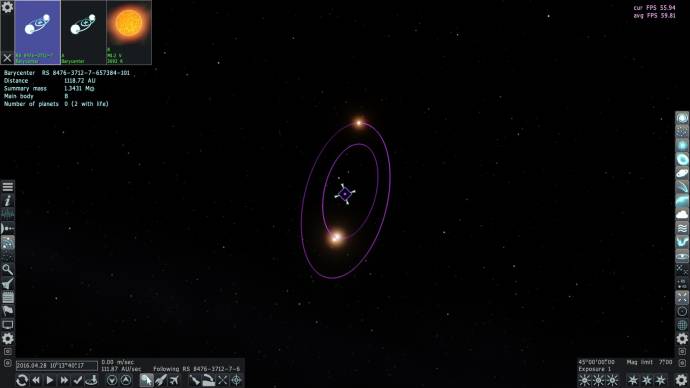
| I have found a bug. It seems that there is 0 planets even though it says there is thirteen with life
http://i.imgur.com/XknMIHr.png
"Man once looked up at the stars and wondered, Now all we do is look at our hands and hesitate"
|
| |
| |
| JackDole | Date: Thursday, 28.04.2016, 23:39 | Message # 2398 |
 Star Engineer
Group: Local Moderators
 Germany
Messages: 1742
Status: Offline
| sinsforeal,
The '0' is not a bug. This means only that the 'Barycenter' has no planets.
The '13', however, is wrong. The system has only two planets with life.
Remove the 'Shaders0974 Backup.pak' file from the 'data\shaders' folder. Remove it completely out of the 'SpaceEngine' directory.
SE reads all .pak files that are located inside the SpaceEngine folder, even if they are not needed. Maybe this can cause problems.
Don't forget to look here.

|
| |
| |
| sinsforeal | Date: Thursday, 28.04.2016, 23:52 | Message # 2399 |
|
Space Pilot
Group: Users
United States
Messages: 129
Status: Offline
| JackDole, I was using your space opera mod, This caused the thiteen 
"Man once looked up at the stars and wondered, Now all we do is look at our hands and hesitate"
|
| |
| |
| Mosfet | Date: Friday, 29.04.2016, 00:12 | Message # 2400 |
 World Builder
Group: Users
 Italy
Italy
Messages: 754
Status: Offline
| I'd remove anyway that backup file as JackDole suggested, or you can simply rename it as .zip. Judging from yor SE.log the program is loading that shaders backup file instead of the other one, probably because he's newer. And there's an error loading a shader texture.
"Time is illusion. Lunchtime doubly so."
Douglas N. Adams
My mods
Asus x555ub: cpu i5-6200u - ram 4gb - gpu nvidia geforce 940m 2gb vram
|
| |
| |
 ENG
ENG New site


 Bosnia and Herzegovina


 Sweden
  Pirate

 United States
  Russian Federation


 Germany
 Italy
Italy