|
Work progress 0.9.7.1
|
|
| Vinny | Date: Friday, 08.11.2013, 23:12 | Message # 331 |
|
Explorer
Group: Users
 United States
Messages: 172
Status: Offline
| Hi, Spaceengineer!
On the Spaceengine 0.9.7.1 preview video above, what kind of spacecraft are you using in the video? Thanks!
Cheers,
Vincent
|
| |
| |
| neutronium76 | Date: Friday, 08.11.2013, 23:34 | Message # 332 |
 World Builder
Group: Users
 Greece
Messages: 718
Status: Offline
| He is using the shuttle.
PC1:Core i7 970@3.34GHz, 6 cores/12 threads, 12GB DDR3 RAM@1.34GHz, 2x(SLI) GTX-580 GPUs 3GB VRAM(GDDR5)@1GHz, OS:Win7x64SP1
PC2:Core2Quad X9770@3.2GHz, 2 cores/4 threads 4GB DDR2 RAM@1GHz, GTX-285 GPU 1GB VRAM(DDR3)@1.24GHz, OS:WinVistax64SP2
|
| |
| |
| gift | Date: Friday, 08.11.2013, 23:39 | Message # 333 |
 Space Pilot
Group: Users
United States
Messages: 108
Status: Offline
| i can't wait for this patch.
|
| |
| |
| Vinny | Date: Friday, 08.11.2013, 23:50 | Message # 334 |
|
Explorer
Group: Users
United States
Messages: 172
Status: Offline
| Hi, neutronium76!
Got it! Thanks!
Cheers,
Vincent
|
| |
| |
| Red_River | Date: Saturday, 09.11.2013, 14:30 | Message # 335 |
 Astronaut
Group: Users
 Canada
Messages: 56
Status: Offline
| will there be a cockpit view option as well?

|
| |
| |
| Salvo | Date: Saturday, 09.11.2013, 15:31 | Message # 336 |
 Star Engineer
Group: Local Moderators
 Italy
Italy
Messages: 1400
Status: Offline
| Red_River, I don't think so 
The universe is not required to be in perfect harmony with human ambition.
CPU: Intel Core i7 4770 GPU: ASUS Radeon R9 270 RAM: 8 GBs
(still don't know why everyone is doing this...)
|
| |
| |
| Proteus | Date: Saturday, 09.11.2013, 19:20 | Message # 337 |
|
Explorer
Group: Users
United States
Messages: 173
Status: Offline
| I'm sorry to interrupt this thread, but this seems to be the absolulte ONLY way I can communicate on this forum now (by replying to a thread), and I can't find any other thread that is relevant enough to reply to with this.... (The site is not letting me send a PM to anybody about this, nor create a new thread, nor post anything in chat - Harbinger, please feel free to move this reply out of this thread and to wherever you need to.)
I'm having a number of issues trying to use the site. I used to be able to create a thread here on the forums, but now I can't find any button or link anywhere to create a topic at all. Am I just not noticing where it is? I've looked as thoroughly as possible and I'm typically pretty savvy with using forums, but I don't see any option anywhere for me, now.
Additionally, embedded youtube videos will not show up for me in any thread. All I see is the post text content presenting it, but there is nothing showing up where the video they put there should be. (I've really been wanting to see SpaceEngineer's video demonstrating the new video capture feature for example, but it doesn't show up and I don't know where else to find the video).
And finally, with the chat at the bottom of the site, I can write a chat message, and hit the okay button to submit, but when the page refreshes, my message does not show up in the chat. I can't seem to figure out why this is.
Have these issues been reported by any others?
Any help you can give me, I'd greatly appreciate.
Thanks.

|
| |
| |
| HarbingerDawn | Date: Saturday, 09.11.2013, 20:03 | Message # 338 |
 Cosmic Curator
Group: Administrators
United States
Messages: 8717
Status: Offline
| This sounds like an issue I've had before several times. Try using a different browser and/or restarting your computer. Most of the time that should work. If that doesn't work then I don't know what to tell you other than to reinstall your operating system (I had an issue like that in Windows 7 that I couldn't solve, and I had to switch to another OS).
All forum users, please read this!
My SE mods and addons
Phenom II X6 1090T 3.2 GHz, 16 GB DDR3 RAM, GTX 970 3584 MB VRAM
|
| |
| |
| midtskogen | Date: Saturday, 09.11.2013, 20:34 | Message # 339 |
 Star Engineer
Group: Users
 Norway
Messages: 1674
Status: Offline
| This site is a mess, strange things happen. I'm not sure if it's related, but I've had issues with this site and forum, such as occasionally not being able to log in, from my work computer. My solution is to use a proxy through an ssh tunnel to my home network. So there are things here that are network related, not just browser and OS related.
NIL DIFFICILE VOLENTI

|
| |
| |
| werdnaforever | Date: Sunday, 10.11.2013, 08:34 | Message # 340 |
 World Builder
Group: Users
 Pirate
Messages: 897
Status: Offline
| Quote SpaceEngineer (  ) And this is demonstration of new video capture... and atmospheric flight
This is incredible. Added with the fact that the SE universe is seamless makes the entire universe more like one giant playground.
Orbiter also has atmospheric flight, but it's not that realistic. It looks like this has surpassed it- a real milestone! Orbiter will one day be like Celestia in comparison to SpaceEngine. In fact, we won't need separate Space and Flight sims!
The handling in SE's avaition mode reminds me of the FS in Google Earth, especially because of the (apparent) ease of maneuverability at supersonic speeds. Since we aren't really in the cockput, displaying the G-force indicator (and other values) in larger text should help give an indication of how realistic one's flight pattern is. Also, adding a blackout effect (which ought to be optional IMHO) would be a nice touch, and easy: it would just be based on the G-force value.
Getting the handling right is key, and, to state the obvious, atmospheric pressure should come into play. Flying that shuttle should be impossible on a Mars-like planet...(EDIT: or very, very difficult) This leaves opportunities open for new types of aircraft designs for really thin or thick environments (like the Mars sim in X-Plane). A SE mother-ship should easily accommodate a variety of different on-board shuttle types.
Edited by werdnaforever - Sunday, 10.11.2013, 08:40 |
| |
| |
| SpaceEngineer | Date: Sunday, 10.11.2013, 11:29 | Message # 341 |
 Author of Space Engine
Group: Administrators
 Russian Federation
Messages: 4800
Status: Offline
| Quote werdnaforever ( ) Flying that shuttle should be impossible on a Mars-like planet...
No, it is possible. Shuttle have a hover engines for vertical take-off and hovering above surface on airless or almost airless bodies. In martian atmosphere, it may accelerate to 500-1000 m/s and switch to airplane-like flight (switch off hover engines). At full thrust in martian atmosphere this shuttle can reach 4 km/s. In controversy, in dense venusian atmosphere, even at full thrust, this shuttle can reach only 100-200 m/s speed.

|
| |
| |
| werdnaforever | Date: Sunday, 10.11.2013, 13:17 | Message # 342 |
|
World Builder
Group: Users
Pirate
Messages: 897
Status: Offline
| Quote SpaceEngineer ( ) No, it is possible. Shuttle have a hover engines for vertical take-off and hovering above surface on airless or almost airless bodies. In martian atmosphere, it may accelerate to 500-1000 m/s and switch to airplane-like flight (switch off hover engines). At full thrust in martian atmosphere this shuttle can reach 4 km/s. In controversy, in dense venusian atmosphere, even at full thrust, this shuttle can reach only 100-200 m/s speed.
OK, that was a poor choice of words on my part. It will be much harder to utilize the atmosphere when there is less of it. A low-atmosphere variant of the shuttle that doesn't need to accelerate to 0.5km/s to 1km/s will be a better choice for localized transportation between local bases or other areas.
|
| |
| |
| SpaceEngineer | Date: Sunday, 10.11.2013, 20:39 | Message # 343 |
|
Author of Space Engine
Group: Administrators
Russian Federation
Messages: 4800
Status: Offline
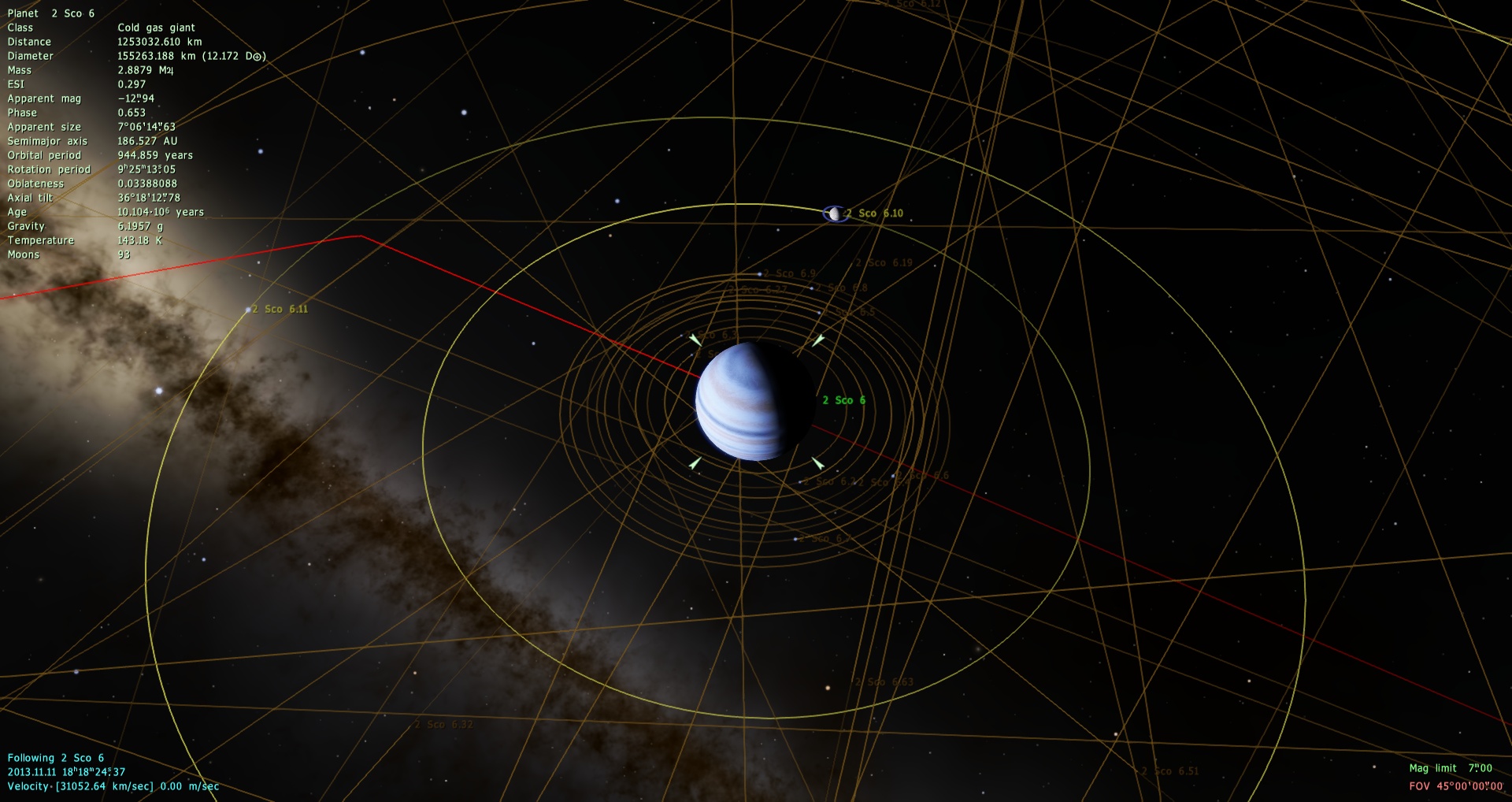
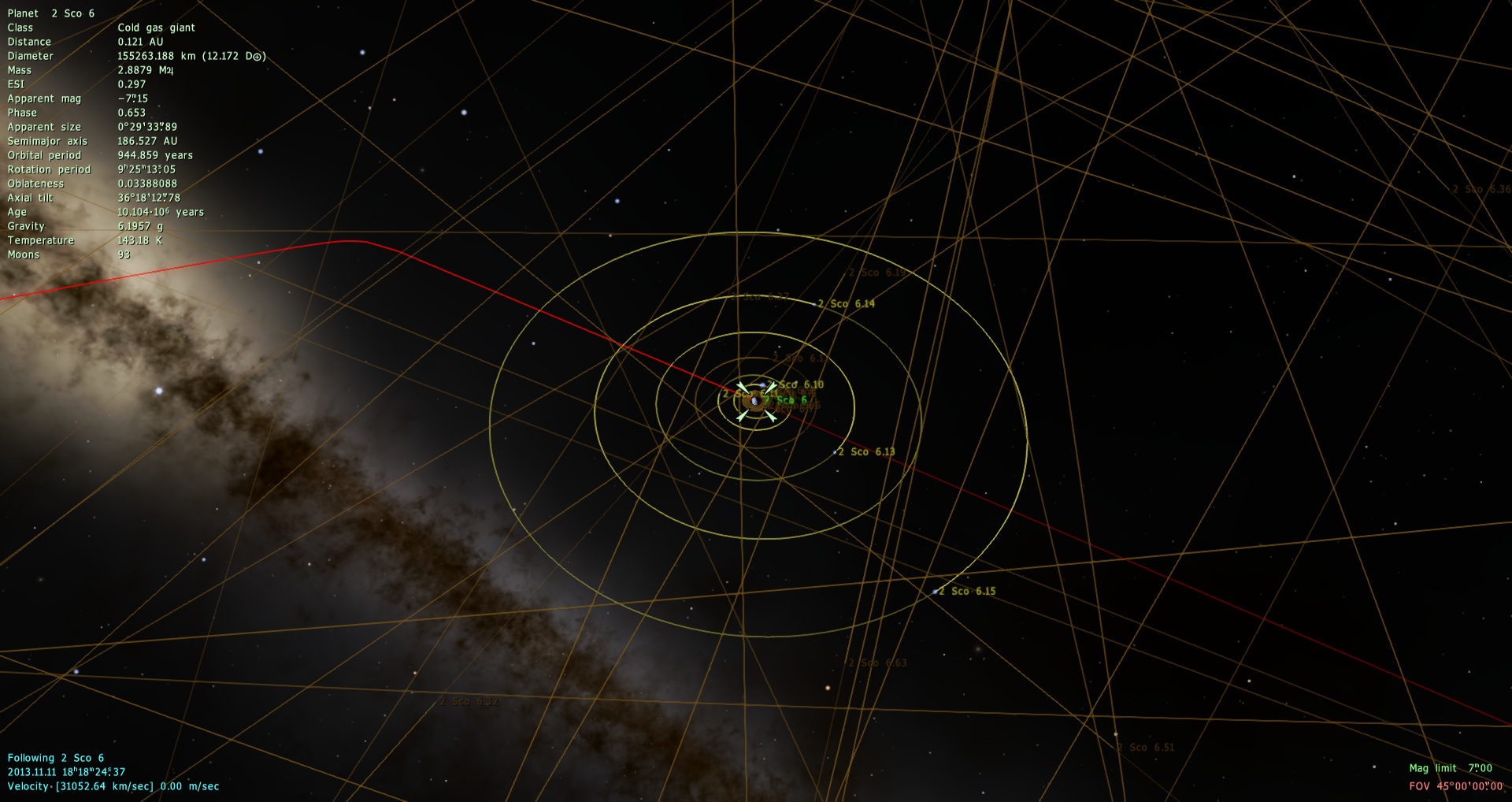
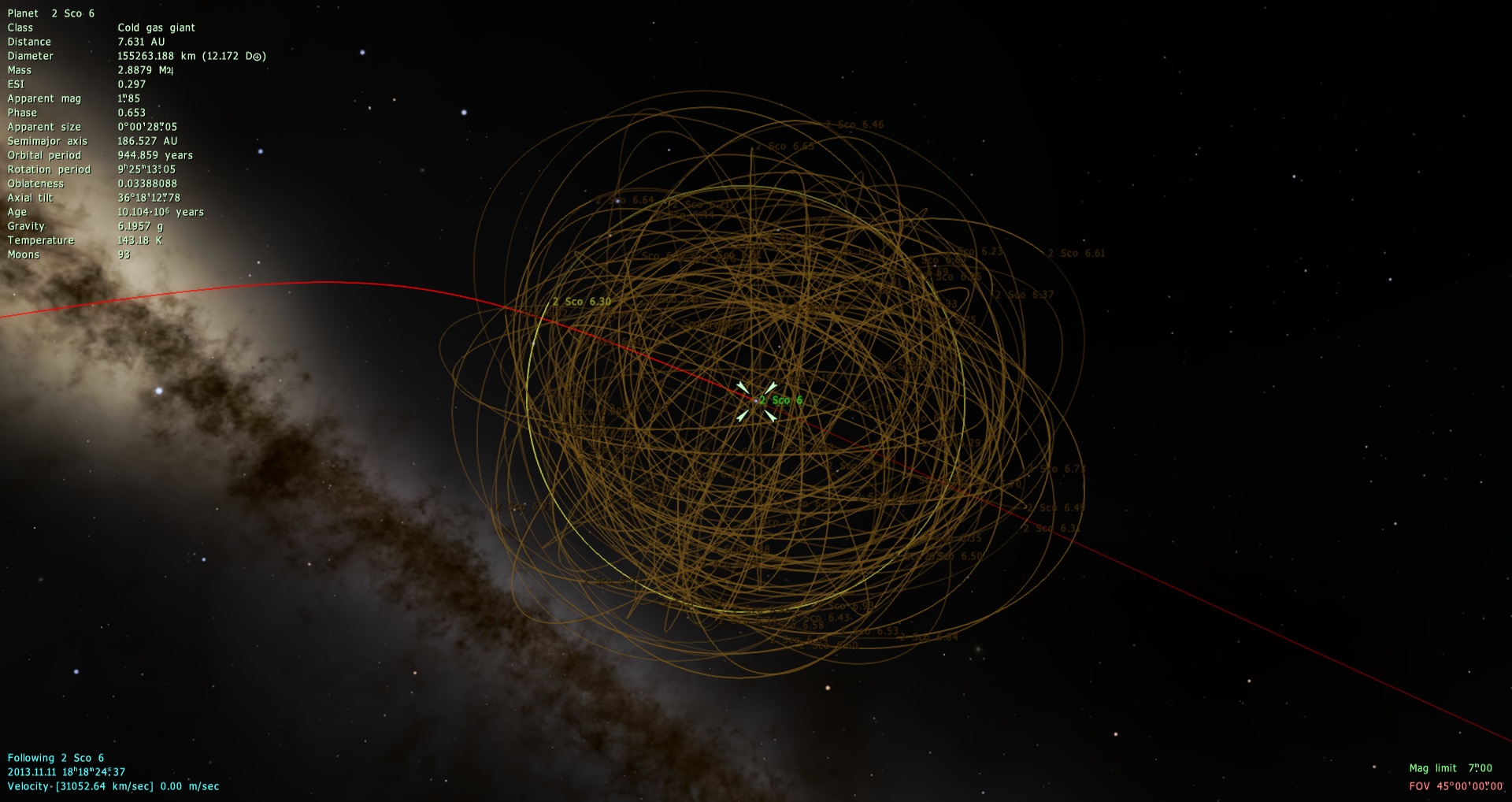
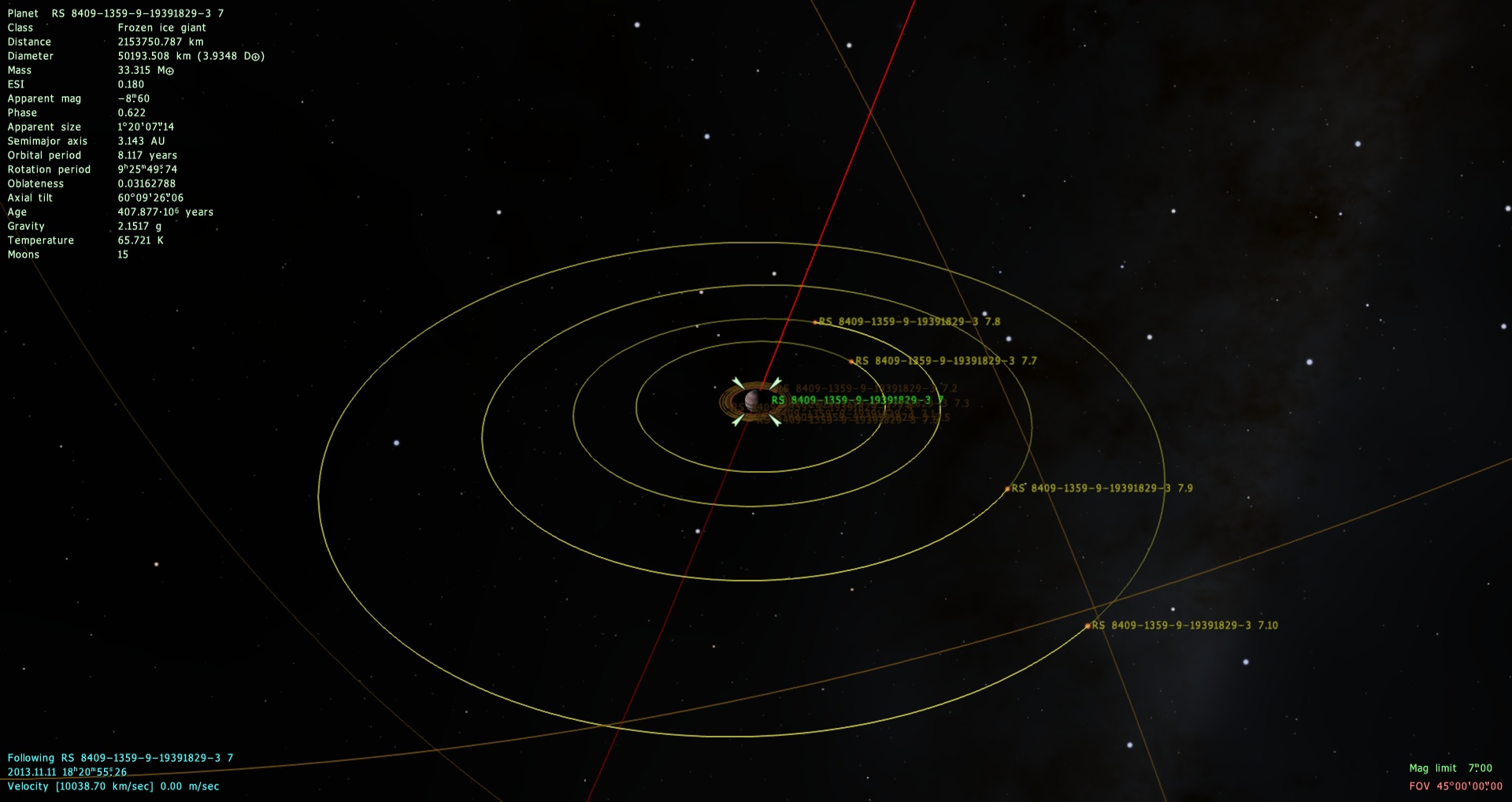
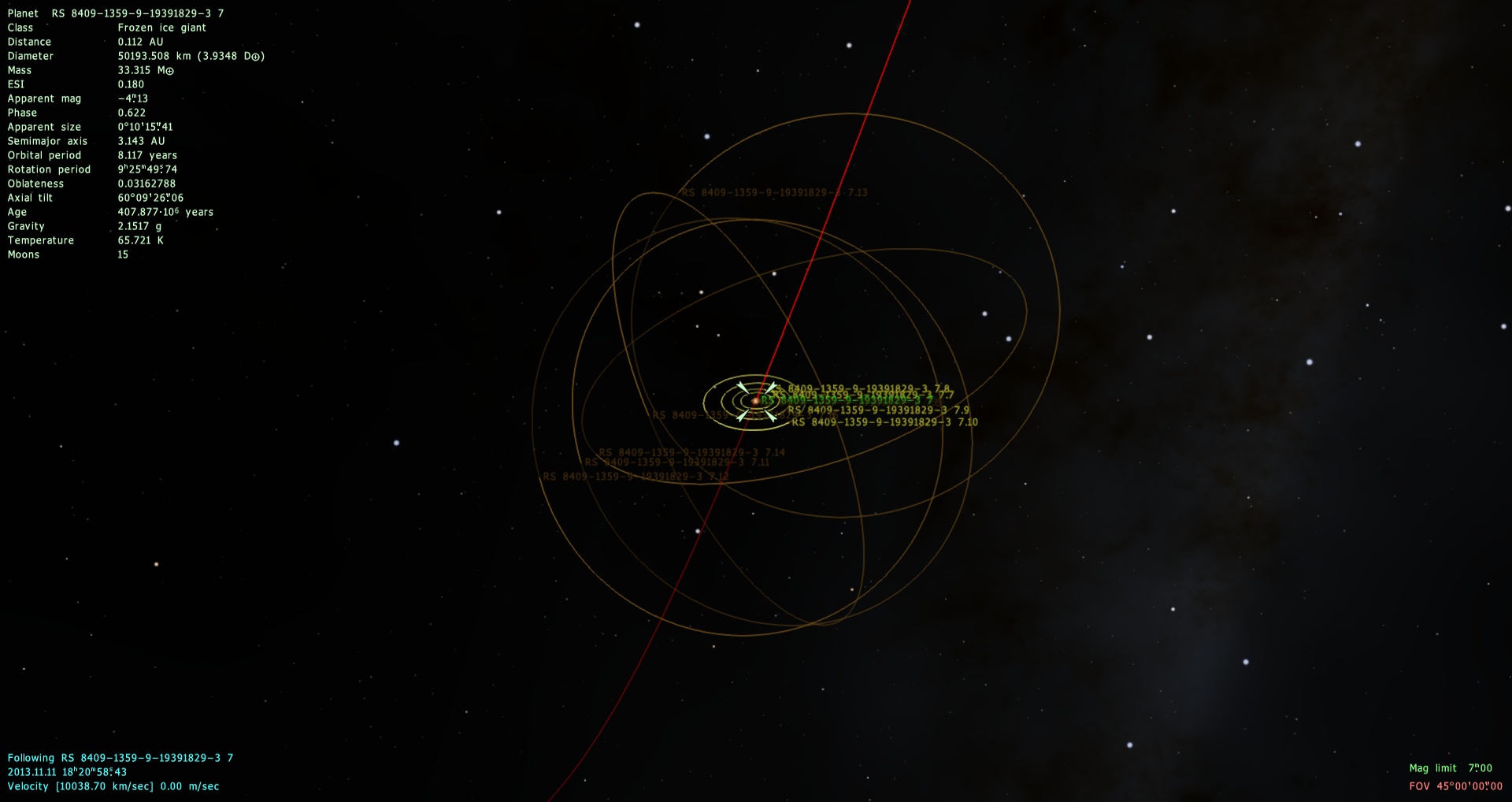
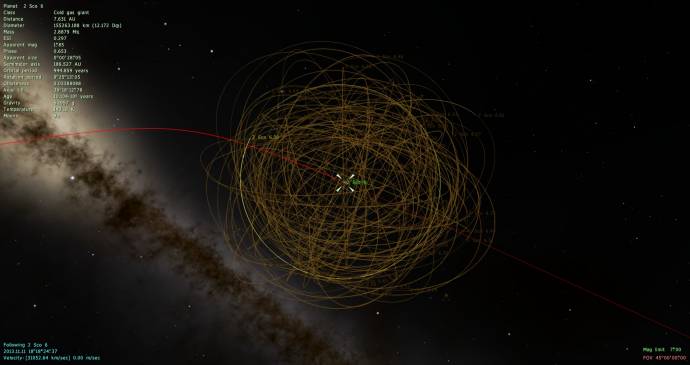
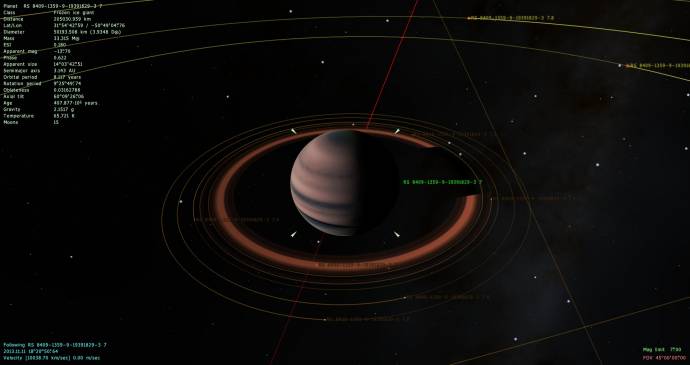
| Ok, I upgraded procedural moon system generator. It now generates 3 types of moons:
Inner moons, small asteroid-like bodies orbiting close to the planet in its equatorial plane, near or inside its rings if they are present.
Regular moons, big spherical shapes satellites (or asteroidal with some small probability), orbiting planet in its equatorial plane with exponentially increasing semimajor axis (Dermott's law).
Outer moons, usually small asteroid-like bodies (or big spherical ones with some small probability), have irregular orbits.
Gas giants now may have up to 100 moons, ice giants up to 40, small planets up to 20. The code used for all type of planets, but some planets may have 0 inner moons, or 0 regular moons, etc, or just 1 giant regular moon (double planets, including double gas giants).
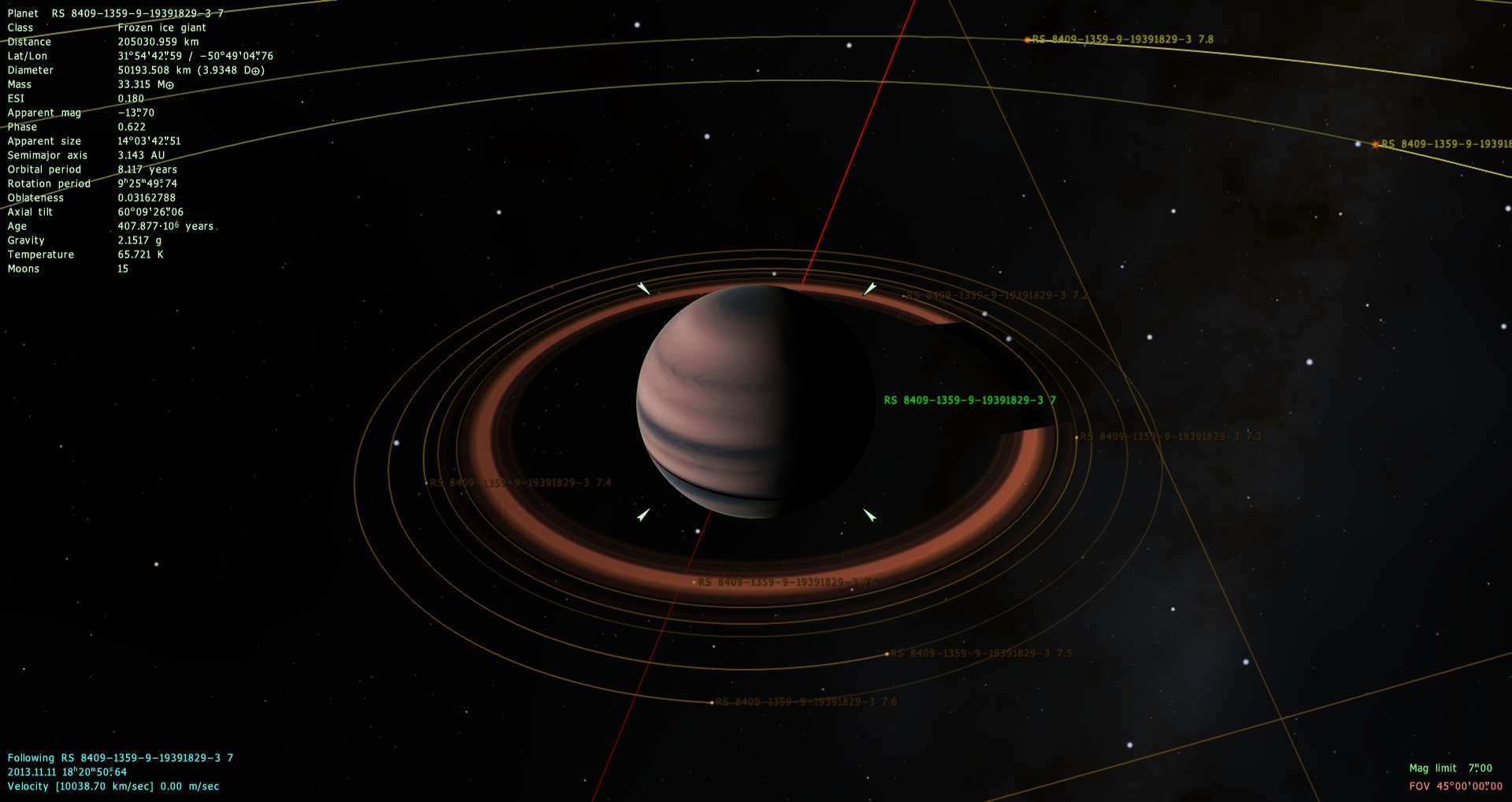
Pictures: inner moons, regular moons, outer moons.
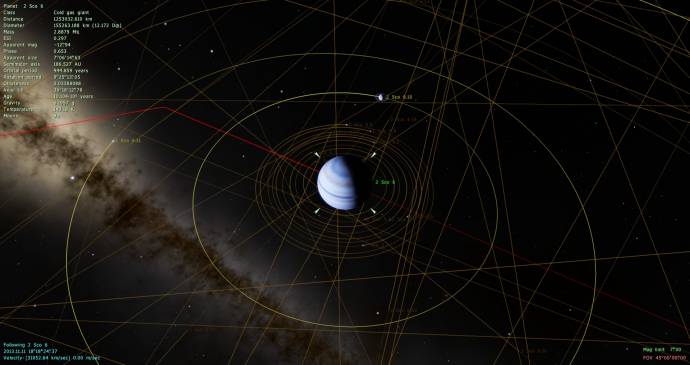
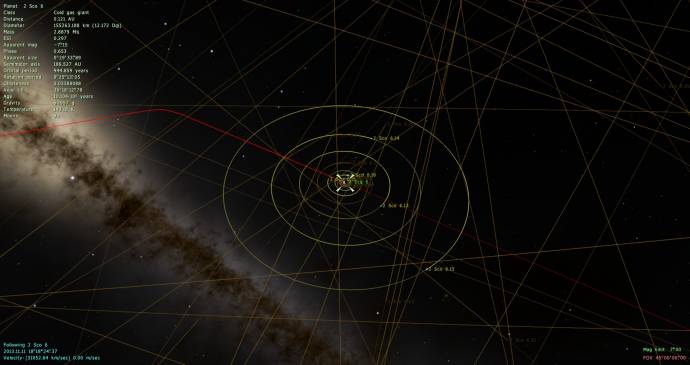
Another gas giant (with rings):
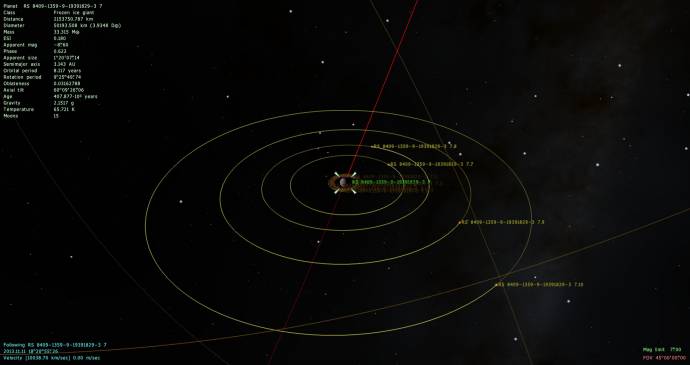
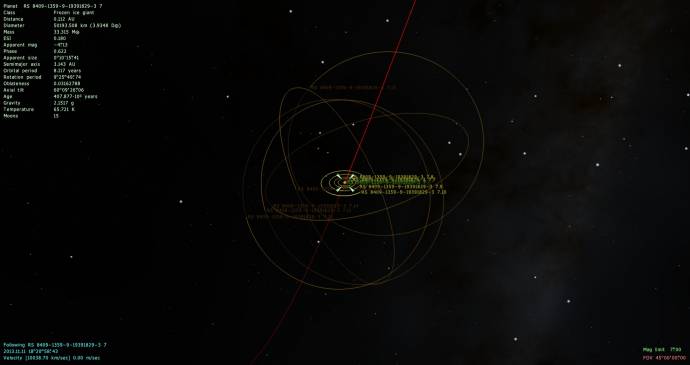
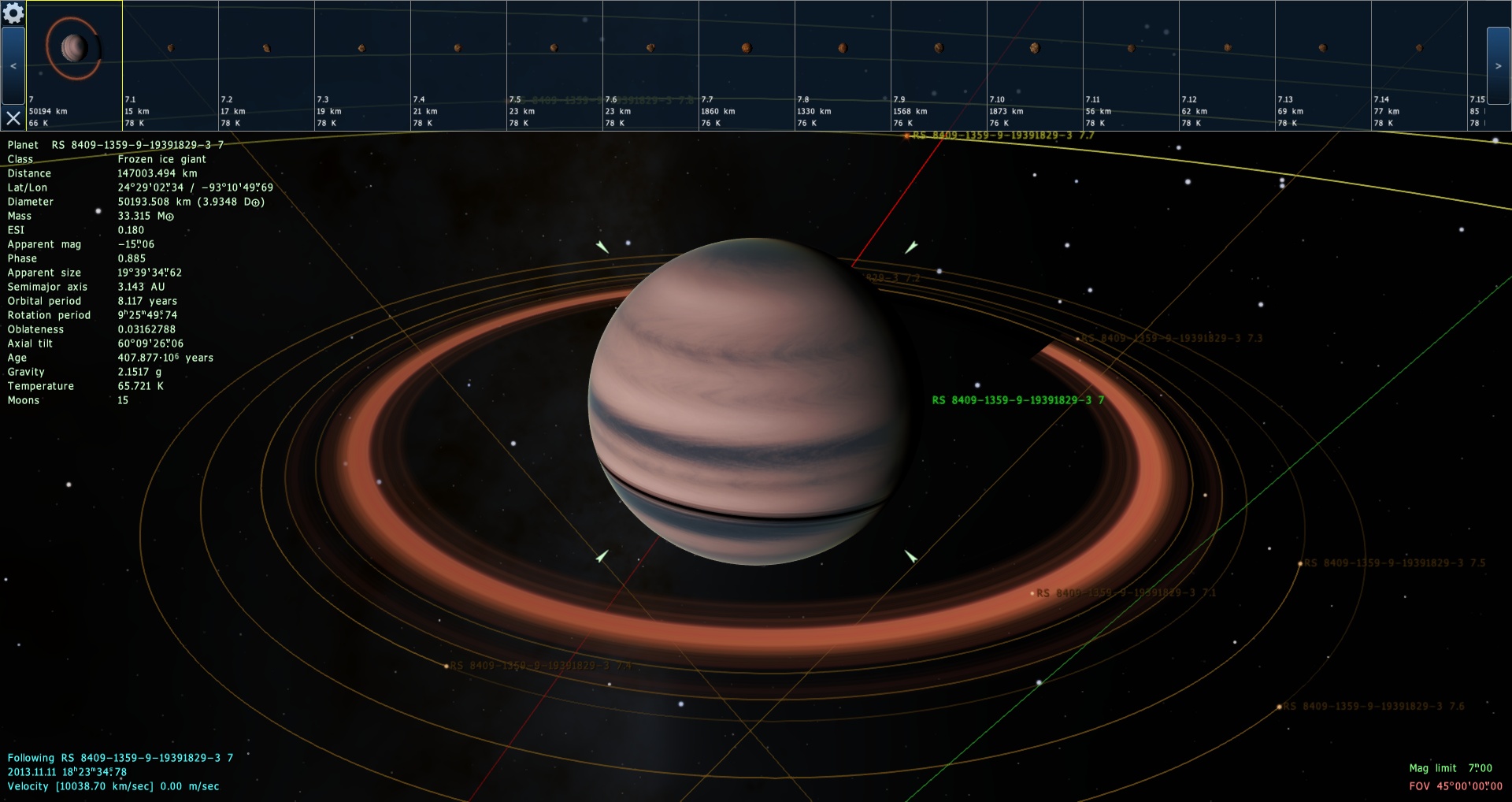
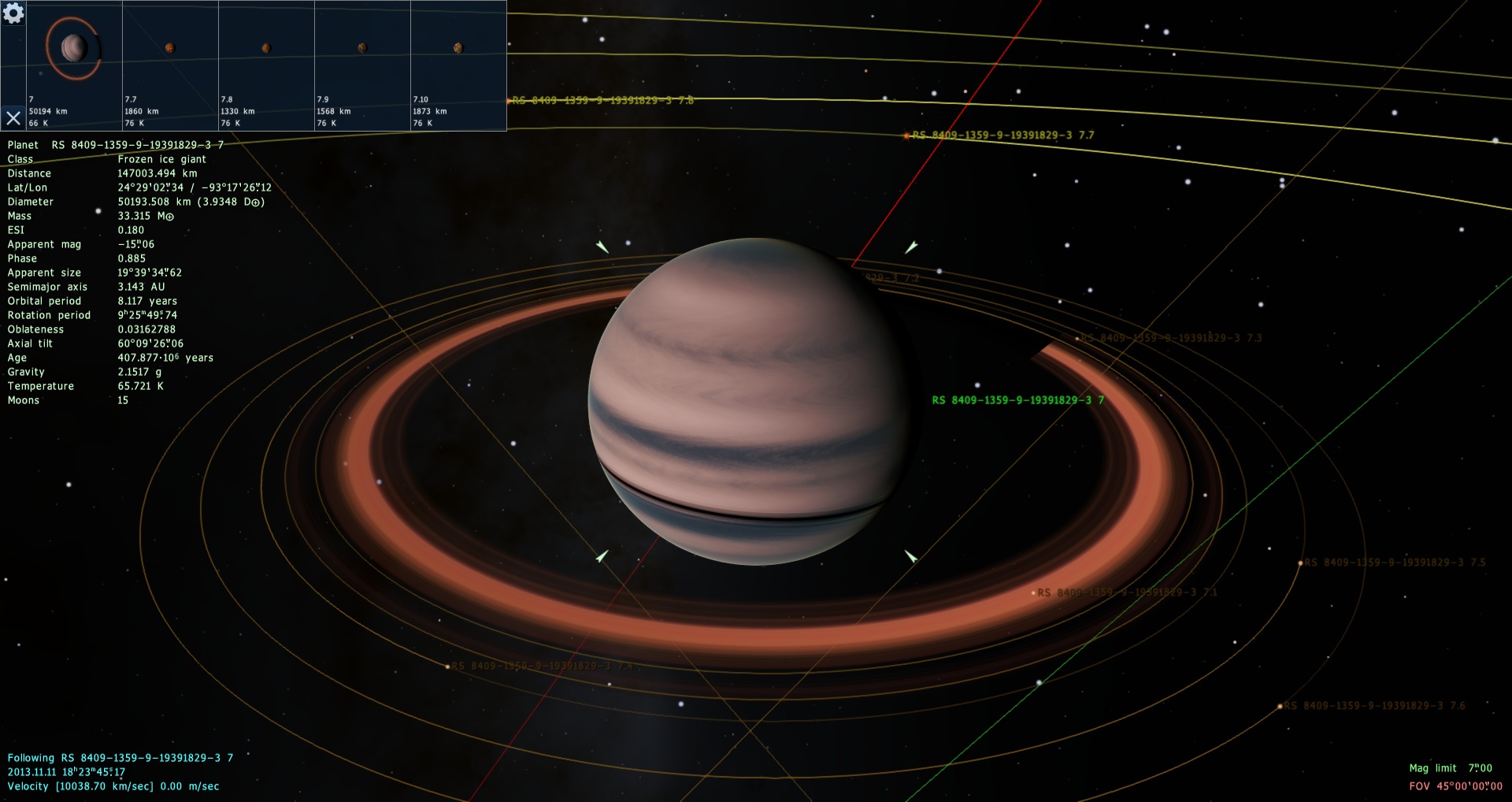
With such huge amount of moons, Planet Browser becomes a mess:
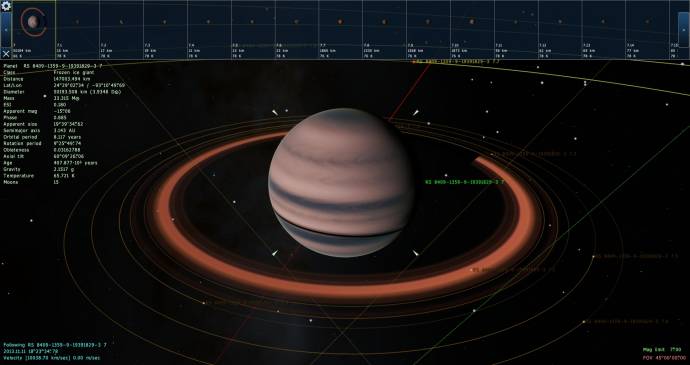
Checkbox to disable dwarf moons in settings helps a bit:
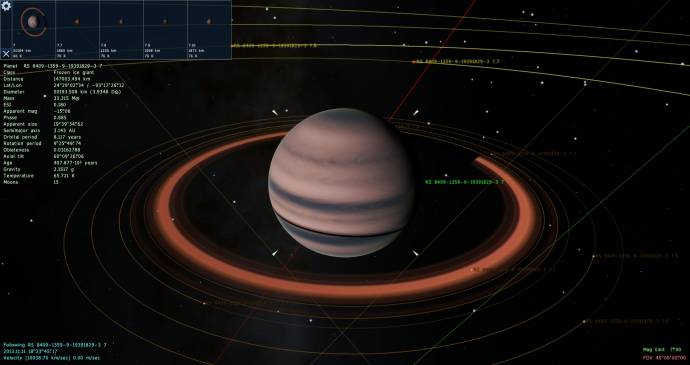
Another problem: moons numbering starting from inner moons, so main (big) moons often have huge numbers like "7.15". So maybe it would be good idea to change naming system: for dwarf moons using names like "7.d59" or so.
|
| |
| |
| HarbingerDawn | Date: Sunday, 10.11.2013, 20:43 | Message # 344 |
|
Cosmic Curator
Group: Administrators
United States
Messages: 8717
Status: Offline
| Quote SpaceEngineer ( ) So maybe it would be good idea to change naming system: for dwarf moons using names like "7.d59" or so.
Would it be possible to make names based on the moon "families", such as 7.a1, 7.b1, 7.c1, with increasing letter value meaning increasing family distance? That way small moons in close equatorial orbits can be easily distinguished from those in distant orbits.
All forum users, please read this!
My SE mods and addons
Phenom II X6 1090T 3.2 GHz, 16 GB DDR3 RAM, GTX 970 3584 MB VRAM
|
| |
| |
| Salvo | Date: Sunday, 10.11.2013, 20:49 | Message # 345 |
|
Star Engineer
Group: Local Moderators
Italy
Messages: 1400
Status: Offline
| Quote SpaceEngineer ( ) Gas giants now may have up to 100 moons, ice giants up to 40, small planets up to 20.
Are you sure this won't kill framerate?
Imagine a binary system with 10 gas giants or more, each of them have on average 50 moons, the result is 500 moons 
The universe is not required to be in perfect harmony with human ambition.
CPU: Intel Core i7 4770 GPU: ASUS Radeon R9 270 RAM: 8 GBs
(still don't know why everyone is doing this...)
|
| |
| |
 ENG
ENG New site


 United States

 Greece
  Canada
 Italy
Italy 


 Norway
  Pirate
  Russian Federation