|
Totally off-topic thread
|
|
| midtskogen | Date: Tuesday, 16.04.2013, 07:40 | Message # 1081 |
 Star Engineer
Group: Users
 Norway
Messages: 1674
Status: Offline
| Quote (Watsisname) That's not much of a time machine. My car gets me an additional 5 femtoseconds per second each time I drive to/from campus.
You gain even more simply for living closer to the equator.

NIL DIFFICILE VOLENTI

|
| |
| |
| Salvo | Date: Tuesday, 16.04.2013, 09:33 | Message # 1082 |
 Star Engineer
Group: Local Moderators
 Italy
Italy
Messages: 1400
Status: Offline
| How many are the deaths? Italians TV says 3 deaths, but my american friend says 5... 
The universe is not required to be in perfect harmony with human ambition.
CPU: Intel Core i7 4770 GPU: ASUS Radeon R9 270 RAM: 8 GBs
(still don't know why everyone is doing this...)
|
| |
| |
| HarbingerDawn | Date: Tuesday, 16.04.2013, 09:45 | Message # 1083 |
 Cosmic Curator
Group: Administrators
 United States
Messages: 8717
Status: Offline
| Quote (Salvo) How many are the deaths?
As far as I know it's 3. But the injuries are the bigger problem. Over a dozen dozen people were injured, and at least 10 were missing limbs, which is the worst thing I think.
All forum users, please read this!
My SE mods and addons
Phenom II X6 1090T 3.2 GHz, 16 GB DDR3 RAM, GTX 970 3584 MB VRAM
|
| |
| |
| midtskogen | Date: Tuesday, 16.04.2013, 12:26 | Message # 1084 |
|
Star Engineer
Group: Users
Norway
Messages: 1674
Status: Offline
| Huge earthquake rolling in on my seismometer and geophones right now.
NIL DIFFICILE VOLENTI
|
| |
| |
| HarbingerDawn | Date: Tuesday, 16.04.2013, 12:30 | Message # 1085 |
|
Cosmic Curator
Group: Administrators
United States
Messages: 8717
Status: Offline
| Quote (midtskogen) Huge earthquake rolling in on my seismometer and geophones right now.
Amazing
Here is the culprit: http://www.nytimes.com/2013....ia.html
All forum users, please read this!
My SE mods and addons
Phenom II X6 1090T 3.2 GHz, 16 GB DDR3 RAM, GTX 970 3584 MB VRAM
|
| |
| |
| Watsisname | Date: Tuesday, 16.04.2013, 13:34 | Message # 1086 |
 Galaxy Architect
Group: Global Moderators
United States
Messages: 2613
Status: Offline
| Quote (midtskogen) You gain even more simply for living closer to the equator.
General Relativistic effect due to being farther from the center of mass almost perfectly cancels this out. (A strange coincidence). 

|
| |
| |
| midtskogen | Date: Tuesday, 16.04.2013, 13:49 | Message # 1087 |
|
Star Engineer
Group: Users
Norway
Messages: 1674
Status: Offline
| I have three geophones registering movements in all three directions. Their peak sensitivity is around 4.5Hz. Then I have a Lehmann type seismometer with a period of 17 seconds (0.059 Hz) registering movement in the N-S direction. It behaves like a 70+ meter pendulum, and ground movement can be registered by measuring the position of the weight of the pendulum relative to the ground. Of course, having a 70+ m pendulum at home is impractical, so the Lehmann type seismometer emulates the pendulum with a weight at the end of a boom which is carefully balanced on a frame (kind of like a gate). Nanometer movement of the boom is registered by having a magnet on the boom and a coil beneath it on the ground. When a distant earthquake occurs the coil and magnet will move slightly with respect of eachother changing the magnetic flux through the coil and the voltage that it produces, which can be amplified and measured. It's well within an amateurs capacity to build this (I admit, though, that I bought a set with all the parts needed to build it for around £400). It's incredibly sensitive. It will pick up any M6 in the world. The limiting factor is mainly noise, in my case often generated by big Atlantic waves crashing the shoreline of western Norway more than 400 km away or by local wind.
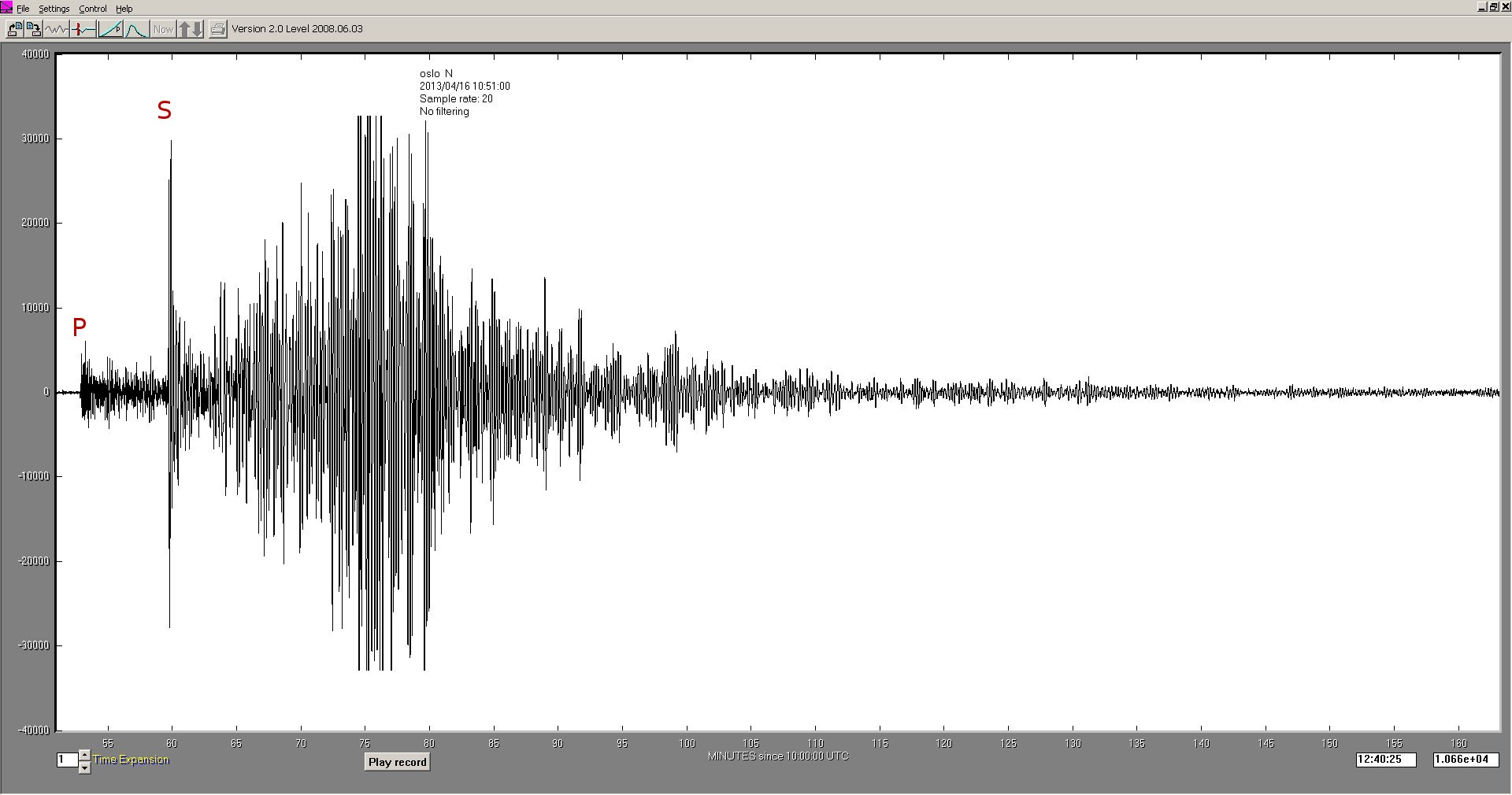
The geophones are best for relatively local quakes, less than a few 1000 km away. But powerful quakes like today's will show up as well. Here's what the vertical geophone got:

Earthquakes generate different kinds of waves through the Earth. On the geophone plot we can see the arrival of the P wave (primary or pressure wave). This is a compression type of wave that goes straight through the earth. These waves are high frequent waves, so even a 4.5 Hz geophone can see them clearly. Next is the S wave, the secondary wave that is a transverse wave, which travels slower than the P wave. As a rule of thumb about half the speed (around 7 km/s or P waves and 3.5 km/s for S waves, but the speeds really depend on the material and depth). The clever part is to look for the time difference between the arrivals, and then one can calculate the distance. Then make a network of seismometers around the world, and you can locate any earthquake with pretty high accuracy. It is remarkable that even the lower frequency S wave of today's quake shows up on the geophones (visible from 10:59:38). That's rare. The quake must be very powerful or close.
The seismometer with a period of nearly 20 seconds is much better at detecting these distant quakes:

Here the arrival of the S wave is clear. What then follow are the surface waves, which are the powerful waves that make the worst damage after a quake. These do not travel through earth but along the surface. Today's quake was more than 5000 km away, and the readings for the surface waves went off scale, so I can't get accurate measurements. But the ground movement here in Oslo must have had an amplitude of about 1.5 mm. That translates into a quake a little under magnitude 8 at a distance of 5200 km. The ground moves between the extremes only a few times per minute, so this movement is of course impossible to feel. For comparison the 2011 Japan quake was more than 7000 km away and caused ground movement here of nearly a cm. Still impossible to feel, but it was possible to watch the boom move!
NIL DIFFICILE VOLENTI
Edited by midtskogen - Tuesday, 16.04.2013, 13:58 |
| |
| |
| HarbingerDawn | Date: Tuesday, 16.04.2013, 14:00 | Message # 1088 |
|
Cosmic Curator
Group: Administrators
United States
Messages: 8717
Status: Offline
| Really cool stuff midtskogen
All forum users, please read this!
My SE mods and addons
Phenom II X6 1090T 3.2 GHz, 16 GB DDR3 RAM, GTX 970 3584 MB VRAM
|
| |
| |
| midtskogen | Date: Tuesday, 16.04.2013, 14:11 | Message # 1089 |
|
Star Engineer
Group: Users
Norway
Messages: 1674
Status: Offline
| Cool, but at it also send shivers down the spine when I see such graphs in the making. It almost always means that somewhere in the world a lot of people died just a few minutes ago.
Earthquakes of this magnitude usually occur a couple of times a year.
NIL DIFFICILE VOLENTI
|
| |
| |
| Watsisname | Date: Tuesday, 16.04.2013, 17:48 | Message # 1090 |
|
Galaxy Architect
Group: Global Moderators
United States
Messages: 2613
Status: Offline
| Thanks for sharing those midtskogen; I've always thought seismology was really fascinating and now you're making me want to get an instrument, if not for the fact that I'd probably have a lot of local traffic noise interfering with it. :/
Early reports indicate there was little in the way of severe damage from this quake, since it was so deep, though there were a handful of deaths. Sad, though a blessing considering what the magnitude was.
|
| |
| |
| HarbingerDawn | Date: Tuesday, 16.04.2013, 17:54 | Message # 1091 |
|
Cosmic Curator
Group: Administrators
United States
Messages: 8717
Status: Offline
| Quote (Watsisname) blessing
Do you think that one day we will ever have non-religious or non-mystical terminology to express such sentiments?
All forum users, please read this!
My SE mods and addons
Phenom II X6 1090T 3.2 GHz, 16 GB DDR3 RAM, GTX 970 3584 MB VRAM
|
| |
| |
| Watsisname | Date: Tuesday, 16.04.2013, 18:47 | Message # 1092 |
|
Galaxy Architect
Group: Global Moderators
United States
Messages: 2613
Status: Offline
| Heh, that's an interesting question. It occurs to me that indeed a lot of similar words (nouns) for such sentiments have such mystical/religious connotations; indeed I can't think of anything that doesn't, except perhaps "accident", but that has totally different unintended connotations. 
Accursed primitive human tendency to attribute supernatural causes to natural phenomenon! *shakes fist*
|
| |
| |
| midtskogen | Date: Tuesday, 16.04.2013, 19:19 | Message # 1093 |
|
Star Engineer
Group: Users
Norway
Messages: 1674
Status: Offline
| Quote (Watsisname) I've always thought seismology was really fascinating and now you're making me want to get an instrument, if not for the fact that I'd probably have a lot of local traffic noise interfering with it.
You can get the seismometer that I have here: http://www.mindsetsonline.co.uk/product_info.php?products_id=9047
See the manual for details. The price seems to have gone a bit up since I bought mine 5 years ago, but I doubt that you can do it much cheaper building it from scratch using plumbing parts, etc. It's a perfect learn-as-you-go science project, and I still find it fascinating. Traffic noise is more a problem for geophones, not that much for a seismometer, since the seismometer is tuned to frequencies well below 1 Hz. I live 30 meters from a tram line and I only see passing trains on the geophones, but if I apply a lowpass filter at around 5-10 Hz, the noise mostly disappears. You will need to place the seismometer on the ground floor, but even then you're going to pick up noise from activity in the building. And you should protect the instrument from draft. I put it in a storeroom in the basement, a room we rarely enter, and I built a case for it with transparent sides. For logging I'm using an old NAS box (266 MHz ARM, 32 MB RAM) with the firmware replace with Debian Linux to avoid the hassle of a clunky PC.
Quote (HarbingerDawn) Do you think that one day we will ever have non-religious or non-mystical terminology to express such sentiments?
I don't know why English went for the mystical, religion only "stain with blood" word for this sentiment. Other languages loan the Latin "benedicere" word (translated in Scandinavian), which simply means "to speak well".
Frankly, I don't see the point of half-hearted attempts to change the language to avoid religious connotations, like changing BC to BCE (which still is a reference to the birth year of Jesus, roughly). A useful change in that case would be to change the zero point altogether (more correctly introduce a zero point, so we can do arithmetic across 1 AD) if there is an astronomical meaningful year 0 (and practical - years after the big bang is not very practical).
Quote (Watsisname) Accursed primitive human tendency to attribute supernatural causes to natural phenomenon! *shakes fist*
It's a way of ascribe meaning and purpose to the world. Science does to a degree the same thing, but rather order and predictability instead of meaning and purpose.
edit: I don't suggest that science is just another religion or something like that, but that it is in human nature to seek answers and that is the origin of both religion and science.
NIL DIFFICILE VOLENTI
Edited by midtskogen - Tuesday, 16.04.2013, 19:34 |
| |
| |
| Watsisname | Date: Tuesday, 16.04.2013, 19:53 | Message # 1094 |
|
Galaxy Architect
Group: Global Moderators
United States
Messages: 2613
Status: Offline
| Quote (Watsisname) Quote (midtskogen)
You gain even more simply for living closer to the equator.
General Relativistic effect due to being farther from the center of mass almost perfectly cancels this out. (A strange coincidence). smile
Ooooh, I need to revisit this post. I started thinking about this a bit more and came to the realization that my understanding was horribly inadequate! I was right in saying that the two effects almost perfectly cancel out, but I was wrong in saying that it was a coincidence. It is not a coincidence at all.
It turns out that if the Earth were a perfect rotating fluid, such that its surface follows an equipotential surface, then there is no change in time dilation with latitude. I.e. on an ideal Earth with no topography, a clock at the equator will tick at exactly the same rate as a clock at one of the poles. Indeed, all clocks on the Earth would tick at the exact same rate.
On the real Earth, this happens to be an extremely good approximation, and the effect of changing one's altitude (e.g. living on a mountain vs sea level) is the most significant source of variation.
Midtskogen, thanks for the info on the seismometers.
|
| |
| |
| HarbingerDawn | Date: Tuesday, 16.04.2013, 21:50 | Message # 1095 |
|
Cosmic Curator
Group: Administrators
United States
Messages: 8717
Status: Offline
| We appear to have set yet another all time attendance record a few hours ago with 133 visitors. I wish I knew where all of these people are coming from...
All forum users, please read this!
My SE mods and addons
Phenom II X6 1090T 3.2 GHz, 16 GB DDR3 RAM, GTX 970 3584 MB VRAM
|
| |
| |
 ENG
ENG New site


 Norway


 Italy
Italy 


 United States