|
Astrophotography
|
|
| Watsisname | Date: Wednesday, 16.12.2015, 11:16 | Message # 541 |
 Galaxy Architect
Group: Global Moderators
 United States
Messages: 2613
Status: Offline
| Awesome! Now it appropriately looks like your logo. 

|
| |
| |
| midtskogen | Date: Wednesday, 16.12.2015, 12:59 | Message # 542 |
 Star Engineer
Group: Users
 Norway
Messages: 1674
Status: Offline
| This year's best Geminid as viewed from my house was this one:
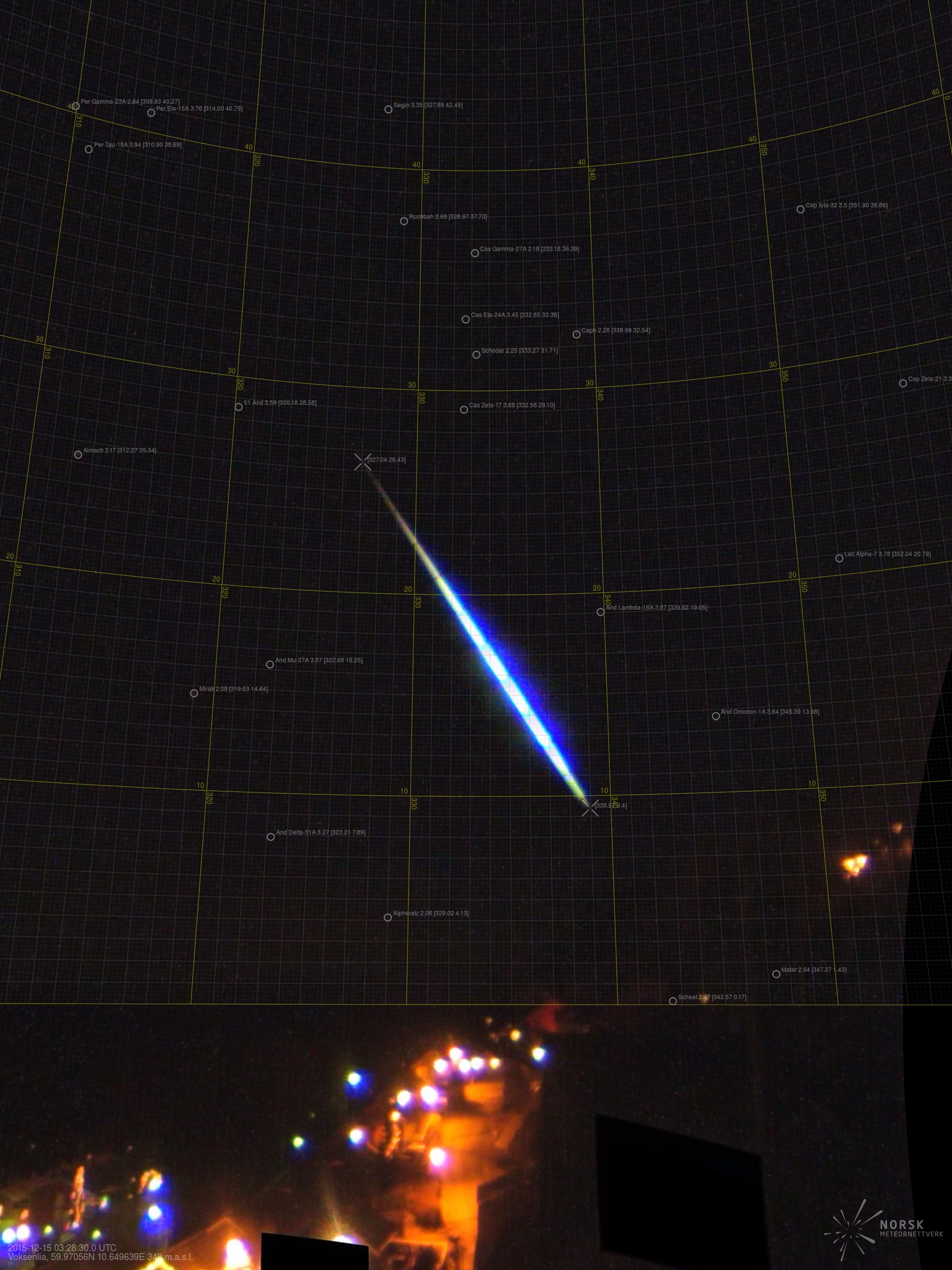
It faded at an altitude of 32.9 km. It was visible for 2.6 seconds. A rough guess of its brightness is -11. The parent body of the Geminids is made of hard stuff.
NIL DIFFICILE VOLENTI

|
| |
| |
| Watsisname | Date: Sunday, 20.12.2015, 05:40 | Message # 543 |
|
Galaxy Architect
Group: Global Moderators
United States
Messages: 2613
Status: Offline
| Incredible airglow photographed by Yuri Beletsky on SpaceWeather.com:

|
| |
| |
| HarbingerDawn | Date: Sunday, 20.12.2015, 10:03 | Message # 544 |
 Cosmic Curator
Group: Administrators
United States
Messages: 8717
Status: Offline
| Quote Watsisname (  ) Incredible airglow photographed by Yuri Beletsky on SpaceWeather.com:
Holy -! That's unbelievable!
All forum users, please read this!
My SE mods and addons
Phenom II X6 1090T 3.2 GHz, 16 GB DDR3 RAM, GTX 970 3584 MB VRAM
|
| |
| |
| midtskogen | Date: Sunday, 20.12.2015, 18:57 | Message # 545 |
|
Star Engineer
Group: Users
Norway
Messages: 1674
Status: Offline
| Some northern lights in Oslo this evening. I just saw the corona, but I scared it away with my camera.
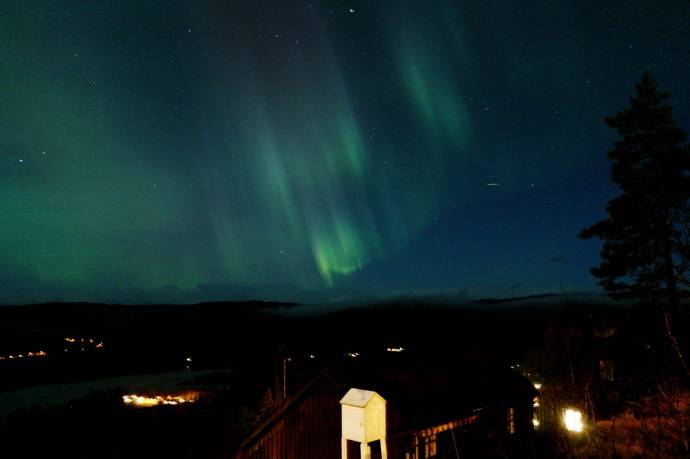
NIL DIFFICILE VOLENTI
Edited by midtskogen - Sunday, 20.12.2015, 21:35 |
| |
| |
| HarbingerDawn | Date: Wednesday, 20.01.2016, 04:06 | Message # 546 |
|
Cosmic Curator
Group: Administrators
United States
Messages: 8717
Status: Offline
| I got a video of the Moon occulting Aldebaran
All forum users, please read this!
My SE mods and addons
Phenom II X6 1090T 3.2 GHz, 16 GB DDR3 RAM, GTX 970 3584 MB VRAM
|
| |
| |
| DoctorOfSpace | Date: Wednesday, 20.01.2016, 04:41 | Message # 547 |
 Galaxy Architect
Group: Global Moderators
 Pirate
Messages: 3600
Status: Offline
| Quote HarbingerDawn ( ) Moon occulting Aldebaran
Very nice
Intel Core i7-5820K 4.2GHz 6-Core Processor
G.Skill Ripjaws V Series 32GB (4 x 8GB) DDR4-2400 Memory
EVGA GTX 980 Ti SC 6GB
|
| |
| |
| Watsisname | Date: Wednesday, 20.01.2016, 05:00 | Message # 548 |
|
Galaxy Architect
Group: Global Moderators
United States
Messages: 2613
Status: Offline
| Neat! I've always wanted to see a bright lunar occultation like this.
|
| |
| |
| HarbingerDawn | Date: Wednesday, 20.01.2016, 15:49 | Message # 549 |
|
Cosmic Curator
Group: Administrators
United States
Messages: 8717
Status: Offline
| I made a gif of the occultation, showing how it progresses over the course of 4 frames.

All forum users, please read this!
My SE mods and addons
Phenom II X6 1090T 3.2 GHz, 16 GB DDR3 RAM, GTX 970 3584 MB VRAM
|
| |
| |
| Watsisname | Date: Saturday, 23.01.2016, 12:25 | Message # 550 |
|
Galaxy Architect
Group: Global Moderators
United States
Messages: 2613
Status: Offline
| Mmm, what's the video framerate? Like 30fps? Would be interesting to use it to try to estimate (if even very imprecisely) the angular size of Aldebaran, and compare with expectation for its true size and distance. 
|
| |
| |
| HarbingerDawn | Date: Saturday, 23.01.2016, 13:32 | Message # 551 |
|
Cosmic Curator
Group: Administrators
United States
Messages: 8717
Status: Offline
| Framerate = 29.97 fps, and (for the sake of completeness) each frame is a 1/31 second exposure.
Next time I'll sacrifice some resolution so I can record at 60 fps.
All forum users, please read this!
My SE mods and addons
Phenom II X6 1090T 3.2 GHz, 16 GB DDR3 RAM, GTX 970 3584 MB VRAM
Edited by HarbingerDawn - Saturday, 23.01.2016, 13:34 |
| |
| |
| midtskogen | Date: Saturday, 23.01.2016, 17:59 | Message # 552 |
|
Star Engineer
Group: Users
Norway
Messages: 1674
Status: Offline
| The sidereal orbit period is 27.322 days, so the Moon moves 360/27.322/24 = 0.55 arc seconds per second. Assuming that Aldebaran was partially occulted during 4 frames, we get the angular size by multiplying with 4/30*1000/1001=0.073 arc seconds if the Moon met Aldebaran "head on", and this figure would be the upper limit. The accepted value is 0.020.
It's difficult to get a precise measurement using this method, since we would have to know the exact slope of the moon hill where it set.
NIL DIFFICILE VOLENTI
|
| |
| |
| Watsisname | Date: Sunday, 24.01.2016, 00:54 | Message # 553 |
|
Galaxy Architect
Group: Global Moderators
United States
Messages: 2613
Status: Offline
| Not too bad to be within a factor of 5, given 4 frames and those assumptions. That's pretty neat! To be more precise, we could account for the variable angular speed of the Moon (its non-circular orbit makes a very big difference), and the contact angle. The terrain slope is then the only significant unknown.
Moon map at time of disappearance for Boston, MA

The contact angle is about -23°, with a radial velocity of 0.36 "/second. Then a 4 frame disappearance time equates to about 0.048" disk diameter. Better; almost factor of 2 accuracy. Lunar terrain could explain that, but would require a very steep slope (>60°).
However, I would actually argue that the star vanishes in only 2 or 3 frames. Frame one has essentially 100% flux, while frame 3 has nearly zero flux, and it is completely gone in frame 4. The Occultation software actually predicts a disappearance time of 0.08 seconds, or 2.4 frames at 30fps, which is exactly consistent with this.
Neat!
|
| |
| |
|
| HarbingerDawn | Date: Thursday, 28.01.2016, 12:17 | Message # 555 |
|
Cosmic Curator
Group: Administrators
United States
Messages: 8717
Status: Offline
| Wow, great shot of the ISS!
All forum users, please read this!
My SE mods and addons
Phenom II X6 1090T 3.2 GHz, 16 GB DDR3 RAM, GTX 970 3584 MB VRAM
|
| |
| |
 ENG
ENG New site


 United States


 Norway

 Pirate
 Poland


