|
Science and Astronomy Questions
|
|
| Bells_Theorem | Date: Thursday, 02.06.2016, 20:31 | Message # 481 |
 Explorer
Group: Users
 United States
Messages: 188
Status: Offline
| Quote spacer (  ) if we ever terraform titan, and lets say the atmosphere will be 70% N 20% O
but also the amount of methane and ethane will stay as today, will we be able to breath?
1.5% of methane sound alot
I would imagine with that much free oxygen available the methane and ethane would oxidize rather quickly.
|
| |
| |
| spacer | Date: Thursday, 02.06.2016, 21:13 | Message # 482 |
 Star Engineer
Group: Users
 Israel
Messages: 1258
Status: Offline
| mmm interesting, only in my first year of chimestry. would like to learn about all of that stuff.
but meanwhile we are just in the basics 
"we began as wanderers, and we are wanderers still"
-carl sagan
-space engine photographer
|
| |
| |
| Bells_Theorem | Date: Friday, 03.06.2016, 00:14 | Message # 483 |
|
Explorer
Group: Users
United States
Messages: 188
Status: Offline
| You are probably ahead of me already 
|
| |
| |
| JackDole | Date: Sunday, 05.06.2016, 12:48 | Message # 484 |
 Star Engineer
Group: Local Moderators
 Germany
Messages: 1742
Status: Offline
| How do I calculate the habitable zone of a star in SpaceEngine?
A simple formula that I've found is:
Radius = sqrt (bolometric luminosity star / bolometric luminosity sun).
The problem is:
The bolometric luminosity of the sun is known (4.72), but SpaceEngine not provides the bolometric luminosity of a star.
Don't forget to look here.

|
| |
| |
| Alek | Date: Sunday, 05.06.2016, 18:49 | Message # 485 |
 Pioneer
Group: Users
United States
Messages: 326
Status: Offline
| Quote JackDole ( ) How do I calculate the habitable zone of a star in SpaceEngine?
I'm not sure, but if you have Universe Sandbox you could recreate the star in that (or if you don't have it I could, for you, if you wanted)
Living among the stars, I find my way. I grow in strength through knowledge of the space I occupy, until I become the ruler of my own interstellar empire of sorts. Though The world was made for the day, I was made for the night, and thus, the universe itself is within my destiny.
|
| |
| |
| JackDole | Date: Sunday, 05.06.2016, 20:06 | Message # 486 |
|
Star Engineer
Group: Local Moderators
Germany
Messages: 1742
Status: Offline
| Quote Alek ( ) if you have Universe Sandbox you could recreate the star in that
That would be a bit complicated. 
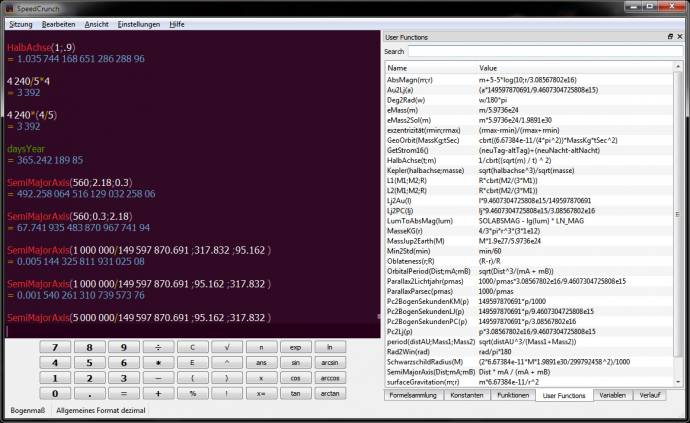
What I need is a formula that I could program as a function in my calculator.
Don't forget to look here.
|
| |
| |
| Watsisname | Date: Sunday, 05.06.2016, 21:31 | Message # 487 |
 Galaxy Architect
Group: Global Moderators
United States
Messages: 2613
Status: Offline
| There are many different ways of defining the habitable zone, so I'll derive a generic formula and you can choose your own parameters to put into it.

This formula will output the distance from the star (in AU) for which the equilibrium surface temperature of the planet is T (in Kelvin). So you can choose your T for the inner/outer edges of the habitable zone and see where they lie.
L*/LSun is the luminosity of the star in solar units
AB is the albedo of the planet (0.3 for Earth, or use 0 for a blackbody)
epsilon (ε) is the emissivity of the planet (this is akin to a "greenhouse parameter" -- set it to 1 for an airless world, or 0.6 for Earth-like)
sigma (σ) is the Stefan-Boltzmann constant = 5.67*10-8W/m^2/K^4.
and the AU*sqrt(kg)/s^(3/2) is just dimensional consistency so that the answer is in AU. (So to actually use this formula it's just 131 times everything under the big square root).

|
| |
| |
| Alek | Date: Sunday, 05.06.2016, 21:53 | Message # 488 |
|
Pioneer
Group: Users
United States
Messages: 326
Status: Offline
| Actually, due to the fact that Space Engine gives you the Absolute Luminosity automatically I don't think you need the Bolometric Luminosity at all.
A formula using only the Absolute Luminosity of the star would be:
InnerRadius = sqrt(StarLuminosity/1.1)
OuterRadius = sqrt(StarLuminosity/0.53)
This will give you the inner and outer radius of the habitable zone without even needing the Bolometric Luminosity at all, you can just use the Absolute Luminosity (Which is given in Space Engine)
Now, if you want more accurate estimates, I don't know, since different planets with different types of atmospheres would of course respond in temperature differently to their star's light and thinner/thicker atmospheres would effect the stability of liquid water, so I assume these estimates are for Earth's situation (atmosphere, albedo, ect.)
Formula source.
Ninja'd. I'll keep this here though in case you just want to use this for whatever reason.
Living among the stars, I find my way. I grow in strength through knowledge of the space I occupy, until I become the ruler of my own interstellar empire of sorts. Though The world was made for the day, I was made for the night, and thus, the universe itself is within my destiny.
Edited by Alek - Sunday, 05.06.2016, 21:56 |
| |
| |
| spacer | Date: Monday, 06.06.2016, 10:05 | Message # 489 |
|
Star Engineer
Group: Users
Israel
Messages: 1258
Status: Offline
| if mars rover will find lets say bacteria on the surface, will it discover the bacteria itself or it will be shown as organic molecules?
"we began as wanderers, and we are wanderers still"
-carl sagan
-space engine photographer
|
| |
| |
| JackDole | Date: Monday, 06.06.2016, 11:37 | Message # 490 |
|
Star Engineer
Group: Local Moderators
Germany
Messages: 1742
Status: Offline
| Watsisname, Alek,
Thank you!
Watsisname,
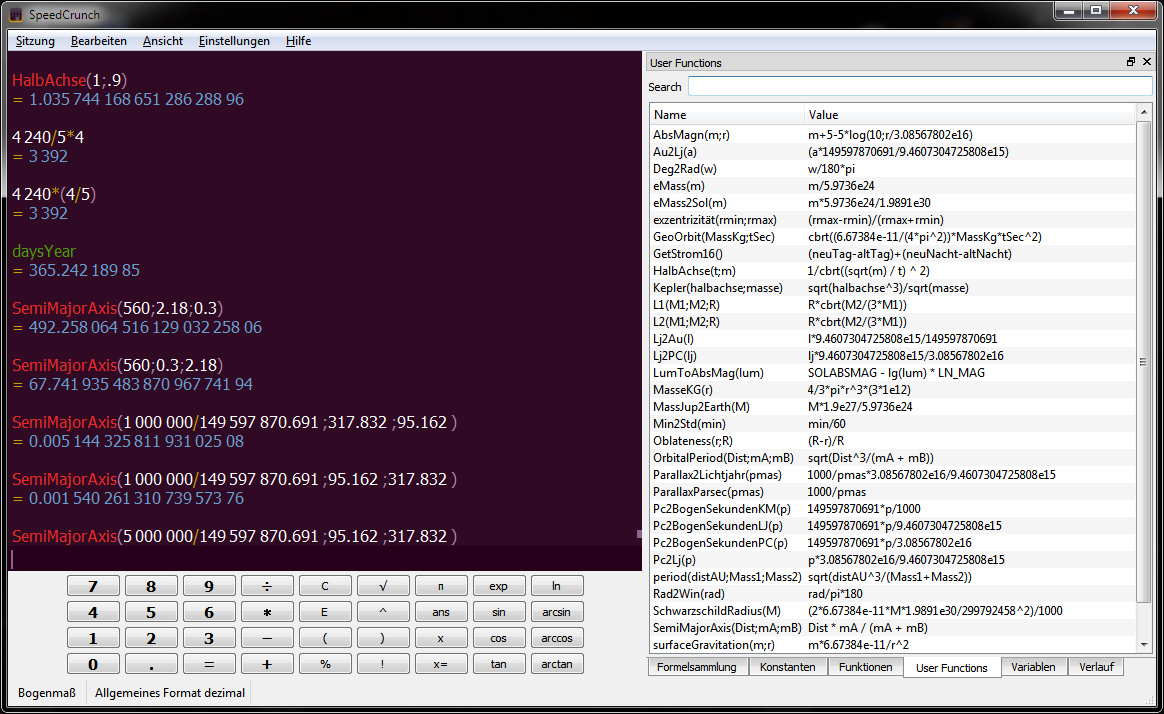
I made your informations to a function for my calculator,
hz(Lstern;Ab;T) = 131*sqrt(Lstern*((1-Ab)/(16*pi*0.6*5.670367e-8*T^4)))
I assume that Lsun is equal 1, therefore I let it away.
For the value of epsilon I used 0.6. (For Earth-like planets.)
I hope, this is correct!
Alek,
Quote Alek ( ) due to the fact that Space Engine gives you the Absolute Luminosity automatically I don't think you need the Bolometric Luminosity at all.
That's just what I wanted. A formula without bolometric luminosity, because this is not supplied by SpaceEngine.
And thanks for the link, that is exactly what I have searched and not found.
Don't forget to look here.
Edited by JackDole - Monday, 06.06.2016, 11:40 |
| |
| |
| Alek | Date: Monday, 06.06.2016, 22:59 | Message # 491 |
|
Pioneer
Group: Users
United States
Messages: 326
Status: Offline
| Quote JackDole ( ) That's just what I wanted. A formula without bolometric luminosity, because this is not supplied by SpaceEngine.
And thanks for the link, that is exactly what I have searched and not found.
No problem, glad I could help.
Living among the stars, I find my way. I grow in strength through knowledge of the space I occupy, until I become the ruler of my own interstellar empire of sorts. Though The world was made for the day, I was made for the night, and thus, the universe itself is within my destiny.
|
| |
| |
| Watsisname | Date: Tuesday, 07.06.2016, 02:42 | Message # 492 |
|
Galaxy Architect
Group: Global Moderators
United States
Messages: 2613
Status: Offline
| Quote JackDole ( ) Watsisname,
I made your informations to a function for my calculator,
hz(Lstern;Ab;T) = 131*sqrt(Lstern*((1-Ab)/(16*pi*0.6*5.670367e-8*T^4)))
I assume that Lsun is equal 1, therefore I let it away.
For the value of epsilon I used 0.6. (For Earth-like planets.)
I hope, this is correct!
Looks perfect! And yep, your Lstern value is just how luminous the star is relative to the sun, which SE should show. As a test, for a temperature of 273K with a star twice as luminous as the Sun (and Ab=0.3, ε=0.6), you should get 1.59AU.
|
| |
| |
| JackDole | Date: Tuesday, 07.06.2016, 08:05 | Message # 493 |
|
Star Engineer
Group: Local Moderators
Germany
Messages: 1742
Status: Offline
| Quote Watsisname ( ) As a test, for a temperature of 273K with a star twice as luminous as the Sun (and Ab=0.3, ε=0.6), you should get 1.59AU.
1.590354
Test passed!
Don't forget to look here.
|
| |
| |
| steeljaw354 | Date: Friday, 10.06.2016, 10:47 | Message # 494 |
 World Builder
Group: Users
 Pirate
Messages: 862
Status: Offline
| But if you have an earth like planet and you look up into the sky will that sun be twice as bright? Or will it be 1 because it is in the habitable zone?
|
| |
| |
| Watsisname | Date: Friday, 10.06.2016, 12:08 | Message # 495 |
|
Galaxy Architect
Group: Global Moderators
United States
Messages: 2613
Status: Offline
| Same brightness. That's actually the fundamental physics for it -- temperature of a planet is based on the balance between energy coming in (sunlight) and energy going out (thermal emission). So for an Earth analogue planet, it better be receiving Earth-like intensity of sunlight to have an Earth-like temperature.
Formula shows that, too. Radius of habitable zone grows as the square root of star's luminosity, if all else is equal. But intensity of solar radiation drops as inverse distance squared. So if you quadruple the star's luminosity, the habitable zone shifts 2 times farther out, where intensity of sunlight was quadrupled from being 4 times weaker.
|
| |
| |
 ENG
ENG New site


 United States

 Israel
 Germany

 Pirate