|
Space anomalies
|
|
| midtskogen | Date: Sunday, 29.12.2013, 20:13 | Message # 166 |
 Star Engineer
Group: Users
 Norway
Messages: 1674
Status: Offline
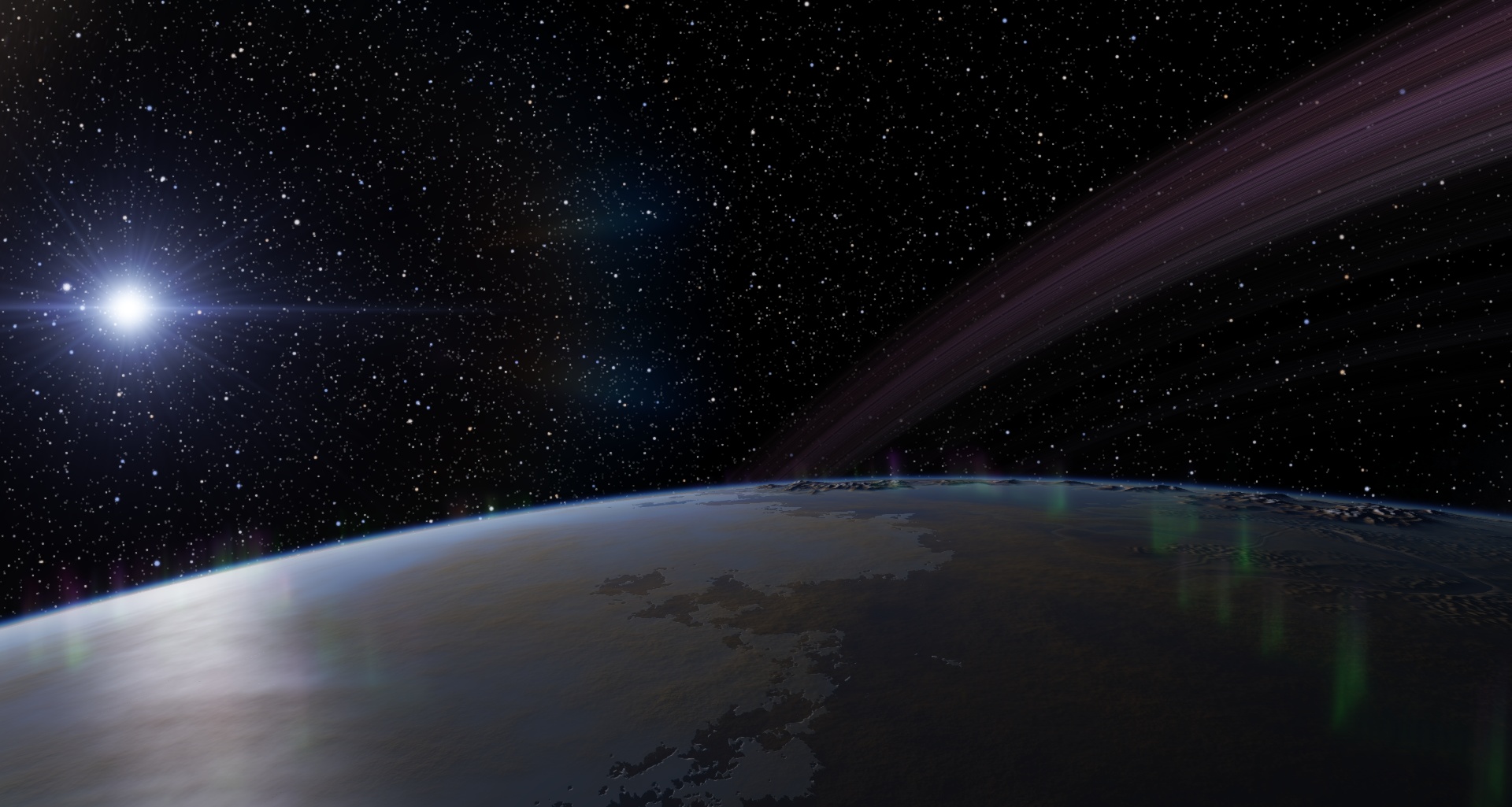
| A couple of oddities with this world RS 8411-1-5-28127-227 7 in 0971: It has big polar caps, yet very large seasonal variations. The axial tilt is 159 degrees, but it doesn't look like that when I speed up time.
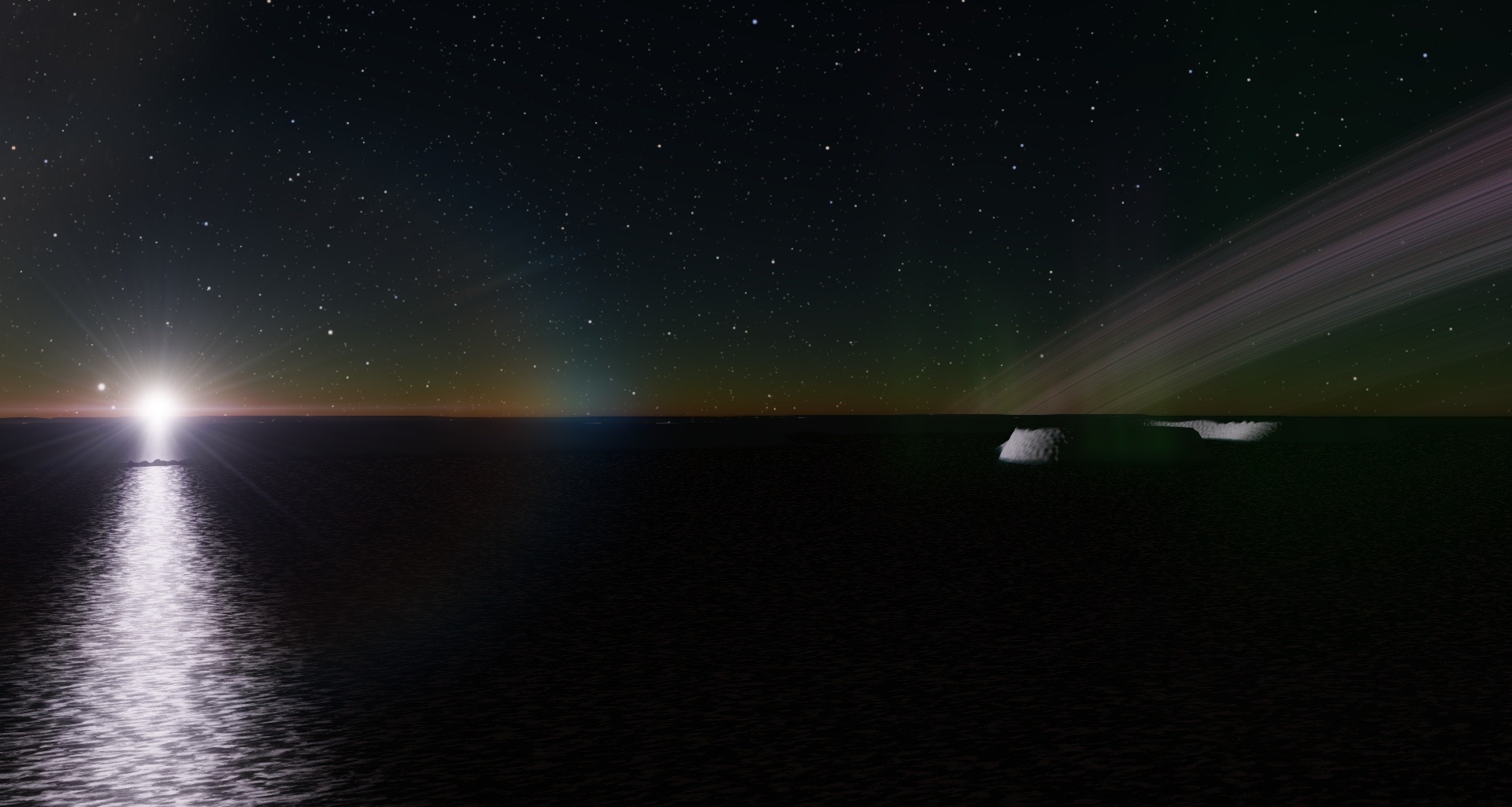
It also has aurora reaching sea level. Which might be the case on alien worlds for what I know. But it also makes aurora visible in front of pretty close objects, which doesn't seem realistic.
NIL DIFFICILE VOLENTI

Edited by midtskogen - Sunday, 29.12.2013, 20:16 |
| |
| |
| HarbingerDawn | Date: Monday, 30.12.2013, 01:05 | Message # 167 |
 Cosmic Curator
Group: Administrators
 United States
Messages: 8717
Status: Offline
| Quote midtskogen (  ) It also has aurora reaching sea level
It must be a bug in the case of this planet; the aurorae are shown extended down beneath the seabed, which is clearly impossible. Aurorae are coded (I think) to begin at the atmosphere height of the planet, so something must be bugged in this particular case.
All forum users, please read this!
My SE mods and addons
Phenom II X6 1090T 3.2 GHz, 16 GB DDR3 RAM, GTX 970 3584 MB VRAM
|
| |
| |
| midtskogen | Date: Monday, 30.12.2013, 08:48 | Message # 168 |
|
Star Engineer
Group: Users
Norway
Messages: 1674
Status: Offline
| I made a gif showing the polar caps and the extreme seasonal variations, which does not at all look like the listed 159 degree axial tilt.
NIL DIFFICILE VOLENTI
|
| |
| |
| Hachouma | Date: Monday, 30.12.2013, 10:36 | Message # 169 |
 Space Tourist
Group: Users
 Algeria
Messages: 22
Status: Offline
| Why are there unknown stars?

Edited by Hachouma - Monday, 30.12.2013, 10:37 |
| |
| |
| DoctorOfSpace | Date: Monday, 30.12.2013, 10:41 | Message # 170 |
 Galaxy Architect
Group: Global Moderators
 Pirate
Messages: 3600
Status: Offline
| Quote Hachouma ( ) Why are there unknown stars?
Considering that is a cataloged star I would assume there is an error in the catalog listing. If you list a spaceship or planet wrong you get an unknown type.
Intel Core i7-5820K 4.2GHz 6-Core Processor
G.Skill Ripjaws V Series 32GB (4 x 8GB) DDR4-2400 Memory
EVGA GTX 980 Ti SC 6GB
|
| |
| |
| HarbingerDawn | Date: Monday, 30.12.2013, 12:14 | Message # 171 |
|
Cosmic Curator
Group: Administrators
United States
Messages: 8717
Status: Offline
| Quote midtskogen ( ) which does not at all look like the listed 159 degree axial tilt.
It orbits a barycenter with its satellite; the axial tilt is probably erroneously given relative to its orbit around the barycenter rather than around the sun.
All forum users, please read this!
My SE mods and addons
Phenom II X6 1090T 3.2 GHz, 16 GB DDR3 RAM, GTX 970 3584 MB VRAM
|
| |
| |
| midtskogen | Date: Monday, 30.12.2013, 13:37 | Message # 172 |
|
Star Engineer
Group: Users
Norway
Messages: 1674
Status: Offline
| Quote HarbingerDawn ( ) It orbits a barycenter with its satellite; the axial tilt is probably erroneously given relative to its orbit around the barycenter rather than around the sun.
Yes, that seems to fit. Technically it can do that since the reference orbit plane is not explicitly stated, but then that tilt shouldn't be used to determine ice caps. The satellite can't emit that much infrared...
NIL DIFFICILE VOLENTI
|
| |
| |
| HarbingerDawn | Date: Monday, 30.12.2013, 15:18 | Message # 173 |
|
Cosmic Curator
Group: Administrators
United States
Messages: 8717
Status: Offline
| Quote midtskogen ( ) The satellite can't emit that much infrared...
Aliens 
All forum users, please read this!
My SE mods and addons
Phenom II X6 1090T 3.2 GHz, 16 GB DDR3 RAM, GTX 970 3584 MB VRAM
|
| |
| |
| Solid_Granite | Date: Sunday, 05.01.2014, 07:05 | Message # 174 |
|
Observer
Group: Newbies
 New Zealand
Messages: 2
Status: Offline
| A supergiant orbiting binary black holes.

Edited by Solid_Granite - Sunday, 05.01.2014, 07:06 |
| |
| |
| JCandeias | Date: Monday, 06.01.2014, 01:50 | Message # 175 |
 Pioneer
Group: Translators
 Portugal
Messages: 387
Status: Offline
| I don't see anything anomalous about this, Solid_Granite. It's just an evolved high-mass multiple star system. There should be many such systems across the universe.
They let me use this!

|
| |
| |
| DeathStar | Date: Monday, 06.01.2014, 02:09 | Message # 176 |
|
Pioneer
Group: Users
 Croatia
Messages: 515
Status: Offline
| JCandeias, although it may not really be an anomaly, an X-ray binary is certainly a rare find(at least for me)
|
| |
| |
| JCandeias | Date: Monday, 06.01.2014, 02:22 | Message # 177 |
|
Pioneer
Group: Translators
Portugal
Messages: 387
Status: Offline
| It is an interesting find (and I'd love to know where that is... coordinates?), and considering how rare heavy stars are overall, it should be pretty rare indeed. But still, if one considers the number of star systems there are in the universe (and even in Space Engine's universe), there should be quite a few examples of this kind of needle in such a humongous haystack.
And again - not an anomaly.
They let me use this!
|
| |
| |
| DIS7RICT | Date: Monday, 06.01.2014, 07:09 | Message # 178 |
 Space Pilot
Group: Users
 Australia
Messages: 114
Status: Offline
| Binary system right next to the center of a star cluster, with 21 planets, 16 if which have life.

PC: Core i7 3770K 3.5GHz, 8GB RAM, GTX670 2GB, Win 7 64-bit
There'll be another time...
|
| |
| |
| DeathStar | Date: Monday, 06.01.2014, 11:15 | Message # 179 |
|
Pioneer
Group: Users
Croatia
Messages: 515
Status: Offline
| Quote DIS7RICT ( ) Binary system right next to the center of a star cluster, with 21 planets, 16 if which have life.
Nothing special in the new version, really. Ive seen systems with 21 planets with life.
|
| |
| |
| HarbingerDawn | Date: Monday, 06.01.2014, 11:35 | Message # 180 |
|
Cosmic Curator
Group: Administrators
United States
Messages: 8717
Status: Offline
| Quote DeathStar ( ) Ive seen systems with 21 planets with life.
I bet they weren't at the very center of a star cluster though.
All forum users, please read this!
My SE mods and addons
Phenom II X6 1090T 3.2 GHz, 16 GB DDR3 RAM, GTX 970 3584 MB VRAM
|
| |
| |
 ENG
ENG New site


 Norway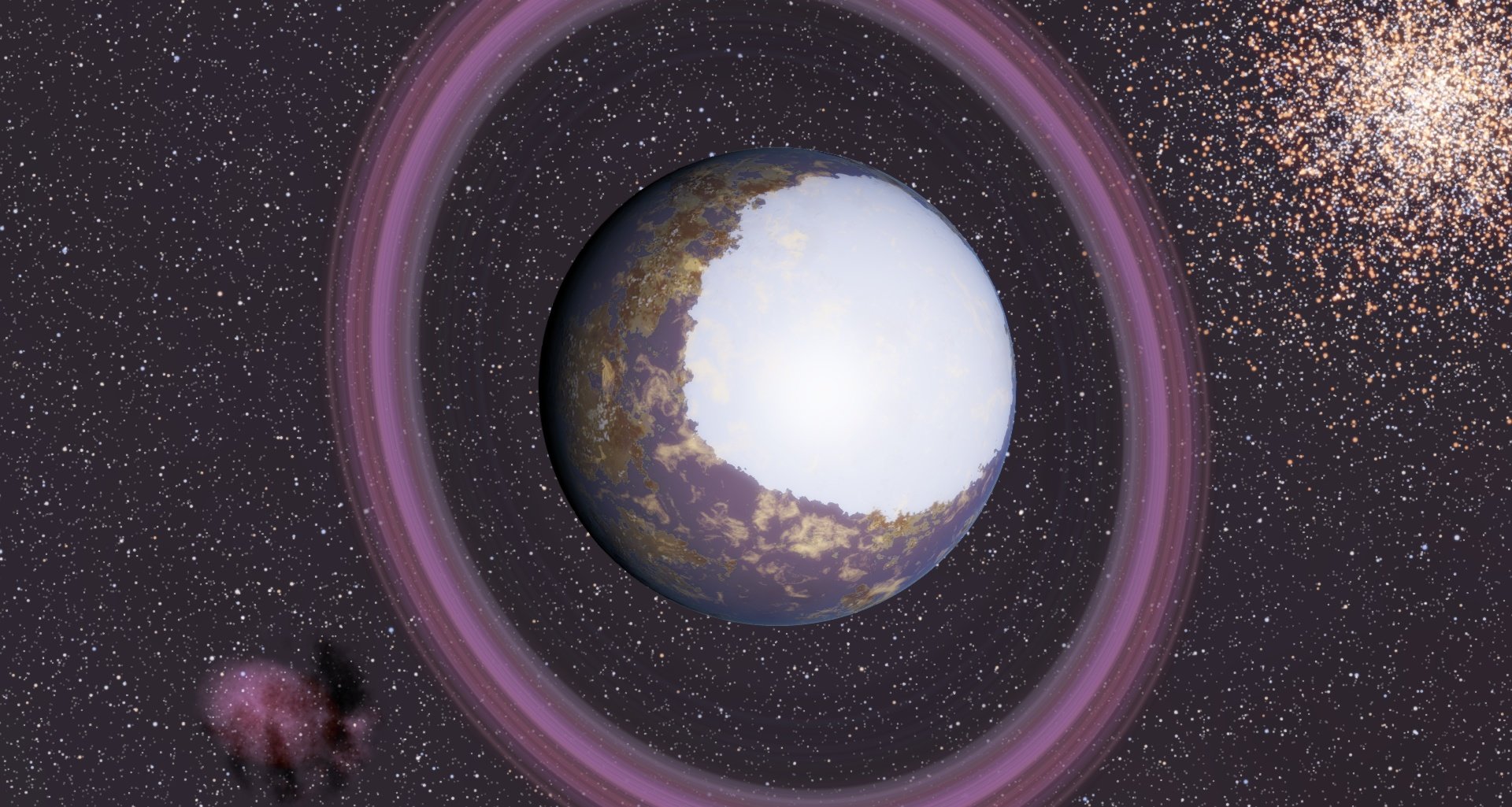


 United States
 Algeria

 Pirate
 New Zealand
 Portugal
  Croatia
  Australia