|
Challenge: Find a new home!
|
|
| Tangle10 | Date: Saturday, 10.01.2015, 22:21 | Message # 91 |
 Space Pilot
Group: Users
 United States
Messages: 129
Status: Offline
| Quote abyssoft (  ) too low gravity and atmo pres.
They may be LOW but they are still safe.
Tips for finding Earth-Like planets: Look for F, G, or K Class stars. M class habitables will almost always be tidelocked. Oceanias can, of course, also be habitable, they just have tiny amounts of land.
|
| |
| |
| isdebesl | Date: Sunday, 25.01.2015, 11:21 | Message # 92 |
 Space Pilot
Group: Users
 Indonesia
Messages: 87
Status: Offline
| must be in milky way?
|
| |
| |
| sjoerd | Date: Sunday, 25.01.2015, 14:05 | Message # 93 |
|
Observer
Group: Newbies
 Pirate
Messages: 5
Status: Offline
| Here is my try on finding an Earth-like planet:
(even though it is probably to far from home to ever be visited by humans...(7.178 Gly))
RS 0-0-0-279-4091-7-1883052-15 A4
Name: Ustora
Specs:
Mass: 0.5292 Earth-masses
Diameter: 10206.856 Km
ESI: 0.954
Moons: 5 (1 large moons for stabilizing its Axis)
Year length: 202.536 days
Day length: 1.047 Days
Axial tilt: 34°33'15."60
Atmo Pressure: 1.0797
Temperature: 20.366 °C
Greenhouse eff: 36.703 °C
Age: 11.869 billion years
Life: Organic multicellular (Marine, Terrestrial)
Sun Specs:
Spectrum: K3 V
Mass: 0.70335 Solar-masses
Temperature: 4456.9 °C
Lifetime: 37.420 billion years
Screenshots:
(with Reshade for fun  ) )
http://i376.photobucket.com/albums....ta9.png
http://i376.photobucket.com/albums....np3.png
http://i376.photobucket.com/albums....2108226
|
| |
| |
| Tangle10 | Date: Sunday, 25.01.2015, 18:30 | Message # 94 |
|
Space Pilot
Group: Users
United States
Messages: 129
Status: Offline
| One thing: Reshade changes the universal seed, making a second universe with planets very different. You're lucky in this case- the star exists. However, it's not binary, is less massive, is a K6, and has no habitable planets in its system.
Tips for finding Earth-Like planets: Look for F, G, or K Class stars. M class habitables will almost always be tidelocked. Oceanias can, of course, also be habitable, they just have tiny amounts of land.
|
| |
| |
| SolarLiner | Date: Sunday, 25.01.2015, 20:00 | Message # 95 |
 Explorer
Group: Users
 France
Messages: 267
Status: Offline
| Quote sjoerd ( ) Screenshots:
(with Reshade for fun)
Hey, nice to see people using my version of Reshade tweaks ! 
But yeah, for some reason it changes the Universe seed. To me it's like saying that a leaf stuck on the wipers broke the car's engine, but it's happening nonetheless, there's a link somewhere ...
custom landing page to share: http://bit.ly/spaceengine
|
| |
| |
| sjoerd | Date: Sunday, 25.01.2015, 21:26 | Message # 96 |
|
Observer
Group: Newbies
Pirate
Messages: 5
Status: Offline
| huh?, wierd,
I didn't know that..., any ideas on how I could fix the glitch (preferebly without losing re-shade...)
(+ yes, I liked you re-shade setting so I copied them and applied them to my space engine )
I will try to disable re-shade and look for another earth copy
|
| |
| |
| Tangle10 | Date: Monday, 26.01.2015, 02:11 | Message # 97 |
|
Space Pilot
Group: Users
United States
Messages: 129
Status: Offline
| Quote isdebesl ( ) must be in milky way?
Nope! Can be in tiny galaxy on the sheer edge of universe.
Tips for finding Earth-Like planets: Look for F, G, or K Class stars. M class habitables will almost always be tidelocked. Oceanias can, of course, also be habitable, they just have tiny amounts of land.
|
| |
| |
| Nol | Date: Monday, 02.02.2015, 16:29 | Message # 98 |
 Space Pilot
Group: Users
 Germany
Messages: 97
Status: Offline
| FINALLY! RS 0-8-5692205-104-23-8-16046743-158 B7.1

"Eins - Hier kommt die Sonne
Zwei - Hier kommt die Sonne
Drei - Sie ist der hellste Stern von allen
Vier - Hier kommt die Sonne"
-Rammstein, Sonne, Mutter, 2001
|
| |
| |
| Elenchus | Date: Wednesday, 04.02.2015, 23:25 | Message # 99 |
 Observer
Group: Newbies
United States
Messages: 5
Status: Offline
| I found this one entirely by accident. I was looking for Titans with exotic multi-cellular life, when this one popped up:
Presenting, Pangaea Ultima, ESI 0.966

Along with a nice view from it's nearest moon

Quote
PObject
{
LocName "Pangaea Ultima"
Name "RS 0-8-3894334-39-5-7-601234-75 4"
Parent "RS 0-8-3894334-39-5-7-601234-75"
Pioneer "Player"
Date "2015.02.04 22:54:24.64"
}
|
| |
| |
| Tac1017 | Date: Monday, 09.02.2015, 17:57 | Message # 100 |
 Explorer
Group: Users
United States
Messages: 167
Status: Offline
| I think that the atmospheric pressure shoud just be from 0.95-1.5, as I don't intend on always wearing an oxygen mask...
The Terra Hunter of the Milky Way!
(By the way, I was born in 2001, NOT 1972 XD)
|
| |
| |
| Tangle10 | Date: Sunday, 15.02.2015, 21:12 | Message # 101 |
|
Space Pilot
Group: Users
United States
Messages: 129
Status: Offline
| Quote Tac1017 ( ) I think that the atmospheric pressure shoud just be from 0.95-1.5, as I don't intend on always wearing an oxygen mask...
By the time we have interstellar travel, we should have genetic modification allowing us to breath thin atmospheres.
Tips for finding Earth-Like planets: Look for F, G, or K Class stars. M class habitables will almost always be tidelocked. Oceanias can, of course, also be habitable, they just have tiny amounts of land.
|
| |
| |
| Wwadlol | Date: Monday, 16.02.2015, 09:47 | Message # 102 |
 Space Pilot
Group: Users
 Norway
Messages: 107
Status: Offline
| Quote Tangle10 ( ) By the time we have interstellar travel, we should have genetic modification allowing us to breath thin atmospheres.
That's actually a pretty good point!
|
| |
| |
|
| Aerospacefag | Date: Thursday, 26.02.2015, 21:36 | Message # 104 |
 Pioneer
Group: Users
 Russian Federation
Messages: 401
Status: Offline
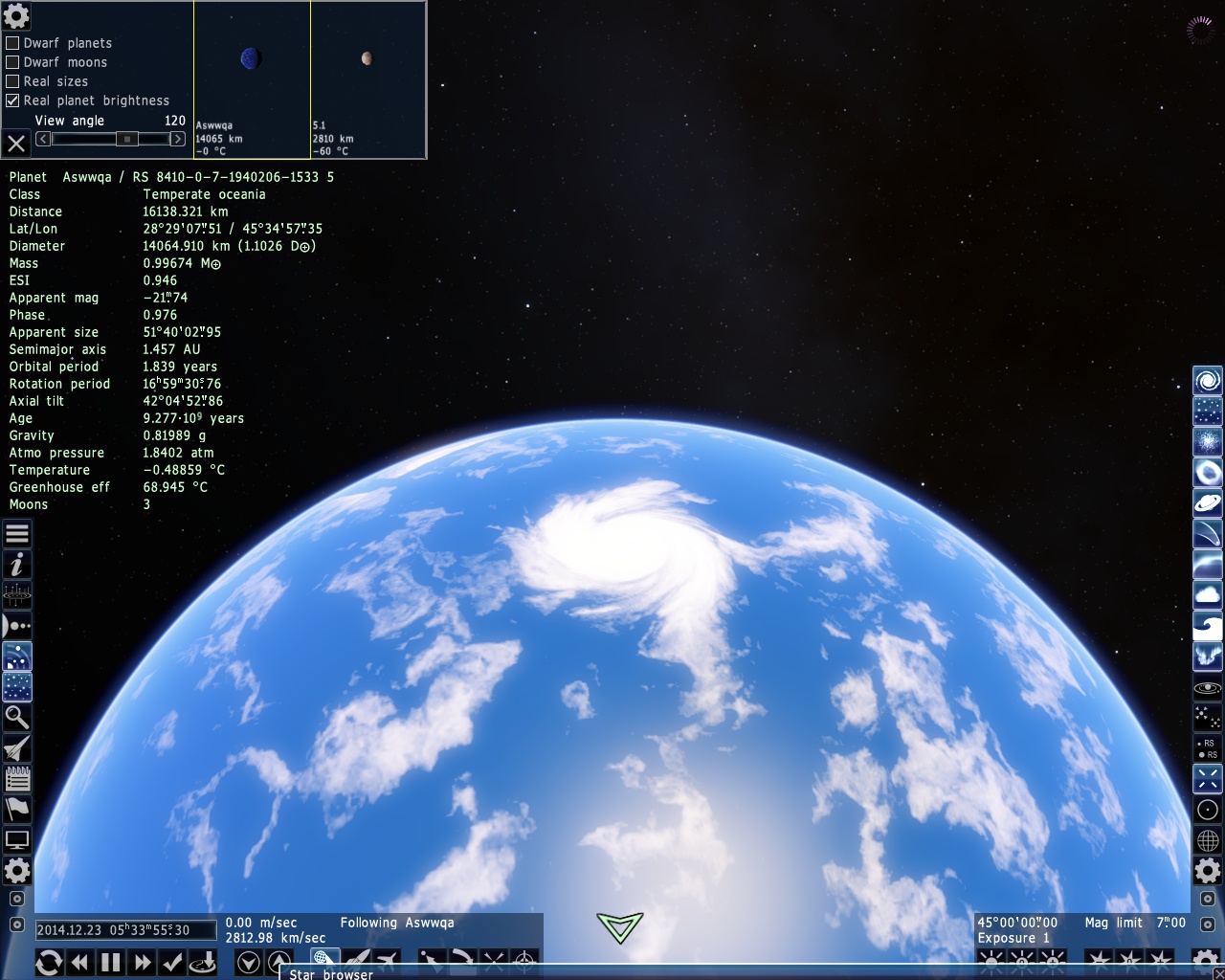
| Looking around near Antares nebula I've found probably one of the most Earth-like worlds out there, by pure chance. The ESI for this one is 0.978 compared to Earth's original 0.984. The differences are almost insignificant - orbital period is half of the Earth's, and atmospheric pressure is a bit lower, but the rest of the parameters are on sport. There are also 3 small moons, pretty close to the planet.
Code Place "planet ESI 0.978"
{
Body "RS 8409-1353-7-1482457-634 A4"
Parent "RS 8409-1353-7-1482457-634 A"
Pos (-1.912807512209624e-010, -2.960157600268541e-010, 1.36410109667336e-009)
Rot (0.6064759836006274, 0.2261140300391542, 0.1465189148589932, -0.7480585099600481)
Date "2445.02.17 02:59:25.95"
Vel 1.2650789e-009
Mode 1
}
Edited by Aerospacefag - Thursday, 26.02.2015, 21:36 |
| |
| |
| Ike | Date: Friday, 27.02.2015, 23:50 | Message # 105 |
|
Observer
Group: Newbies
United States
Messages: 9
Status: Offline
| Sorry, this is a very noob question, but how do I find these planets? Copying and pasting the code doesn't turn up anything. Thanks and sorry!
|
| |
| |
 ENG
ENG New site


 United States

 Indonesia
 Pirate
  France
 Germany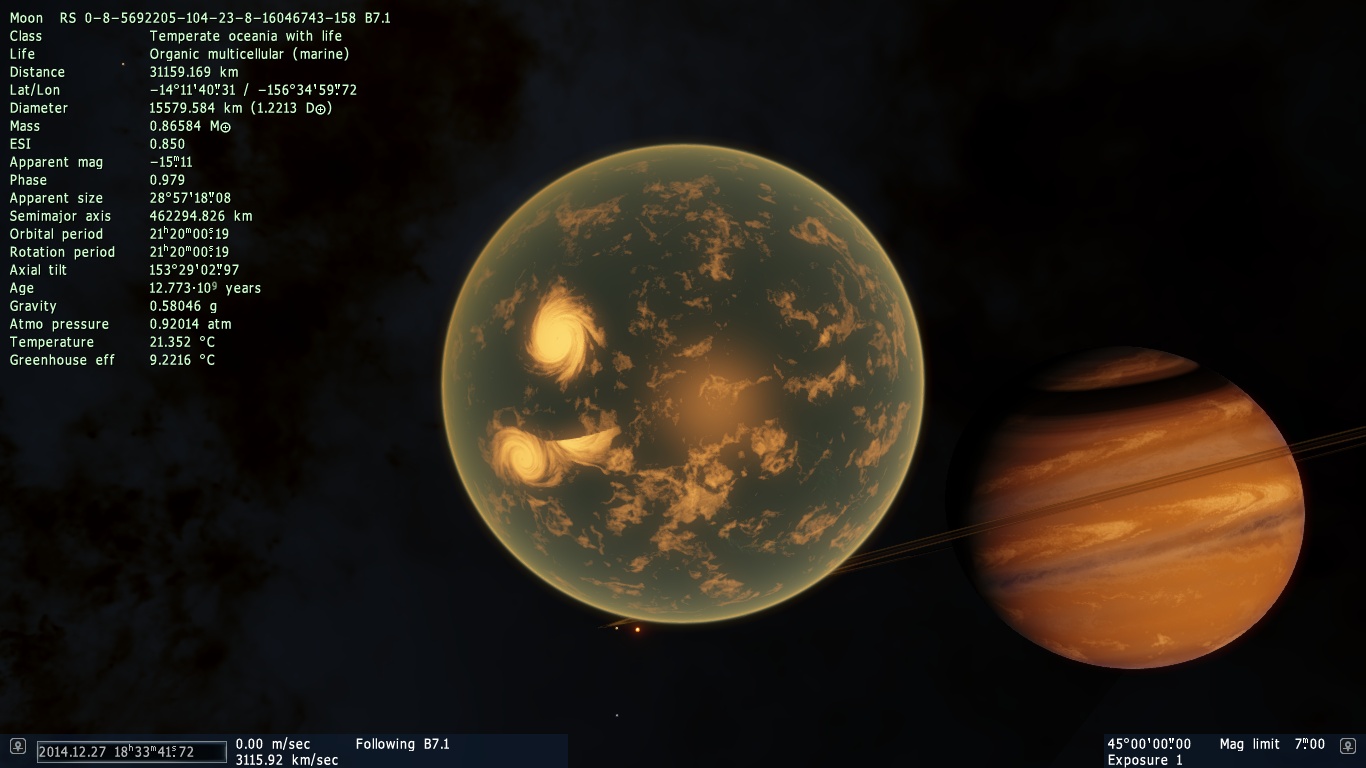
 Norway
 Australia


 Russian Federation